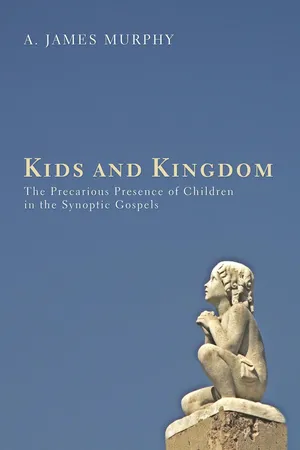
eBook - ePub
Kids and Kingdom
The Precarious Presence of Children in the Synoptic Gospels
- 156 pages
- English
- ePUB (mobile friendly)
- Available on iOS & Android
eBook - ePub
About this book
Kids and Kingdom challenges the traditional view that Jesus was deeply concerned over children. Instead, it is argued that despite the Synoptic authors' attempts to convince us that children are fully included in the kingdom of God--that "Jesus loves the little children"--their presentations fail to conceal images of household disruption and alienation of children brought about by Jesus' eschatological movement.
After establishing what Greco-Roman and Jewish sources reveal about children by the end of the first century, a deconstructive literary approach is applied to the Synoptic Gospels, foregrounding children over other characters in relation to Jesus' adult ministry. Murphy scrutinizes prominent healing narratives involving children, and teachings involving children such as "The Child in the Midst" (Mark 9:36-37 and parallels), "One of These Little Ones" (Mark 9:42 and parallels), and "Let the Young Children Come to Me" (Mark 10:13-16 and parallels). These are examined against sayings of Jesus relativizing family ties and the lifestyle indicative of the radical call to discipleship in the Synoptic narratives. Fundamentally, this study does not seek to resolve but to highlight the tensions in the Synoptic Gospels between attempts at child inclusivity and the radical demands of discipleship.
Information
Chapter One
Let the Young Children Come to Me
Jesus loves me, this I know, for the Bible tells me so.
Little ones to him belong. They are weak but he is strong.
Yes, Jesus loves me. Yes, Jesus loves me. Yes, Jesus loves me.
The Bible tells me so.1
This Christian hymn is learned by countless children every year. It underscores Jesus’ concern and commitment for children in the vulnerability of youth. The theme central to this hymn probably stems, in large part, from the widely familiar biblical refrain, “Let the young children come to me” (Mark 10:14 and parallels).2 This verse has been used to justify infant baptism and communion for young children, Sunday-School programs, children and youth ministries, mission trips and Christian relief agencies that specifically target children abroad, as well as the simple practice of bedtime prayers. Some of these have only emerged in recent centuries as the Industrial Age began to alter the place and functions of children in modern western culture. Corresponding to these social changes, children and childhood have seemingly become more important in our society, and have gained significant legal protections. And yet, their prominence in the Gospels has only recently received noteworthy consideration, perhaps as an inevitable result of such changes.3
Furthermore, like the hymn above, modern theologians and Christian writers who reflect on children, faith, and community usually reinforce our belief, perhaps our need to believe, that God is good and just, and is especially so where the concerns of children in all their vulnerability lie. Much of this belief is constructed by reading children into the creation account of Genesis 1, where God calls everything “good.” For example, David Jensen has written that as creator God’s benevolent justice extends to “all children, regardless of heritage.”4 Marianne Thompson explains that, “Because they are created by God . . . they have status, dignity, and inestimable value.”5 Certainly from Torah, God’s concern about, and legal recognition of children, at least Jewish boys, is signified by circumcision, a mark symbolizing their covenant relationship with Israel’s god, including “the youngest in the fold, even those young (such as slave children) who might be considered ‘outsiders.’”6 Still, most theologians who write on children, like Thompson, express the universality of divine concern: “God is the giver of all life and . . . the law of God protects those to whom God has given life.”7 However, such sweepingly positive assessments gloss over texts such as the flood narrative (Gen 6–9) and passages of the conquest of Canaan (Deut 20:14, 16–17) where Israel’s god sentences to death untold children under circumstances not of their own making.8 Nevertheless, with such positive assessments of the deity’s concern for children, it should come as no surprise that Christian writers find the same level of concern for children in Jesus. And where the Jesus of history appears thus concerned in the Synoptic Gospels, even more so the post-resurrection Jesus of faith, petitioned as God throughout the Christian world for protection and sustenance.
As I write these words, my one-year-old daughter studies me from her high chair; my eight-year-old stands proudly next to me in our picture from last year’s father-daughter dance. From these faces I recall how god-like my own parents once seemed to me at a tender age. Caregivers such as parents or guardians feed and clothe us; they can seem omnipresent in our early lives. They can mete out god-like punishments that in pre-adolescent years seem unchallengeable. And they provide a sense of unrivaled security, and may even be called upon to display such protection before their child’s eyes. A faith is developed within the child, a faith in the god-like provisions of her caregivers.9
So what then becomes of such faith when the god fails? How does the child’s perception of his or her father (or Father) change when protection is suddenly needed and is not forthcoming? Maybe the father or mother is absent, or perhaps the perpetrator of some act against the child. Of course we mortal caregivers are not gods, and sometime ago, usually in our adolescence, we learned that neither were our own caregivers.
Fortunately for many, the Hebrew Bible makes it pretty clear that the god of Israel is not human, and the New Testament points toward the divinity of Jesus as his son. Furthermore, a number of scholars claim that Christianity has been directly responsible for positive steps in the concern for and treatment of children throughout history.10
Still, what happens within a child when her faith, and the god of her faith, fails to protect and provide against all that threatens? Matthew says the risen Christ promised his followers (usually taken implicitly to include Christians today), “And remember, I am with you always, to the end of the age” (28:20b; NRSV). Yet, where is God for the untold numbers of children of every generation suffering abuse or neglect? Where is Jesus for the thousands of victims of sexual abuse by priests, church leaders, and laypersons, which has scandalized the modern Church? Lest anyone think this merely a Catholic problem, how absent the deity must have seemed for the Pentecostal boy I knew as a child that was fondled by an older member of our church. Sexual abuse knows no denominational boundaries. If the Synoptic authors11 felt it so important to show Jesus’ concern for children that he embraces them and wants them near to him, at what point does his concern languish? Is not at least one possible interpretation by one of “these little ones,” represented in this paragraph, that he or she has been abandoned by Jesus? Do the Synoptic authors only present Jesus as a “friend of little children,”12 or might they unwillingly reveal traces of a lesser god, the potential for an interpretation most “believers” would find impossible, s...
Table of contents
- Title Page
- Acknowledgments
- Abbreviations
- Chapter 1: Let the Young Children Come to Me
- Chapter 2: Out of The Shadows
- Chapter 3: The Kingdom, Discipleship, and Family Ties in the Synoptic Gospels
- Chapter 4: Children and Discipleship in the Synoptic Gospels
- Chapter 5: Echoes of Neglect
- Bibliography
Trusted by 375,005 students
Access to over 1.5 million titles for a fair monthly price.
Study more efficiently using our study tools.
Frequently asked questions
Yes, you can cancel anytime from the Subscription tab in your account settings on the Perlego website. Your subscription will stay active until the end of your current billing period. Learn how to cancel your subscription
No, books cannot be downloaded as external files, such as PDFs, for use outside of Perlego. However, you can download books within the Perlego app for offline reading on mobile or tablet. Learn how to download books offline
Perlego offers two plans: Essential and Complete
- Essential is ideal for learners and professionals who enjoy exploring a wide range of subjects. Access the Essential Library with 800,000+ trusted titles and best-sellers across business, personal growth, and the humanities. Includes unlimited reading time and Standard Read Aloud voice.
- Complete: Perfect for advanced learners and researchers needing full, unrestricted access. Unlock 1.5M+ books across hundreds of subjects, including academic and specialized titles. The Complete Plan also includes advanced features like Premium Read Aloud and Research Assistant.
We are an online textbook subscription service, where you can get access to an entire online library for less than the price of a single book per month. With over 1.5 million books across 990+ topics, we’ve got you covered! Learn about our mission
Look out for the read-aloud symbol on your next book to see if you can listen to it. The read-aloud tool reads text aloud for you, highlighting the text as it is being read. You can pause it, speed it up and slow it down. Learn more about Read Aloud
Yes! You can use the Perlego app on both iOS and Android devices to read anytime, anywhere — even offline. Perfect for commutes or when you’re on the go.
Please note we cannot support devices running on iOS 13 and Android 7 or earlier. Learn more about using the app
Please note we cannot support devices running on iOS 13 and Android 7 or earlier. Learn more about using the app
Yes, you can access Kids and Kingdom by James Murphy in PDF and/or ePUB format, as well as other popular books in Theology & Religion & Biblical Criticism & Interpretation. We have over 1.5 million books available in our catalogue for you to explore.