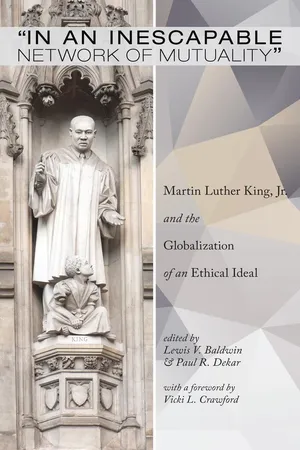
The scholarship on Martin Luther King Jr. has too often cast him in the image of the Southern black preacher and the American Gandhi, while ignoring or trivializing his global connections and significance. This groundbreaking work, written by scholars, religious leaders, and activists of different backgrounds, addresses this glaring pattern of neglect in King studies. King is treated here as both a global figure and a forerunner of much of what is currently associated with contemporary globalization theory and praxis. The contributors to this volume agree that King must be understood not only as a thinker, visionary, and social change agent in his own historical context, but also in terms of his meaning for the different generations who still appeal to him as an authority, inspiration, and model of exemplary service to humanity. The task of engaging King both in context and beyond context is fulfilled in remarkable ways in this volume, without doing essential violence to this phenomenal figure.
eBook - ePub
In an Inescapable Network of Mutuality
Martin Luther King, Jr. and the Globalization of an Ethical Ideal
- 408 pages
- English
- ePUB (mobile friendly)
- Available on iOS & Android
eBook - ePub
In an Inescapable Network of Mutuality
Martin Luther King, Jr. and the Globalization of an Ethical Ideal
About this book
Information
Topic
Theology & ReligionSubtopic
Christian TheologyPart One
For a World Made New
Exposing the Global Martin Luther King, Jr.
1
Living in the “World House”
Martin Luther King, Jr. and Globalization as Theory and Praxis
However deeply American Negroes are caught in the struggle to be at last at home in our homeland of the United States, we cannot ignore the larger world house in which we are also dwellers.
Martin Luther King, Jr.1
The current ferment in the scholarship on Martin Luther King, Jr. is leading to a new appreciation of his relevance and significance in this modern era of globalization.2 While any discussion of King in relation to contemporary perspectives on globalization is fraught with risk, given that he is a figure from the past, it is not excessive to contend that the civil rights leader was both a precursor to and a critic of much of what is defined as globalization theory and praxis today. Moreover, King continues to have a profound impact on the world—religiously, socially, politically, and otherwise—and his insights, values, and activities still inform many facets of world cultures. Thus, it is not odd or peculiar to speak of the global Martin Luther King, Jr., and to consider how his ideal of the “world house,” or his communitarian ideal, might take on new hues and pertinence3 for those who wish and struggle for a more legitimate globalization in today’s astoundingly altered and vastly different world.
Toward a New World Order: The Challenge of Global Citizenship
In his last two books, King was clearly speaking to the challenge of global citizenship, and of living and surviving in what he regarded as an increasingly globalized world. In his Trumpet of Conscience (1967), he defined his own quest for justice, peace, and human equality in global terms, declaring that “I speak as a citizen of the world.”4 In his Where Do We Go from Here: Chaos or Community? (1967), King variously described peoples across the earth as part of a “world house,” a “worldwide neighborhood,” a “single neighborhood,” or a “human family,” which stood in dire need of healthier ways of being globally connected and integrated. He wrote:
This is the great new problem of mankind. We have inherited a large house, a great “world house” in which we have to live together—black and white, Easterner and Westerner, Gentile and Jew, Catholic and Protestant, Moslem and Hindu—a family unduly separated in ideas, culture, and interest, who, because we can never again live apart, must learn somehow to live with each other in peace.5
Clearly, the concept of the global was not foreign to King. He envisioned a totally integrated world, undiminished and undeterred by human differences, and committed to the ethical norms of love, justice, equal opportunity, peace, and community.6 This was consistent with King’s personal idealism, which affirmed the dignity and worth of all human personality and the communitarian and/or social nature of human existence.7 I submit that King’s “world house” vision is still meaningful, and especially so in a context in which globalization theorists and activists are calling for global justice, the advancement of democratic freedoms and human rights, and the transnational sharing and/or exchange of the kinds of ideas, values, and material goods that serve the most cherished intellectual, cultural, economic, social, political, and religious interests of the entire human family.8 Indeed, any serious study of King and globalization should remind us of how certain modes of thinking about life, humanity, and the world might extend across generations and geographical and cultural boundaries.
The world is now interconnected in ways that King could only have imagined in his time. Even so, associating King with globalization, in a historic sense, is not oxymoronic. The term and concept of globalization would have been familiar to King in the 1960s. In fact, the term globalization was first widely used by economists and other social scientists in the 1960s,9 when King and his activities at home and abroad dominated much of global consciousness. Since the 1980s, the term has achieved widespread use in the mainstream social media, and it is now “one of the most fashionable buzzwords” in contemporary academic and political debate and discourse.10 Driven primarily by powerful international corporations that benefit enormously from the movement of capital, goods, and technology across borders, globalization is commonly described as “a process by which regional economies, societies, and cultures have become integrated through a global network of communication, transportation, and trade.” The term is most often used “to refer to economic globalization,” or “the integration of national economies into the international economy through trade, foreign direct investment, capital flows, migration, and the spread of technology.” Globalization “can also refer to the transnational circulation of ideas, languages, or popular culture through acculturation.”11Amazingly, one finds in globalization theory and praxis today echoes of some of what King had in mind when he spoke of the “world house,” the “worldwide neighborhood,” or the “new world order” as “the great new problem of mankind.”12
King prefigured contemporary globalization theorists and activists in highlighting the need for a fresh core of globally shared values. In other words, how should we approach the question of global justice? How should we address the many enduring threats to democratic freedoms and human rights worldwide? What is our responsibility in the face of the globalization of racism? How concerned should we be about poverty, economic injustice, and the poor? What should be our response to the redefinition of the role of women and other marginalized groups in this global age? How should we deal with the problem of war and human destruction? What should we do about the degradation and destruction of the environment? What does globalization mean in terms of religion and its changing contexts? In the context of globalization, should we be uncritical supporters of the status quo or advocates for diversity and the celebration of human differences?13
Unlike most economists and other social scientists today, King approached these questions as a philosopher and theologian, giving far more priority to the moral and/or ethical than to economic and political considerations. And perhaps more importantly, King called for “a revolution of values to accompany the scientific and freedom revolutions engulfing the earth” in his time. Here he had in mind the shift from “a thing-oriented” society and world to “a person-oriented” society and world, the expression of loyalties that are “ecumenical” rather than “sectional” in scope, and the movement beyond the idea that “self-preservation is the first law of life” to the principle that “other-preservation is the first law of life.”14 King was really talking about a radical reconstruction of global society with an accent on the highest human values—values that would draw on the very best qualities of people from every part of the globe. Currently, globalization is widely considered a real threat to “trad...
Table of contents
- Title Page
- Contributors
- Acknowledgments
- Foreword
- General Introduction
- Part 1: For a World Made New
- Chapter 1: Living in the “World House”
- Chapter 2: Becoming “a Single Neighborhood”
- Chapter 3: Beyond Patriarchy
- Part 2: A Global Quest for Common Ground
- Chapter 4: On Racism and War as Global Phenomena
- Chapter 5: Forging Bonds and Obligations
- Chapter 6: The Hospitality of Receiving
- Chapter 7: Mohandas K. Gandhi and Martin Luther King, Jr.’s Bequest
- Chapter 8: A Network of Mutuality
- Part 3: Linked in a Single Garment of Destiny
- Chapter 9: What Method for the Oppressed?
- Chapter 10: The Relationship of Revolutions
- Chapter 11: Toward Prospects for Peace
- Chapter 12: An American, but Not an Imperialist
- Chapter 13: Martin Luther King, Jr. in the Holy Land
- Chapter 14: From the Mountaintop to the Roof of the World
Trusted by 375,005 students
Access to over 1.5 million titles for a fair monthly price.
Study more efficiently using our study tools.
Frequently asked questions
Yes, you can cancel anytime from the Subscription tab in your account settings on the Perlego website. Your subscription will stay active until the end of your current billing period. Learn how to cancel your subscription
No, books cannot be downloaded as external files, such as PDFs, for use outside of Perlego. However, you can download books within the Perlego app for offline reading on mobile or tablet. Learn how to download books offline
Perlego offers two plans: Essential and Complete
- Essential is ideal for learners and professionals who enjoy exploring a wide range of subjects. Access the Essential Library with 800,000+ trusted titles and best-sellers across business, personal growth, and the humanities. Includes unlimited reading time and Standard Read Aloud voice.
- Complete: Perfect for advanced learners and researchers needing full, unrestricted access. Unlock 1.5M+ books across hundreds of subjects, including academic and specialized titles. The Complete Plan also includes advanced features like Premium Read Aloud and Research Assistant.
We are an online textbook subscription service, where you can get access to an entire online library for less than the price of a single book per month. With over 1.5 million books across 990+ topics, we’ve got you covered! Learn about our mission
Look out for the read-aloud symbol on your next book to see if you can listen to it. The read-aloud tool reads text aloud for you, highlighting the text as it is being read. You can pause it, speed it up and slow it down. Learn more about Read Aloud
Yes! You can use the Perlego app on both iOS and Android devices to read anytime, anywhere — even offline. Perfect for commutes or when you’re on the go.
Please note we cannot support devices running on iOS 13 and Android 7 or earlier. Learn more about using the app
Please note we cannot support devices running on iOS 13 and Android 7 or earlier. Learn more about using the app
Yes, you can access In an Inescapable Network of Mutuality by Lewis V. Baldwin, Paul R. Dekar, Lewis V. Baldwin,Paul R. Dekar, Baldwin, Dekar in PDF and/or ePUB format, as well as other popular books in Theology & Religion & Christian Theology. We have over 1.5 million books available in our catalogue for you to explore.