- 394 pages
- English
- ePUB (mobile friendly)
- Available on iOS & Android
eBook - ePub
About this book
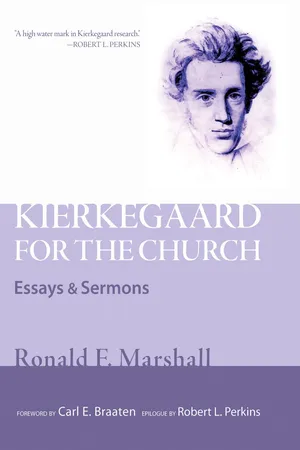
Most of what is written on Kierkegaard today is for the college classroom and academic conferences. The guiding question of this book is that if Kierkegaard's words about Christianity are true, how do they change the way we learn and practice the Christian faith today? This book is an answer to that question. It does not enter into an extended critical discussion over the truth of Kierkegaard's ideas. Instead it just believes what Kierkegaard said and runs with it. It does that by showing how his ideas change our understanding of Christian identity, suffering and illness, worship and preaching, the Bible, baptism, prayer, marriage and divorce, criticism, and the Christian minister. Interspersed are many quotations from Martin Luther, whose thought significantly shaped Kierkegaard's. At the end of the book is a hefty collection of sermons to show how all of this can be preached in the church.
What Kierkegaard for the Church adds to our understanding of Kierkegaard is the place of the church in his thought. Because of his criticisms of the Danish state church and his stress on the need for the single individual to appropriate Christian teachings, it could be imagined that he rejected the church. But that would be to throw the baby out with the bath. The fact is that Kierkegaard remained a loyal son of the church even while he attacked it. And he did this only so he could strengthen what he loved.
Information
Topic
Theology & ReligionSubtopic
Christian Church1
On Simplicity and Complexity
What a pleasure it is to have written a book that does not
owe its origin to an inexplicable inner need and therefore is ignorant
of whether it fits into the world, indeed, is bashful and ashamed
like an ambivalent witness to a sinful love affair. (P 13)1
Reading Kierkegaard can be a bewildering experience. “The dialectical verbal pyrotechnics, the paradoxical turns in the argument, the pseudonyms2 that mask the author who refuses to make his point straightforwardly—all of these and other characteristic features of Kierkegaard’s strategy of indirect communication disorient even the most sophisticated reader.”3 This is so even when most readers of his works who are “preoccupied above all with discovering his thought, fail to realize how much attention the author paid to construction and style.”4
That disregard for style, or how Kierkegaard expressed himself, only adds to the confusion because then the reader would not see that the inherent difficulty in what Kierkegaard had to say is in part due to how he said it.5 Kierkegaard’s goal in his authorship was to show how one becomes a Christian according to New Testament teachings (PV 23, 90; TM 39)—in contrast to being “nominal Christians” according to cultural norms (PV 125, 141).6 Because taking on the genuine Christian way of life includes the cross, suffering, and rigor (PV 16, 79, 130, 229), reading about this must also be difficult—even though reading about becoming a Christian is not the same as becoming one. But Christianity seldom is presented “in its true form” (PV 80, 138) because it has been allowed to drift away from its historical norms. To offset this diminishment, Kierkegaard uses his many writings to draw a map to explain how one properly becomes a Christian (JP 6:6283). He does this because, to an “unusual degree,” he believes he knows “with uncommon clarity and definiteness what Christianity is, what can be required of the Christian, what it means to be a Christian” (PV 138).
In his writings, then, all “protective devices like closure and foreshortening are sabotaged.”7 His map therefore covers the full “traversed path” (PV 7)—bumpy, harrowing and “narrow” though it may be (PV 118). So just as it would be a mythological fantasy to imagine that we could reach the top of Mount Moriah by way of the “winged horse” Pegasus (FT 52) and get the same blessing Abraham did without having to traverse by foot, in “anxiety and distress” (FT 53, 64–66, 74, 113), that three day journey, so it would be wrongheaded to expect Kierkegaard’s books to make Christianity easier than it is. Rather than trying to make life easier—following the genre of the modern self-help book—Kierkegaard’s authorship does the opposite by protecting “the difficulties of the life of faith.”8 According to Kierkegaard, books on Christianity should be like Christianity itself, where the “help looks like a torment” and we stick with it whether it is “a help or a torment” (PC 114–15).
In this chapter I will show how this difficulty ends up in clarification and simplicity—rather than being mired down in puzzlement, confusion and ambiguity (EUD 306, 324). This movement from difficulty to simplicity is in large part the burden of Kierkegaard’s argument in The Point of View on the meaning of what and why he wrote. In the first section of this chapter I will discuss the illusions that Kierkegaard’s method of indirection sets out to combat in order to maintain clarity and simplicity. These are the theological illusions that faith is free of any duty to God and that quantity matters more than the quality of our life before God. Here I also show that self-denial is what these illusions are trying to avoid. In the second section I will show how his method of indirection—the new science of arms—tackles these illusions by way of humor, sarcasm and counter-sentences. I will illustrate this technique of counter-sentences by way of Kierkegaard’s view that love does not seek its own. In the third section I will illustrate Kierkegaard’s move from indirect to direct statements through his discourse on James 1:22–27 on being doers of the word. And in the fourth section I will show how this clarity and simplicity in Kierkegaard’s authorship drives toward a Pythagorean version of Christian identity.
Emptying the Jar of Illusions
“In relation to pure receptivity, like the empty jar that is to be filled, direct communication is appropriate,” writes Kierkegaard, “but when illusion is involved,” which is a blight on Christianity that needs eradication, then “direct communication is inappropriate” (PV 8). Because Denmark in Kierkegaard’s time was plagued by philosophical and theological illusions, he believed that a direct prescribing of a remedy would fail, and so indirection would first have to be used to empty out the jar before filling it with any directly stated solutions. In this section I want to describe those illusions that Kierkegaard seeks to eliminate by way of indirection. Chief among them is that belief in God does not imply that people have a duty to him (PV 41) and that quantity matters more than quality (PV 125–26; TM, 37). Both of these illusions are grounded in a disregard for religious appropriation which, when ignored, fosters hypocrisy and spiritual lethargy. These illusions have been around since the beginning of Christianity.9 This is because the principal duty we have before God is so demanding—that we must die to ourselves, our understanding and to the world (FSE 76–82). Not surprisingly, Christians have shrunk back from this duty. They have recoiled from this self-denial as a veritable “living death.”10 Even so the Christian message continues to beckon us to become “intimate with the death-thought of self-denial” (EUD 288) and the power it brings to transform us:
It is only all too easy to understand the requirement contained in God’s Word (“Give all your goods to the poor.” “If anyone strikes you on the right cheek, turn the left.” “If anyone takes your coat, let him have your cloak also.” “Rejoice always.” “Count it sheer joy when you meet various temptations” etc.).11 It is all just as easy to understand as the remark “The weather is fine today,” a remark that could become difficult to understand in only one way—if a literature came into existence in order to interpret it. The most limited poor creature cannot truthfully deny being able to understand the requirement—but it is tough for flesh and blood to will to understand it and to have to act accordingly. In my view,12 it is human for a person to shrink from letting the Word really gain power over him. . . . But . . . it is not human to give the matter a totally different turn . . . [and] cast it as far away as possible. (FSE 34–35)
In addition to this living death, there is also the duty to love others—and this love is not just for those whom we like or for those who will love us in return (WL 373, 349). This sort of love goes against the grain and incurs disfavor (WL 109). And that is not because it is unloving, but because of the nature of the love itself—and so we “must always be on the watch” for attacks when we love in this way (WL 130). Because of this danger, God’s way of loving will always be unpopular. And again, this is not because we have been unloving. The low success rate is instead due to the inherent difficulty in the love which we share.13 It would therefore be a disaster to water down Christian love in order to make it more palatable. While that might seem like a good idea so that more could embrace this love, it actually will not help at all but only keep it further away from those who need it (PV 131, 134).
Kierkegaard called this intensification of Christian life and love a “jacking up” of the cost of being Christian (PV 95, 138–39).14 Martin Luther also did this.15 In a time when Christian hypocrisy was running rampant and the church profited from indulging our sins, Luther called for greater dedication to one’s Christian life. He admonished parents, for instance, to raise their children in a more strenuous Christian way, warning that if they refused to do so, they would “earn hell” for themselves:16
Thus it is true . . . that parents could attain salvation by training their own children, even if they were to do nothing else. . . . [God] sets you over them as a hospital superintendent, to wait on them, to give them the food and drink of good words and works. He sets you over them that they may learn to trust God, to believe in him, to fear him, and to set their whole hope upon him; to honor his name and never curse or swear; to mortify themselves by praying, fasting, watching, working; to go to church, wait on the word of God, and observe the Sabbath. He sets you over them that they may learn to despise temporal things, to bear misfortune without complaint, and neither fear death nor love this life.17
These indeed are strong words for children. But only this sort of instruction on trusting, fearing, fasting, hoping, mortifying, waiting and despising brings...
Table of contents
- Title Page
- At Kierkegaard’s Death
- Figures
- Abbreviations
- Foreword
- Preface: Needing Kierkegaard—A Tribute
- Acknowledgments
- Introduction: Kierkegaard for the Church
- Chapter 1: On Simplicity and Complexity
- Chapter 2: On Sickness
- Chapter 3: On Self-Hatred
- Chapter 4: On Divine Authority and Pastors
- Chapter 5: On Worship—Hanging on God’s Hook
- Chapter 6: On Discipleship
- Chapter 7: On Divorce
- Chapter 8: On God and Dialectics
- Chapter 9: On Self-Forgetfulness
- Chapter 10: On Prayer
- Chapter 11: On Walking
- Chapter 12: Sermons—Not for Itching Ears
- Sermon 1: Practice Your Faith
- Sermon 2: Do Just a Bit
- Sermon 3: Rejoice in the Intercessor
- Sermon 4: Rejoice in Christ’s Victory
- Sermon 5: Be Confident
- Sermon 6: Don’t Preach Yourself
- Sermon 7: Don’t Try to Save Yourself
- Appendix 1: Part 1: A Dangerous Man
- Appendix 1: Part 2: A Critique of Garff’s Biography
- Appendix 1: Part 3: A Lutheran Heritage
- Appendix 2: On Regine Olsen
- Conclusion: The Thorough Kneading of Reflection
- Postscript: My Father in the Faith
- Epilogue
- Selected Bibliography
- About the Author
Trusted by 375,005 students
Access to over 1.5 million titles for a fair monthly price.
Study more efficiently using our study tools.
Frequently asked questions
Yes, you can cancel anytime from the Subscription tab in your account settings on the Perlego website. Your subscription will stay active until the end of your current billing period. Learn how to cancel your subscription
No, books cannot be downloaded as external files, such as PDFs, for use outside of Perlego. However, you can download books within the Perlego app for offline reading on mobile or tablet. Learn how to download books offline
Perlego offers two plans: Essential and Complete
- Essential is ideal for learners and professionals who enjoy exploring a wide range of subjects. Access the Essential Library with 800,000+ trusted titles and best-sellers across business, personal growth, and the humanities. Includes unlimited reading time and Standard Read Aloud voice.
- Complete: Perfect for advanced learners and researchers needing full, unrestricted access. Unlock 1.5M+ books across hundreds of subjects, including academic and specialized titles. The Complete Plan also includes advanced features like Premium Read Aloud and Research Assistant.
We are an online textbook subscription service, where you can get access to an entire online library for less than the price of a single book per month. With over 1.5 million books across 990+ topics, we’ve got you covered! Learn about our mission
Look out for the read-aloud symbol on your next book to see if you can listen to it. The read-aloud tool reads text aloud for you, highlighting the text as it is being read. You can pause it, speed it up and slow it down. Learn more about Read Aloud
Yes! You can use the Perlego app on both iOS and Android devices to read anytime, anywhere — even offline. Perfect for commutes or when you’re on the go.
Please note we cannot support devices running on iOS 13 and Android 7 or earlier. Learn more about using the app
Please note we cannot support devices running on iOS 13 and Android 7 or earlier. Learn more about using the app
Yes, you can access Kierkegaard for the Church by Ronald F. Marshall in PDF and/or ePUB format, as well as other popular books in Theology & Religion & Christian Church. We have over 1.5 million books available in our catalogue for you to explore.