eBook - ePub
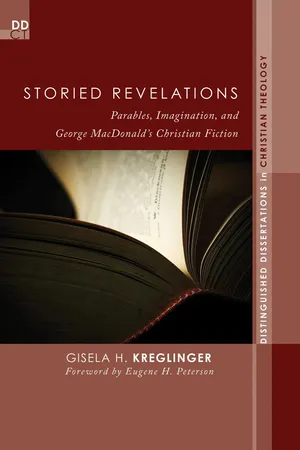
Storied Revelations
Parables, Imagination, and George MacDonald’s Christian Fiction
- 250 pages
- English
- ePUB (mobile friendly)
- Available on iOS & Android
eBook - ePub
Storied Revelations
Parables, Imagination, and George MacDonald’s Christian Fiction
About this book
Parables--used by Jesus to reveal to us the kingdom of God, used to move us from being bystanders to active recipients of God's work of revelation--are constantly at risk of being buried as "mummies of prose," as George MacDonald puts it. We become so familiar with the language of Scripture that Jesus' parables no longer work on us in this revelatory and transforming way.
George MacDonald, the Victorian poet and theologian, observed this very process at work in Victorian society. It was a culture saturated with Christian jargon but often devoid of a profound understanding of the gospel for its own time and culture. The language of Scripture no longer penetrated people's hearts, imaginations, and attitudes; it no longer transformed people's lives. MacDonald, called to be a pastor, turned to story and more specifically the "parabolic" as a means of spiritual awakening. He created fictive worlds in which the language of Jesus would find a new home and regain its revelatory power for his particular Victorian audience.
Information
Topic
Theology & ReligionSubtopic
Christian Church1
George MacDonald
Poet and Theologian
MacDonald is primarily a theological thinker and writer. This seems surprising to many as he is mostly known today for his fiction and fairytales and his influence on the famous Inklings, especially C. S. Lewis and J. R. R. Tolkien. This book explores MacDonald’s theological rationale for writing Christian fiction, arguing that it is precisely in his less overt theological works of fiction that one finds some of his most profound thinking on the lived dimension of Christian faith. When MacDonald has been considered as a serious theologian (as is the case in two of the most recent important works on MacDonald), his theology, and especially his theological understanding of the imagination, is not brought to bear upon his intentional creation of Christian fiction for expressing his theology.3 Only when one considers both the form and the content of his works of fiction as theology does one come to a deeper understanding of his particular theology, a theology that aims at the participation and transformation of his literary audience. Many went before MacDonald and shaped him in profound ways, but the greatest influence upon MacDonald always remained Scripture. His imaginative engagement with the world, Scripture, and literature made him a unique voice within his Victorian context, where story became a primary way to express his theology—a kinship that is ancient but often forgotten in our time, especially in theological circles. Today we would call George MacDonald a spiritual theologian because his primary interest was in the lived dimension of the Christian faith. All of his writings give witness to this pastoral concern, but his fiction does so in a unique way.
MacDonald employed a wide range of genres for his writing. Realistic fiction, mostly set in Scotland and England, make up the largest part of the MacDonald corpus. These novels are significant theologically, as MacDonald addresses many theological issues of his time in these novels, often employing the Aberdeenshire dialect Doric for his most important discussions.4 MacDonald also wrote poetry and essays on literature, the imagination, and human development. He translated significant literary works from German, Latin, and Italian, including works by Novalis, Schiller, Goethe, Heine, Luther, and Milton.5 He wrote and preached sermons throughout his life, and these sermons are an important key to understanding his theology. In what follows, we shall provide a brief introduction to George MacDonald that focuses on his Scottish theological background, his emerging interest in literature, and his call to pastoral ministry.6
MacDonald’s Scottish Background
George MacDonald was born in Huntly, Aberdeenshire, Scotland in 1824 to a financially struggling family, deeply steeped in rural culture with strong roots in Scottish reformed Protestantism. Like his mother, George MacDonald struggled with tuberculosis for most of his life but lived to the age of eighty-one and died in 1905. While MacDonald’s maternal grandparents were Catholic, the primary spiritual influence came from his paternal grandparents and his father, who were Protestant. MacDonald’s mother died when he was only nine. His grandmother left the mainstream Presbyterian church to attend an independent church called “The Missionar Kirk,” which split off from the mainstream Reformed church as a result of the Secession. The family ran a bleaching business but was financially burdened due to a family scandal. MacDonald’s uncle Charles had fled the country after accumulating a high amount of debt in illegal financial affairs, and MacDonald’s family was held responsible to pay back the debt. George MacDonald’s grandmother, a strong and religiously fervent woman, believed that it was Charles’s violin lessons that lured him into Satan’s snares and resulted in his scandalous behavior. Not uncommon among Secession churches, she burned his violin, believing that music had a bad influence on her children.7 We mention this particular incident as it shows that MacDonald grew up in a religious context that had at least a skeptical but sometimes even hostile attitude towards the arts. The novel Robert Falconer contains autobiographical references to this incident. Greville, George MacDonald’s son, mentions that Secession churches on the Isle of Lewis burned pipes and fiddles. How was it possible that such a seemingly narrow religious context would produce one of the most creative and prolific spiritual theologians of the Victorian period?
MacDonald’s Theological Background:Scottish Calvinism
MacDonald grew up in a reformed Scottish church that was deeply steeped in scholastic Calvinism of the time. A one-sided emphasis on the sovereignty of God, double predestination, the wrath and judgment of God, and a highly mechanical, impersonal, and legal/contractual understanding of the atonement with a focus on humanity’s utter depravity provided the seedbed for a spirituality that was fueled by fear and great uncertainty of one’s election into God’s kingdom. It also eclipsed God’s great love and compassion for his creation. Good works were seen as a sign of God’s sovereign election of the believer, and this belief developed into a severe and rigid from of legalism. Kerry Dearborn in particular has gone to great lengths to show the kind of theory of atonement that MacDonald sought to critique and move away from.8
The character of Annie Anderson, an orphan child in MacDonald’s adult novel Alec Forbes of Howglen, personifies the kind of terror a child would have felt by being continually exposed to this particular teaching. MacDonald provides a careful account of the preaching of Annie’s local Missionar Kirk and her response to it. It is worth quoting MacDonald here at some length in order to demonstrate the pastoral impact of this particular teaching:
He chose for his text these words of the Psalmist: ‘The wicked shall be turned into hell, and all the nations that forget God.’ His sermon . . . consisted simply of answers to the two questions: ‘Who are the wicked?’ and ‘What is their fate?’ The answer to the former question was, ‘The wicked are those that forget God;’ the answer to the latter, ‘The torments of everlasting fire.’ Upon Annie the sermon produced the immediate conviction that she was one of the wicked, and that she was in danger of hell-fire . . . A spiritual terror was seated on the throne of the universe, and was called God—and to whom should she pray against it? Amidst the darkness, a deeper darkness fell. She knelt by her bedside, but she could not lift up her heart; for was she not one of them that forget God? And was she not therefore wicked? And was not God angry with her every day? Was not the fact that she could not pray a certain proof that she was out of God’s favour, and counted unworthy of his notice? But there was Jesus Christ: she would cry to him. But did she believe in him? She tried hard to convince herself that she did; but at last she laid her weary head on the bed, and groaned in her young despair.9
MacDonald’s theological and pastoral response to this one-sided and at times distorted theological perspective of this particular scholastic Calvinism was a nuanced one. He conti...
Table of contents
- Title Page
- Foreword
- Acknowledgments
- Introduction
- Chapter 1: George MacDonald
- Chapter 2: Patterns of Subversion and Promise
- Chapter 3: Patterns of Subversion and Promise
- Chapter 4: George MacDonald’s Theological Rationale for Story and the “Parabolic”
- Chapter 5: Patterns of Subversion and Promise
- Conclusion
- Bibliography
Trusted by 375,005 students
Access to over 1.5 million titles for a fair monthly price.
Study more efficiently using our study tools.
Frequently asked questions
Yes, you can cancel anytime from the Subscription tab in your account settings on the Perlego website. Your subscription will stay active until the end of your current billing period. Learn how to cancel your subscription
No, books cannot be downloaded as external files, such as PDFs, for use outside of Perlego. However, you can download books within the Perlego app for offline reading on mobile or tablet. Learn how to download books offline
Perlego offers two plans: Essential and Complete
- Essential is ideal for learners and professionals who enjoy exploring a wide range of subjects. Access the Essential Library with 800,000+ trusted titles and best-sellers across business, personal growth, and the humanities. Includes unlimited reading time and Standard Read Aloud voice.
- Complete: Perfect for advanced learners and researchers needing full, unrestricted access. Unlock 1.5M+ books across hundreds of subjects, including academic and specialized titles. The Complete Plan also includes advanced features like Premium Read Aloud and Research Assistant.
We are an online textbook subscription service, where you can get access to an entire online library for less than the price of a single book per month. With over 1.5 million books across 990+ topics, we’ve got you covered! Learn about our mission
Look out for the read-aloud symbol on your next book to see if you can listen to it. The read-aloud tool reads text aloud for you, highlighting the text as it is being read. You can pause it, speed it up and slow it down. Learn more about Read Aloud
Yes! You can use the Perlego app on both iOS and Android devices to read anytime, anywhere — even offline. Perfect for commutes or when you’re on the go.
Please note we cannot support devices running on iOS 13 and Android 7 or earlier. Learn more about using the app
Please note we cannot support devices running on iOS 13 and Android 7 or earlier. Learn more about using the app
Yes, you can access Storied Revelations by Gisela H. Kreglinger in PDF and/or ePUB format, as well as other popular books in Theology & Religion & Christian Church. We have over 1.5 million books available in our catalogue for you to explore.