eBook - ePub
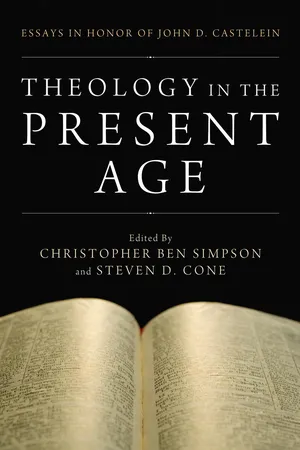
Theology in the Present Age
Essays in Honor of John D. Castelein
- 322 pages
- English
- ePUB (mobile friendly)
- Available on iOS & Android
eBook - ePub
Theology in the Present Age
Essays in Honor of John D. Castelein
About this book
This volume of essays centers on the theme of doing Christian theology in the present postmodern context, a consistent theme of the teaching of John D. Castelein. The work will celebrate and honor John's years of service by representing reflections of his teaching in the thought of his students and colleagues. The essays range over such topics as theological reflections on the postmodern philosophical themes, the relations between Christian theology and culture, the contributions of philosophical hermeneutics for Christian theology, and the challenges of engaging in ministry in a postmodern context. The seventeen contributors to the volume are former students and both present and former colleagues involved in various ministries, be they in a college setting or in a local church.
Information
Topic
Theology & ReligionSubtopic
Christian TheologyTheoretical Essays
1
Self-Transcending Life
Lonergan’s Appropriation of Augustine and Aquinas on Authentic Being-in-the-World1
Is There Hope?
I will begin with a quotation from Friedrich Nietzsche, although this paper is not about him: “We don’t know ourselves, we knowledgeable people—we are personally ignorant about ourselves. And there’s good reason for that. We’ve never tried to find out who we are. How could it ever happen that one day we’d discover our own selves?”2
Nietzsche testifies to an alienation all too familiar to us—are we late-born, or perhaps come too early, the children of modernity who find suspicion ensconced within our very selves.3 But here I refer to the salutary suspicion Paul Ricoeur envisions, and I will follow his lead in examining more closely the two masters of suspicion he allies with Nietzsche—Karl Marx and Sigmund Freud.4
In truth this paper is not about them, either, though I will, penitential, ponder their purgative thought.5 For what I seek is hope, a horizon for human destiny, for my own true self, that neither springs from nor ends in ideology, nor infantile desire, nor the machinations of means of production. And yet for everything to be shaken that can be shaken, I must learn the place of these many things.
The harbingers of this kingdom that will endure—the sure goal of hope—I hear in the clarion voices of Augustine of Hippo and Thomas Aquinas. This paper is about them. And yet not only about them, for to carry their insights into our time and our age, I turn also to one who walks after them, both interpreting them and speaking something new, the Canadian Jesuit Bernard Lonergan.
Lonergan argued that the masters of suspicion are in large part right with respect to the forces that they identify as constituting us. Lonergan fully acknowledged the embodiment of our being. Yet he argued that the selves that we are transcend space and time; a metaphysics of presence cannot fully define human reality. The self that constitutes itself in wonder and love forms the possibility of the self as historically constituted. The freedom of this self creatively emerges from these bounds, and it is known insofar as the self is grasped as human—a unity that both transcends and affirms any data posited about it, an identity that essentially is open to knowing and loving a world.
Being-in-love, therefore, grounds the authentic existence of the self as embodied in the world. Lonergan draws on Augustine to insist that reason finds its healing and true home in love. For reason is not an instrument that we use but rather our very conscious selves as we are struck by wonder, contemplate, and affirm the world. Lonergan also develops Aquinas’ insight that the world is fully known only in charity, for charity grounds the wisdom by which the right ordering of the world can be known.
Suspicion and the Self
Freud and Marx both speak of history as explaining human existence, but on quite different scales. I will begin with Freud.
Freud
In The Interpretation of Dreams, Sigmund Freud explains the significance of dreams according to our motivations and desires: “The dream represents a certain state of affairs, such as I might wish to exist; the content of the dream is thus the fulfillment of a wish; its motive is a wish.”6
A wealth of meaning lies behind this simple-sounding assertion. For the desires he speaks of, in main, only masquerade as the explicit dream content, images and affects connected with the world of our waking hours.
Freud develops his case by examining a manifold of dreams, and he reveals an ingenious complexity to the human psyche. Behind the manifested level of our dreams —the “dream content”—he argues for a deep subterranean of unconscious, infantile desires, mostly though not all sexual in nature. These desires animate the true meaning of the dream—the “dream thought”—the reason why our psyche has found it worthwhile to dream.
I would like to bring out three key points with respect to Freud and the human self.
First, Freud does not consider there to be a structural difference between the sleeping and waking operation of our psyche, and this operation is a domination of what we call consciousness by the outworking of our unconscious infantile desires.7 As he concludes his analysis: “What role is now left, in our representation of things, to the phenomenon of consciousness, once so all-powerful and overshadowing all else? None other than that of a sense-organ for the perception of psychic qualities.”8
The main differences between sleeping and waking are that in sleep we are immobilized by a wish to sleep, due to this immobility the preconscious censor allows more of the psychic energy from our unconscious desires to come into consciousness (that is, the defense mechanisms operate in a different way), and certain logical activities are suspended. But the intellectual and artistic endeavors of our waking lives are every bit as much as the dream the outworking of our childhood history.
Second, this psychological outworking is absolutely deterministic. The paths of our unconscious are set in early childhood and cannot change. Freud conceived the psyche as mechanistically working out the energy states of our psychological desires. Whether we are involved in intellectual or artistic endeavor, in dreaming, in the throes of psychosis, or in any other activity or state, our psyche is working out in the most efficient way it can the energy of these desires.
Third, Freud developed this theory in the context of providing healing, and his insights were able to provide healing for many psychological and psychosomatic diseases that medical science had been ineff...
Table of contents
- Title Page
- Introduction
- Contributors
- Part 1: Theoretical Essays
- Chapter 1: Self-Transcending Life
- Chapter 2: Exceeding Immanence
- Chapter 3: “The Incomprehensible Someone”
- Chapter 4: Breaking Forth from Form’s Interior
- Chapter 5: On the Conceptual Relationship between Religion and Science
- Chapter 6: The Stone-Campbell Understanding of Conversion
- Chapter 7: Post-Protestantism
- Chapter 8: Twentieth-Century Theological Method
- Chapter 9: Fugue and Faith
- Chapter 10: The Virtue of Metaphysical Patience
- Part 2: Practical Essays
- Chapter 11: The Postmodern, Missional (Emerging) Church Movement and the Epistle of James
- Chapter 12: Rekindling a Sacramental Imagination
- Chapter 13: Uncommon Sense
- Chapter 14: Reading Scripture Together
- Chapter 15: Business and the Beatific Vision
- Chapter 16: Influence and Method
- Part 3: Personal Essays
- Chapter 17: Reflecting on a Teacher’s Influence
- Chapter 18: Undone and Redone on the Way Back to Jerusalem
Trusted by 375,005 students
Access to over 1.5 million titles for a fair monthly price.
Study more efficiently using our study tools.
Frequently asked questions
Yes, you can cancel anytime from the Subscription tab in your account settings on the Perlego website. Your subscription will stay active until the end of your current billing period. Learn how to cancel your subscription
No, books cannot be downloaded as external files, such as PDFs, for use outside of Perlego. However, you can download books within the Perlego app for offline reading on mobile or tablet. Learn how to download books offline
Perlego offers two plans: Essential and Complete
- Essential is ideal for learners and professionals who enjoy exploring a wide range of subjects. Access the Essential Library with 800,000+ trusted titles and best-sellers across business, personal growth, and the humanities. Includes unlimited reading time and Standard Read Aloud voice.
- Complete: Perfect for advanced learners and researchers needing full, unrestricted access. Unlock 1.5M+ books across hundreds of subjects, including academic and specialized titles. The Complete Plan also includes advanced features like Premium Read Aloud and Research Assistant.
We are an online textbook subscription service, where you can get access to an entire online library for less than the price of a single book per month. With over 1.5 million books across 990+ topics, we’ve got you covered! Learn about our mission
Look out for the read-aloud symbol on your next book to see if you can listen to it. The read-aloud tool reads text aloud for you, highlighting the text as it is being read. You can pause it, speed it up and slow it down. Learn more about Read Aloud
Yes! You can use the Perlego app on both iOS and Android devices to read anytime, anywhere — even offline. Perfect for commutes or when you’re on the go.
Please note we cannot support devices running on iOS 13 and Android 7 or earlier. Learn more about using the app
Please note we cannot support devices running on iOS 13 and Android 7 or earlier. Learn more about using the app
Yes, you can access Theology in the Present Age by Christopher Ben Simpson,Steven D. Cone, Simpson, Cone in PDF and/or ePUB format, as well as other popular books in Theology & Religion & Christian Theology. We have over 1.5 million books available in our catalogue for you to explore.