eBook - ePub
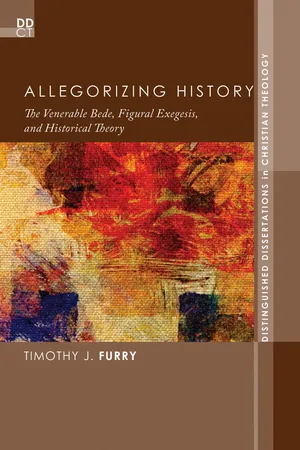
Allegorizing History
The Venerable Bede, Figural Exegesis, and Historical Theory
- 174 pages
- English
- ePUB (mobile friendly)
- Available on iOS & Android
eBook - ePub
About this book
What is history and how does it impact biblical interpretation and theology? Allegorizing History seeks to begin answering this question by arguing that conceptions of the past and the purpose(s) of history impact biblical interpretation and vice versa. Furthermore, it is shown how philosophy and theology inevitably affect the understandings and practice of historical writing, thereby making all history figural or allegorical. Famous for his Ecclesiastical History of the Anglo-Saxon People and biblical commentaries, the Venerable Bede is studied in dialogue with Augustine, contemporary theology, and historical theory to make this interdisciplinary argument.
Information
Topic
Teologia e religioneSubtopic
Teologia cristiana1
(Re)Framing History
A Contemporary Historiography of Bede’s Historia
“To attempt to judge of Bede merely as an historian is inevitably to misjudge him. In history and in science, as well as in theology, he is before all things the Christian thinker and student.”
—Carolus Plummer
Editor’s Preface to the 1896 Opera Historica
Editor’s Preface to the 1896 Opera Historica
Introduction
As with scholarship on any historical figure, much has changed in how the Venerable Bede has been understood, specifically as an historian and with respect to what he was trying to accomplish in his Historia ecclesiastica gentis anglorum. This chapter will explore historiographical issues beginning with Plummer’s introduction to the 1896 edition of the Historia and ending with more recent publications on Bede and his histories. I will show how scholars wrestled with integrating Bede’s theological, exegetical, and historical works into even a quasi-coherent account throughout the twentieth century, while highlighting theoretical obstacles that caused them difficulties. Due to the extensive writing on this topic, I will have to be selective in my more detailed analysis by studying the more substantive and influential scholarship on Bede and history.
A definite trajectory can be seen in the work on Bede and history in the twentieth century, and it often mirrors developments in historical theory itself as the century progressed; for instance, earlier scholarship frequently addressed questions of miracles and their place in a historical work. In short, authors often see Bede moving in and out of the proper practice of history because of his theological or hagiographical interests. This results in a picture of Bede in constant tension with himself and presumes history to be a simple and objective reporting of facts that can be corroborated through critical study of sources. These scholars tend to be more overtly dogmatic about the superiority of modern historical methods and assumptions in comparison to Bede. In the middle and latter parts of the century, the influence of Bede’s exegesis and theological interests on Bede’s Historia began to be investigated and discussed. A conversation ensued that continued to become more complex as the century moved forward; not only were the influences of Bede’s exegetical works and theology seen as important for understanding the Historia, larger theoretical concerns about the discipline of history as such began to be addressed.
Setting the Stage: Carolus Plummer’s 1896 Edition of the Historia
Plummer’s English introduction to Bede’s Ecclesiastical History set the English scholarly agenda on Bede for the twentieth century.26 Not all scholars agreed with Plummer, but his insightful summary, introduction, and scholarship on manuscripts began the major conversations regarding Bede and his works that took place over the subsequent century. While some of Plummer’s work has been rightly criticized and corrected, much of Plummer’s scholarship has stood the test of time. For example, his dating of Bede’s birth (672/673) has become the presumed date.27 Plummer understood that Bede primarily thought of himself as a biblical exegete and Christian theologian and that one must understand Bede’s exegetical and theological works in order to understand Bede’s histories. In this regard, Plummer is like many of the scholars who will follow him and who struggle to integrate Bede’s exegesis and theology with the Historia.
Mostly sympathetic to Bede and his accomplishments, Plummer takes Bede and other authors from the eighth century at their word. To be sure, Plummer addresses modern concerns, like Bede’s allegorical approach to Scripture and the miracles in the Historia, but I will say more about that below. The strength of Plummer’s work is that he recognizes the importance of Bede’s monastic way of life for Bede’s own scholarship,28 and he also shows how political concerns and a declining Northumbrian culture (both monastic and secular) influence Bede’s narration in the Historia and his commentary on Luke.29 Plummer even takes the time to cite at length Cuthbert’s description of Bede’s last days that details the kind of monastic and pious life that Bede led.30
Plummer describes Bede’s “mode of exposition” as “allegorical” and rightly notes the influence of Scripture and preceding patristic, exegetical tradition.31 Again, showing his sympathy, Plummer states that Bede’s allegorical exegesis “rests upon the belief, in itself, surely, no ignoble one, that nothing in Scripture can be devoid of significance.”32 Plummer also astutely describes Bede’s use of sacramentum in his exegesis as “the inner and spiritual meaning of an external fact, or narrative, or name.”33 Plummer recognizes that Bede’s allegorical and figural interpretation does not eclipse the literal or plain sense but seeks to transform it, exempting perhaps Bede’s commentary on the Song of Songs.34 Using Bede’s own texts, Plummer rightly attempts to show that Bede’s spiritual exegesis is not as arbitrary or subjective as moderns sometimes think. Bede often employed rules and standards in his allegorical method, and Plummer cites many relevant examples.35 However, Plummer’s description does not attempt to understand the theo-logic that underlies Bede’s approach to allegorical exegesis in any sufficient detail. Thus, while Plummer can offer an accurate description and summary of what Bede said and how he read Scripture, Plummer does not venture to explicate the logic of what makes allegorical exegesis “work” and explain that to modern readers.
Following his treatment of Bede’s allegorical approach to Scripture, Plummer addresses “another point which may strike the modern reader unfavourably . . .”36 This potentially unfavorable point is the miraculous element found in Bede’s histories. Plummer somewhat subtly voices suspicion regarding Bede’s narration of miracles. For example, he says it was “natural” for Bede and his “religious spirit” to find the supernatural everywhere.37 A footnote on that sentence states, “There are ages when belief is so utterly uncritical that it does seem as if they could not under any circumstances afford us satisfac...
Table of contents
- Title Page
- Acknowledgments
- Introduction
- Chapter 1: (Re)Framing History
- Chapter 2: Can History Be Figural?
- Chapter 3: Interpreting Genesis
- Chapter 4: Anachronism and the Status of the Past in Bede’s Historia and Figural Exegesis
- Chapter 5: Bede and Frank Ankersmit
- Conclusion
- Bibliography
Trusted by 375,005 students
Access to over 1.5 million titles for a fair monthly price.
Study more efficiently using our study tools.
Frequently asked questions
Yes, you can cancel anytime from the Subscription tab in your account settings on the Perlego website. Your subscription will stay active until the end of your current billing period. Learn how to cancel your subscription
No, books cannot be downloaded as external files, such as PDFs, for use outside of Perlego. However, you can download books within the Perlego app for offline reading on mobile or tablet. Learn how to download books offline
Perlego offers two plans: Essential and Complete
- Essential is ideal for learners and professionals who enjoy exploring a wide range of subjects. Access the Essential Library with 800,000+ trusted titles and best-sellers across business, personal growth, and the humanities. Includes unlimited reading time and Standard Read Aloud voice.
- Complete: Perfect for advanced learners and researchers needing full, unrestricted access. Unlock 1.5M+ books across hundreds of subjects, including academic and specialized titles. The Complete Plan also includes advanced features like Premium Read Aloud and Research Assistant.
We are an online textbook subscription service, where you can get access to an entire online library for less than the price of a single book per month. With over 1.5 million books across 990+ topics, we’ve got you covered! Learn about our mission
Look out for the read-aloud symbol on your next book to see if you can listen to it. The read-aloud tool reads text aloud for you, highlighting the text as it is being read. You can pause it, speed it up and slow it down. Learn more about Read Aloud
Yes! You can use the Perlego app on both iOS and Android devices to read anytime, anywhere — even offline. Perfect for commutes or when you’re on the go.
Please note we cannot support devices running on iOS 13 and Android 7 or earlier. Learn more about using the app
Please note we cannot support devices running on iOS 13 and Android 7 or earlier. Learn more about using the app
Yes, you can access Allegorizing History by Timothy J. Furry in PDF and/or ePUB format, as well as other popular books in Teologia e religione & Teologia cristiana. We have over 1.5 million books available in our catalogue for you to explore.