eBook - ePub
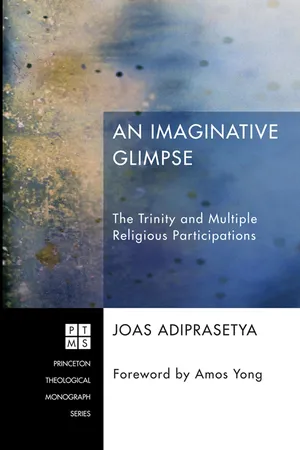
An Imaginative Glimpse
The Trinity and Multiple Religious Participations
- 216 pages
- English
- ePUB (mobile friendly)
- Available on iOS & Android
eBook - ePub
About this book
In contrast to the popular notion that the doctrine of the Trinity hinders Christians from engaging with the reality of religious diversity, this book argues that the doctrine is the best way of constructing contemporary theology of religions. An Imaginative Glimpse reexamines three prominent Trinitarian theologians of religions (Raimundo Panikkar, Gavin D'Costa, and S. Mark Heim) and proposes a fresh and creative model by bringing the classical idea of perichoresis to its present-day multifaith situation.
Opening a new alternative in both Trinitarian theology and theology of religions, Adiprasetya's approach adds a distinctive contribution to the ongoing and challenging discussion in both fields. By using perichoresis imaginatively as a multidimensional category for multiple religious participations within the Trinity, Adiprasetya argues that the model is able to respect all religions on their own terms, while at the same time being faithful to the Christian standpoint.
Information
Topic
Theology & ReligionSubtopic
Christian Church1
Introduction
This book critically applies the complex Trinitarian doctrine of perichoresis to the issue of religious plurality. The Greek word perichoresis refers to the mutual indwelling or coinherence of two or more persons (in the Trinity) or natures (in the person of Christ) or beings (in the case of God-world relationship), where each interpenetrates the others without confusion, separation, or division.1 The classical understanding of the doctrine, as it appears in the Eastern Orthodox tradition, emphasizes the perichoretic relation in the hypostatic union of Christ’s two natures in the incarnation (nature-perichoresis) and the perichoretic relations between the persons of the Trinity (person-perichoresis).2 There is another type of perichoretic relation, which I call reality-perichoresis, referring to God’s cosmological embrace of the world that makes it possible for the world to participate in the inner life of God. Although the third perichoretic relation has not received as much attention as the other two, it nonetheless appeared consistently in the writings of the Orthodox church fathers.
Since the focus of the book is on the issue of religious plurality, it needs to be clearly understood from the beginning that any Christian theology of religions should maintain dialectically the commitment to Christian truth and openness to the truths of other religious traditions. Based on this conviction, my thesis is that, within a creative appropriation of the doctrine of the Trinity, the concept of perichoresis can function as the fundamental principle of the plurality of the world’s religions, such that they can be reconciled as different dimensions of one complex perichoretic reality.
In my attempt to prove my thesis, I will demonstrate the plausibility of my model of perichoretic theology of religions in comparison with other Trinitarian theologies of religions. To do so, a critical analysis of three other models, proposed by Raimundo Panikkar, Gavin D’Costa, and S. Mark Heim, will be in order. I will demonstrate that all employ the Trinity as the central category for theology of religions, yet each of them arrives at a very different explanatory model of how the Trinity relates to the multiple religious traditions and how the doctrine becomes the principle of differentiation among those multiple religious traditions.
Significance of the Study
This study is significant in furthering the conversation within the contemporary Trinitarian theology of religions. The term “Trinitarian theology of religions” points to one of the most recent trends in Christian theology merging two significant developments in the twentieth century, namely, the discipline of theology of religions and the revival of the doctrine of the Trinity.3 Thus, it is indispensable to demonstrate in brief the recent developments in both fields and how they become the proper contexts of this study.
For a long period of time, theology of religions has been dominated by the typology of exclusivism, inclusivism, and pluralism.4 Recently, however, this way of positing various attitudes toward other religions from within Christianity has become the target of strong criticisms. Perry Schmidt-Leukel has surveyed the various criticisms and mapped them into eight major categories.
1. The typology has an inconsistent structure, “because the positions are not of the same genre and do not address the same question.” 2. The typology is misleading, because it obscures or misses the real issues of a theology of religions. 3. The typology is too narrow. There are more than three options . . . 4. The typology is too broad. There are not really three options but only one . . . 5. The typology is too coarse or abstract. It does not do justice to the more complex and nuanced reality of real theologies . . . 6. The typology is misleading, because it does not do justice to the radical diversity of the religions . . . 7. The typology is offensive. 8. The typology is pointless, because we are not in a position to choose any of these options and therefore have to refrain from all of them.5
Although particular rebuttals may be developed in response to any of the objections, it is clear that together they help us to see fundamental flaws in the classical typology as a whole. In addition to the discontent with the classical typology, the contemporary discourse in theology of religions is marked by the emergence of theologians who take a critical stance toward pluralistic theology.6 The proponents of the position that is often called “post-pluralism” have at least two things in common.7 First, “they defend the rights of religions to hold on their own, mutually inconsistent truth claims,” and second, “they can evaluate and encounter other faiths only from a Christian perspective.”8
These two commonalities can be seen in the models proposed by Panikkar, D’Costa, and Heim. On the one hand, each argues that all religions are mutually incommensurable. This attitude certainly shows their willingness to accept other religions in their own terms. On the other hand, however, each believes that there is no non-tradition-specific or neutral approach toward the plurality of religions. It is precisely for this reason that they all employ the Christian Trinity as their starting point for theology of religions.9
Looking at the second field, Trinitarian theology, we can find that after the so-called “rediscovery” of the doctrine of the Trinity in the twentieth century, commonly credited to Karl Barth and Karl Rahner, Trinitarian theology in the twentieth and twenty-first centuries has developed in various directions and has become the central category not only in systematic theology, but also in other fields, such as ecological theology,10 liberation theology,11 feminist theology,12 pastoral theology,13 ecclesiology,14 and many others.15 The linkage of the Trinitarian theology to theology of religions, which is the focus of the book, is also a part of this new development.
Many of those who attempt to perform a mutual and creative conversation between the doctrine of the Trinity and other fields of theology have taken Social Trinitarianism as their basic model. This has led Leonardo Boff, for example, to employ the communal-relational characteristic of the Trinity expressed by the term perichoresis as a basis on which to perfect human community; or in Boff’s words, following Nicholas Fedorov, “The holy Trinity is our social program.”16 Others who adopt this approach are Jürgen Moltmann, Elizabeth Johnson, and Catherine LaCugna.
However, from the Western point of view—often called Latin Trinitarianism—the primacy of God’s inner relationality sounds suspiciously tritheistic.17 This approach is also criticized as having destroyed the radical distinction between God and human being.18 While the debate still continues, the most important question at hand concerns how to arrive at an appropriate understanding of the reality-perichoresis without eradicating the fundamental difference between God and creation. This question needs to be asked repeatedly of Panikkar, Heim, D’Costa, and myself.
The discussion of these three theologians is important in creating a discursive context for my study. Each of them represents a different model of Trinitarian theology of religions. The first model, proposed by Raimundo Panikkar, construes the Trinity as the structure of reality. Panikkar views the Trinity through the notion of cosmotheandrism, which he understands as the complete unity between the divine, the cosmos, and the human, and which becomes the ultimate goal of all reality. The second model, which is the most popular, and of which D’Costa is a representative, employs the dynamic relationship between the Word and the Spirit as one between the particularity and universality of God’s salvific works in Christianity and in other religions.19 The third model, proposed by Heim, employs the notion of multiple religious ends rooted in the plenitude of the Trinity.
Each model clearly offers a very different, and yet plausible, explanation of how the Trinity relates to the multiple religious traditions, and how it becomes the principle of differentiation among religious traditions. They all maintain, however, that any Christian theology of religions cannot claim a neutral universality and should rather be based on the symbol of the Trinity as the central category in the Christian faith. By analyzing each model critically and comparing them I will try to find their similarities and, more importantly, their dissimilarities.
I will pay special attention to how each model deals with the notion of perichoresis. Among the three thinkers, D’Costa shows the least interest in linking the perichoretic idea to other religions. He does not, however, entirely want to abandon the idea of perichoresis. He accepts perichoresis only within the inner life of God, which is applicable to the Christian ecclesial community yet experienced in a fragmented w...
Table of contents
- Title Page
- Foreword
- Preface
- Chapter 1: Introduction
- Chapter 2: The Trinity and Religions
- Chapter 3: Comparative Analyses
- Chapter 4: Perichoretic Indwelling of and in the Triune God
- Chapter 5: A Perichoretic Theology of Religions
- Embracing, Rather than Including, Others
- Bibliography
Trusted by 375,005 students
Access to over 1.5 million titles for a fair monthly price.
Study more efficiently using our study tools.
Frequently asked questions
Yes, you can cancel anytime from the Subscription tab in your account settings on the Perlego website. Your subscription will stay active until the end of your current billing period. Learn how to cancel your subscription
No, books cannot be downloaded as external files, such as PDFs, for use outside of Perlego. However, you can download books within the Perlego app for offline reading on mobile or tablet. Learn how to download books offline
Perlego offers two plans: Essential and Complete
- Essential is ideal for learners and professionals who enjoy exploring a wide range of subjects. Access the Essential Library with 800,000+ trusted titles and best-sellers across business, personal growth, and the humanities. Includes unlimited reading time and Standard Read Aloud voice.
- Complete: Perfect for advanced learners and researchers needing full, unrestricted access. Unlock 1.5M+ books across hundreds of subjects, including academic and specialized titles. The Complete Plan also includes advanced features like Premium Read Aloud and Research Assistant.
We are an online textbook subscription service, where you can get access to an entire online library for less than the price of a single book per month. With over 1.5 million books across 990+ topics, we’ve got you covered! Learn about our mission
Look out for the read-aloud symbol on your next book to see if you can listen to it. The read-aloud tool reads text aloud for you, highlighting the text as it is being read. You can pause it, speed it up and slow it down. Learn more about Read Aloud
Yes! You can use the Perlego app on both iOS and Android devices to read anytime, anywhere — even offline. Perfect for commutes or when you’re on the go.
Please note we cannot support devices running on iOS 13 and Android 7 or earlier. Learn more about using the app
Please note we cannot support devices running on iOS 13 and Android 7 or earlier. Learn more about using the app
Yes, you can access An Imaginative Glimpse by Joas Adiprasetya in PDF and/or ePUB format, as well as other popular books in Theology & Religion & Christian Church. We have over 1.5 million books available in our catalogue for you to explore.