- 292 pages
- English
- ePUB (mobile friendly)
- Available on iOS & Android
eBook - ePub
About this book
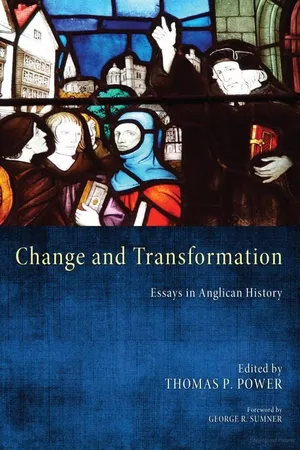
The integrative theme of this collection of essays is change and transformation explored in the context of diverse expressions within the context of Anglican Church history. It addresses some central themes--notably the sacraments, liturgy, biblical interpretation, theological education, the relationship of church and state, governance and authority, and Christian education.
The volume traces Anglican Church history chronologically. It includes a comparative study of penance in the thought of John Wyclif and Thomas Cranmer. The book also treats the dispersal of authority evident in the development of the Book of Common Prayer and the King James Bible, consensus in eucharistic theology in the seventeenth century, and developments in biblical interpretation in the early eighteenth century. This book also discusses a vision for the Christian education of children, change in theological education in the 1830s, the metanarrative of continuity developed by High Church historians in the late nineteenth century, increasing self-government in the Church at the outset of the twentieth century, and models of governance at the outset of the twenty-first.
While this collection highlights aspects of change and transformation as an integrative theme, it is not its premise that change was normative or pervasive, perpetual or constant, within Anglicanism. Nevertheless, these essays raise some new lines of inquiry, make some suggestive interpretations, or propose revision of accepted views.
Information
Topic
Theology & ReligionSubtopic
Christian Church1
John Wyclif and Thomas Cranmer on Penance
The medieval sacrament of penance became a matter of controversy in the second half of the fourteenth century. John Wyclif (c. 1330–84), came to reject the understanding of confession and penance put forward by most of his contemporaries. Likewise, Thomas Cranmer, Archbishop of Canterbury in the early sixteenth century, came to reject the practices associated with penance advocated by those of his contemporaries still loyal to Roman theology. A number of arguments that the two men made were strikingly similar, as were their bases for rejecting contemporary practices. However, there were also a number of pointed differences in their understandings of penance. On balance, it seems that Wyclif was much more medieval than his Reformed admirers would have us believe, at least in the matter of penance.
Penance In Late Medieval England
By the late Middle Ages, with the increasing division of the various disciplines into compartmentalized and competing faculties, along with the development of opposing schools of thought in the medieval universities, controversies over the proper understanding of penance became common. It is not the case that there was a wholesale consensus on the issue; rather, the variety of opinions and practice was more appreciated and less antagonistic. Gratian’s Decretum and Peter Lombard’s Sentences, the standard textbooks of canon law and theology, respectively, had given generations of students a broad sampling of the various authorities on the issues involved, but had not set out so much to define doctrine by reconciling these authorities as to master them and present them to new generations of scholars.1
Nevertheless, despite the variety of interpretations, there was consistency in key areas of the Church’s understanding of penance. In particular, the three elements that made up penance, contrition of heart (cordis contritio), confession of the mouth (oris confessio) and work of satisfaction (operis satisfactio), were generally seen as the constitutive elements of the sacrament. However, there had never truly been a consensus regarding the exact role and function of these elements. All three were seen as necessary, but at different times and in different schools of thought emphasis was laid on one or the other. Changes occurred in four particular areas: penances became lighter and arbitrary, contrition came to take on a more important role, private confession became obligatory by church law, and the role of the priest became more defined and important.2
The lessening of penances and the move away from so-called tariff penances came about for several reasons, with the main one being that theorists argued that as the Church grew in numbers, discipline needed to be slackened in order to keep members from falling away.3 If penances were too strict, the penitent, who might be truly sorry for their sins, might despair of ever being forgiven. For this reason, it was left up to the individual priest to decide the penance, rather than having the penance imposed according to a penitential.4
Contrition is the sorrow that a penitent feels for his or her sins. It can be distinguished from attrition, which is a lesser, imperfect sorrow over sin. As early as the tenth century theologians argued that contrition was the central element in penance, superior to satisfaction, which was seen as more important in earlier theologies of penance. Contrition’s centrality to sacramental penance was secure by the thirteenth century, having been espoused by the likes of Peter Abelard and Hugh of St. Victor, although they disagreed about other aspects of the sacrament.5 Most importantly, the centrality of contrition was affirmed by both Gratian and Peter Lombard, whose popular textbooks spread the teaching on the subject to the universities.6
Obligatory, once-a-year confession was made universal church law in the West at the Fourth Lateran Council of 1215 in the famous decree Omnis utriusque sexus.7 This decree was not the first piece of legislation to require confession, but it, along with the other decrees of the council, did provide a framework for such an enterprise on a church-wide scale and it influenced other, local legislation, such as the pastoral syllabi of Robert Grosseteste of Lincoln and Archbishop Peckham of Canterbury.8 These, in turn, led to large-scale educational efforts, since penitents and priests needed to understand their roles in this system of private confession.
Nonetheless, the priest’s role in the sacrament of penance was difficult to define given the various practices that the Church had adopted.9 There came to be three basic responses to this problem. The first arose out of Peter Lombard’s exposition and suggested that the priest’s role was to declare the sinner absolved after God had already removed the guilt of sin. This did not, however, remove the punishment of sin, which was thought to take place in purgatory, or to be reduced or eliminated through the work of satisfaction enjoined by the priest in the sacrament of penance. This first option placed a heavy emphasis on contrition to the detriment of the priest’s role in absolution. The second option was that argued by Thomas Aquinas, who taught that the words of the priest, “I absolve you,” constituted the form of the sacrament: “Pronounced in the indicative mood, the absolution works to cause grace just as the words of the baptismal formula produce grace in connection with water. Only the absolution of the priest, St. Thomas argued, can apply the passion of Christ to the forgiveness of the guilt of sins.”10 The sacrament of penance, in this understanding, can change the imperfect sorrow of attrition into the perfect sorrow of contrition, and this sacrament becomes integrated into the means of justification.11 This means that the sacrament works by the working of the work itself (ex opere operato) and not by the working of the one performing the sacrament (ex opere operantis) as would be the case if contrition were the formal element of the sacrament, and can be seen as...
Table of contents
- Title Page
- Contributors
- Foreword
- Preface
- Abbreviations
- Introduction
- Chapter 1: John Wyclif and Thomas Cranmer on Penance
- Chapter 2: The King James Version, Dispersed Authority, and Anglican Identity
- Chapter 3: The Reformed Consensus on the Doctrine of the Eucharist
- Chapter 4: Reconciling the Old and New Testaments in the Eighteenth-Century Debate over Prophecy
- Chapter 5: Spiritual Transformation in Sarah Trimmer’s Essay on Christian Education
- Chapter 6: “Of No Small Importance”
- Chapter 7: The Waning of Protestantism in the Anglican Historical Imagination, 1874–1916
- Chapter 8: Reforming Ecclesiastical Self-Government Within the Establishment
- Chapter 9: Anglicanism and the Search for Christian Concord
Trusted by 375,005 students
Access to over 1.5 million titles for a fair monthly price.
Study more efficiently using our study tools.
Frequently asked questions
Yes, you can cancel anytime from the Subscription tab in your account settings on the Perlego website. Your subscription will stay active until the end of your current billing period. Learn how to cancel your subscription
No, books cannot be downloaded as external files, such as PDFs, for use outside of Perlego. However, you can download books within the Perlego app for offline reading on mobile or tablet. Learn how to download books offline
Perlego offers two plans: Essential and Complete
- Essential is ideal for learners and professionals who enjoy exploring a wide range of subjects. Access the Essential Library with 800,000+ trusted titles and best-sellers across business, personal growth, and the humanities. Includes unlimited reading time and Standard Read Aloud voice.
- Complete: Perfect for advanced learners and researchers needing full, unrestricted access. Unlock 1.5M+ books across hundreds of subjects, including academic and specialized titles. The Complete Plan also includes advanced features like Premium Read Aloud and Research Assistant.
We are an online textbook subscription service, where you can get access to an entire online library for less than the price of a single book per month. With over 1.5 million books across 990+ topics, we’ve got you covered! Learn about our mission
Look out for the read-aloud symbol on your next book to see if you can listen to it. The read-aloud tool reads text aloud for you, highlighting the text as it is being read. You can pause it, speed it up and slow it down. Learn more about Read Aloud
Yes! You can use the Perlego app on both iOS and Android devices to read anytime, anywhere — even offline. Perfect for commutes or when you’re on the go.
Please note we cannot support devices running on iOS 13 and Android 7 or earlier. Learn more about using the app
Please note we cannot support devices running on iOS 13 and Android 7 or earlier. Learn more about using the app
Yes, you can access Change and Transformation by Thomas P. Power, Power in PDF and/or ePUB format, as well as other popular books in Theology & Religion & Christian Church. We have over 1.5 million books available in our catalogue for you to explore.