- 102 pages
- English
- ePUB (mobile friendly)
- Available on iOS & Android
eBook - ePub
About this book
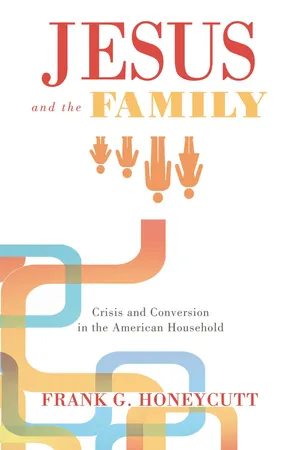
There are few more loaded words in American life than "family." Jesus grew up in one and honored his parents in fulfillment of the commandments. But his teachings on family life stand among the most jarring things he ever said. Jesus invites serious followers to "hate" mother and father. He predicts discipleship will bring division rather than peace to family life. He completely recasts the definition of kinship as "whoever does the will of God." In an era when families face unprecedented challenges sticking together for the long haul, Jesus's words at first glance seem to welcome disintegration of the Christian household rather than offering healing and a clear way forward. This book examines the off-putting words of Jesus in the wider context of radical allegiance and baptismal priority. In a country where family devotion is akin to honoring the national flag, Honeycutt unpacks an old word for a new generation of Christians called to place Jesus first in all things. It's only then that we'll be able to truly help those who share a common roof and lineage.
Information
1
Lost in the Woods
I lost a child in the woods a couple summers ago; came very close to appearing on the evening news. No kidding.
For close to twenty summers, I’ve taken youth backpacking for three-day trips in the Virginia and Carolina mountains. The most serious incident in past years was blisters. Well, I did misplace two young girls once for about ten minutes. They talked themselves right past our campsite. But this was different.
Boyce was in the middle group at the end of a long and hot day. Two miles from camp we took a break. I described the trail ahead to our leaders and led the way. An hour later we all piled into camp; no Boyce. Somehow he’d been allowed to go ahead of his group. I knew exactly where Boyce had missed a turn in the clearly-marked trail, but with afternoon turning to evening, it didn’t matter.
I grabbed my cell phone (which of course did not work in the gorge where we planned to camp) and started running back toward the last road crossing. Unbidden, lawsuits and even memorial services danced in my head. Someone called search and rescue. We flagged down a car and a young woman took me back to another road crossing further north. With lengthening shadows, still no Boyce. I was very close to pastoral panic mode. Hours had passed since anyone last saw him. Evening was turning towards darkness. I’d read about how these things sometimes end.
The voice mail on my cell phone as we emerged from the low point on the forest service road was that of an incredibly calm mother who said, “Pastor Frank, they have Boyce at the entrance to the state park.” I almost started crying. When we caught up with Boyce he was surrounded by state police, park personnel, and several serious search and rescue professionals. I’m still a bit surprised they were willing to relinquish the lad to his embarrassed and incompetent pastor.
Boyce and I got back to camp with zero light left in the day. The woods were absolutely black. We had a hard time making out the relieved faces of our church youth group in the dark. Boyce began to explain excitedly the events of his day to a mesmerized audience. I collapsed in a heap of exhaustion, finally remembering that we should give God thanks for all the remarkable events that led to one of our members getting found. Wandering over to the group in the dark, I interrupted Boyce’s animated regaling and suggested we pray together. “Gosh, Pastor Frank,” said the once-lost boy, now a bit irked. “Can’t you see I’m tryin’ to tell my story here?”
* * *
I’ve laughed and thought a lot about that irritated question since that crazy afternoon and evening. Even though it was offered by a sixth-grader, the question sums up a lot of postmodern impatience with the Bible and church tradition. Almost desperate to make sense of and share ad nausea the Facebook and Twitter details of our lives through cyberspace, there is also regular resistance, even among church people, to filtering our stories creatively through the older and wider canvas of scripture. The Bible, for many, cannot hold a candle to authentic personal experience. Can’t you see I’m tryin’ to tell my story here? We are finding, through agonizing trial and error, that our personal stories cannot alone withstand the weight of the forces of sin and darkness that seek to separate and break us apart.
Families in the United States today—fraught with divorce, teen depression, and a desperate search for meaning—are thirsty, whether they know it or not, for a story wider than their limited genealogy that makes sense and brings unity. Families need and want a way out of the woods when they become lost. Very often the desire to “tell my own story” (however compelling and interesting) fails to forge a trustworthy path leading to freedom and new life. We need an older guide. We need Jesus.
The challenge for pastors and biblically astute congregations is that Jesus says some downright strange and even off-putting things about the family, foreshadowed by how he seems to treat his own kin.
The chapters to come will treat these rather alien texts head-on. For many years I ignored these passages as preaching possibilities when they rolled around in the lectionary cycle—too strange and isolating, especially for families that seemed on the verge of breaking up. I’ve since concluded that Jesus’s words on the family are key to understanding what he meant by the kingdom of God. If we listen closely, his “offensive” words about home life are the very ideas and teachings that can bring health to spouses and children who desperately search for a way out of the woods.
2
Jesus and His Own Family
Yes, I see them there. Two cousins sipping tea in the hill country (Luke 1:39–56), comparing notes about unusual pregnancies, water retention, hopes for their children, and promises from God. Two prospective moms. A mute old priest slinks around in the shadows: old Zechariah, struck dumb by an angel for innocently wondering how in the world an octogenarian couple could possibly get pregnant together. I imagine him in slippers, serving the women silently. It’s just as well for Zechariah, for any man during a pregnancy, don’t you think? Just listen, zip it, and get out of the way.
Maybe Elizabeth was old enough that she never lived to hear about her famous son, John the Baptist, call a whole assembly of religious elite a “brood of vipers,” a pack of snakes. Perhaps Elizabeth was spared that little report from the river. I hope so. Moms want their kids to do well, but not to wind up in jail, as John did, even for the right reasons—headless, come to think of it, when he told the truth one too many times. Too much for any mom, I suspect. I hope for her sake that Elizabeth was resting with the saints by the time her baby boy went a little wild for God.
But how about the other mother? I love her mettle as the story opens. “She set out and went with haste to the hill country.” Mary is excited. Let’s say she pulls on her hiking shoes. She gains elevation. She’s moving along at a pretty decent speed, sometimes gleefully jumping from rock to rock; maybe moving across a mountain meadow like Julie Andrews, arms open wide in rapture. Jesus is still a zygote inside of her, early in the first trimester, but she has to tell somebody.
With nobody around, maybe she rehearses her famous song that she will soon belt out in Elizabeth’s kitchen: My soul magnifies the Lord. The Magnificat. A song so radical, so full of reversals and change, rich and poor trading places, that parts of the world (notably Brazil) have banned the song for the political unrest it’s caused among the people. This song is so sure of what God is going to do in Jesus that Mary uses verbs that suggest it’s already been done. Most of the verbs in the Magnificat are in the past tense. Mary senses the whole world changing inside of her. She cannot keep quiet. She cannot keep still. She pulls on her boots and hikes with haste into the hill country. I’ve always loved that about her.
Magnificat. Magnify. Magnification. Think of the magnifying glass you used to carry in a pocket to burn up a dry leaf or paper with the sun’s rays. I used to try and lure my little brother into mayhem with my magnifying glass but he never fell for it. But a magnifying glass was principally used to make things larger. Mary’s soul magnified the Lord; made God larger. Her own maternal soul did that.
The soul can be a dark place. My own soul, I’ll be the first to confess, darker than most, often minimizes the Lord. On my worst days, I could sing the Minificat rather than the Magnificat. I’m wondering if this was also true of Mary at times.
Part of the truth of the Christian life is that baptism creates a whole new family—a family that magnifies the Lord and embraces this upside-down vision of the world of which Mary sings. John the Baptist, Jesus’s little womb buddy back in Elizabeth’s kitchen, would grow up and get it just right: “He must increase, but I must decrease” (John 3:30).
And Mary also had it right. “My soul magnifies the Lord.” Her soul made God larger. But part of what I love about this woman is that she undoubtedly must have had days when she was not so sure about that; surely had questions about the song she rapturously sang in her cousin’s kitchen. Even Mary. I like that about her. Because oddly, it gives my own fickle soul—forgiven through the cross, washed in baptism, fed in communion—the gumption and courage to take the next step. The next step in my own family’s halting attempts to magnify the man. The next step as a husband, a dad, a disciple. The next step as one household of God living at a specific address.
* * *
In Luke’s Christmas story, most of the light (before and after the sacred birth) shines on Mary even more than Jesus. After the angels appear and frighten the shepherds; after they collect their wits, locate the stable, and share their news with the weary parents, Mary has a quiet moment in the margins of the story that’s easy to miss, but may serve as an early key to understanding Jesus’s theological take on the human family. Look closely. What is Mary doing?
“Mary treasured all these words and pondered them in her heart” (Luke 2:19). Mary “pondered” these words from the excited shepherds—which is sort of odd, if you think about it. An angel has already popped in on Mary prior to her happy dash to Elizabeth’s kitchen and so she surely expected the rather paranormal nature of the birth out there somewhere on the horizon. But she seems rather surprised and taken aback by the shepherds’ midnight tale. She treasures their words. She “ponders” them.
The Greek word here is symballo. It’s where we get our English word “symbol.” The stems in this word, broken apart, are sym (“together”) and ballo (“to throw”). When Mary “ponders” here at the manger, she is literally throwing ideas together; ideas that had not been together in her thinking heretofore. Mary ponders. A related word is “parable,” even though it’s spelled a little differently than “symbol” there at the end of the word. A “parable,” literally, is one idea “thrown alongside” another idea or image. Jesus, upon growing up, told these a lot in his ministry with marvelous theological friction and sparks occurring as a result of the encounter, the narrative toss.
Mary ponders. She “symballo-s” the words that she hears. She throws them together into her heart and they rattle around there, percolating with promise amidst the clattering of cows and sheep herders. The story does not say she “believed.” Nor does it say she ran out into the Bethlehem night shouting, “Hey everybody! Look at me! I’m the lucky one! I’m the lucky girl!” No, Mary “ponders.” For me it’s a new place from which to consider Christmas.
Several years ago I ran across an interesting sociological study that I first heard from evangelist Tony Campolo. One hundred ninety-five year olds were asked a single question: If you could live your life over again, what would you do differently? One hundred older people at the end of their lives—what would you change?
As you might imagine, there were lots of answers to that question. But the answers were also amazingly similar, grouped into three consistent thoughts. These older people basically said three things: 1) They would take more risks and not live this life in such a safe way; 2) They would engage in work that would outlive their time on this earth, work that would continue to make a difference long after they were gone. But then they said a third thing. These 100 ninety-five year olds said that if they had another life to live they would all reflect more. They would slow down and think about this amazing world, the intricacies of breath and love and food and rivers; just being alive. They would all spend a lot more time in reflection—deep appreciation and wonder.
I once saw a wonderful photo in the museum of a Columbia, South Carolina, hospital, only a couple blocks from the church building where I served. I was visiting one of our members and took a little detour into the museum. There was an old picture (1926) behind the glass—a long line of nurses looking out at the camera on graduation day; fifty-nine young nurses in a long row (I counted them) in their starched uniforms and caps; all expectant and hopeful as they went out to serve their patients over eighty-five years ago, their lives completely ahead of them. Something new was beginning for these young women, the passage of time now a certain history for them, as time makes its slow march forward for us all.
Mary “pondered” all the words of the shepherds. She “threw them together” into her heart. The story reports that the very first moments of her life as a mom began by thinking, reflecting, wondering.
I find it instructive that Mary did not pick up her cell phone, so to speak, and contact mom and dad instantly with the good news. “He’s here, mom! Eight pounds, seven ounces; brown hair, ten toes with an excellent Apgar score.” No, Ma...
Table of contents
- Title Page
- Acknowledgments
- Chapter 1: Lost in the Woods
- Chapter 2: Jesus and His Own Family
- Chapter 3: Jesus and the American Family
- Chapter 4: Jesus and the New Family
- Chapter 5: Household Economics According to Jesus
- Chapter 6: Raising Children in the Faith
- Chapter 7: Spiritual Maturity and Conversion at the Home Address
- Chapter 8: Why Jesus Has More in Mind than Mother’s Day
- Bibliography
Trusted by 375,005 students
Access to over 1.5 million titles for a fair monthly price.
Study more efficiently using our study tools.
Frequently asked questions
Yes, you can cancel anytime from the Subscription tab in your account settings on the Perlego website. Your subscription will stay active until the end of your current billing period. Learn how to cancel your subscription
No, books cannot be downloaded as external files, such as PDFs, for use outside of Perlego. However, you can download books within the Perlego app for offline reading on mobile or tablet. Learn how to download books offline
Perlego offers two plans: Essential and Complete
- Essential is ideal for learners and professionals who enjoy exploring a wide range of subjects. Access the Essential Library with 800,000+ trusted titles and best-sellers across business, personal growth, and the humanities. Includes unlimited reading time and Standard Read Aloud voice.
- Complete: Perfect for advanced learners and researchers needing full, unrestricted access. Unlock 1.5M+ books across hundreds of subjects, including academic and specialized titles. The Complete Plan also includes advanced features like Premium Read Aloud and Research Assistant.
We are an online textbook subscription service, where you can get access to an entire online library for less than the price of a single book per month. With over 1.5 million books across 990+ topics, we’ve got you covered! Learn about our mission
Look out for the read-aloud symbol on your next book to see if you can listen to it. The read-aloud tool reads text aloud for you, highlighting the text as it is being read. You can pause it, speed it up and slow it down. Learn more about Read Aloud
Yes! You can use the Perlego app on both iOS and Android devices to read anytime, anywhere — even offline. Perfect for commutes or when you’re on the go.
Please note we cannot support devices running on iOS 13 and Android 7 or earlier. Learn more about using the app
Please note we cannot support devices running on iOS 13 and Android 7 or earlier. Learn more about using the app
Yes, you can access Jesus and the Family by Frank G. Honeycutt in PDF and/or ePUB format, as well as other popular books in Theology & Religion & Biblical Criticism & Interpretation. We have over 1.5 million books available in our catalogue for you to explore.