- 384 pages
- English
- ePUB (mobile friendly)
- Available on iOS & Android
eBook - ePub
About this book
John Henry Newman (1801-1890) was a man who sought to integrate life and holiness. He believed that the spiritual life needed to be lived in an active and dynamic way, touching a person's fundamental attitudes and actions.
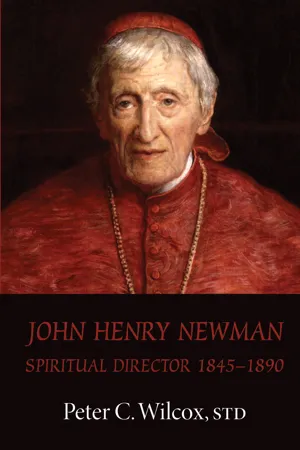
Although Newman rejected the title of spiritual director as such, it is obvious from his correspondence that directing others through various facets of the Christian life was one of his dominant concerns. Surprisingly, comparatively little has been written about Newman's idea of spiritual direction. This book investigates Newman's understanding of spiritual direction during his life as a Roman Catholic, 1845-1890. It examines the major areas in which Newman gave spiritual direction through an analysis of the correspondence from his Catholic years. It also explicates those principles of Newman's own spiritual life that found expression in his direction of others.
Newman had a mammoth "apostolate of correspondence." His Letters and Diaries have been edited and published in a series of thirty-two volumes, embracing more than twenty thousand letters. The first ten volumes deal with Newman's Anglican period; the remaining twenty-two volumes cover his Catholic period and are the primary source for this book. These volumes have been studied chronologically in order to determine and extract the major areas in which Newman gave spiritual direction to others, and to investigate the stages of development in his spiritual advice.
Information
Topic
Theology & ReligionSubtopic
Biblical Studies1
A Spiritual Biography of Newman
“Holiness before peace”1
“Let a person . . . look back upon his past life, and he will find how critical were moments and acts, which at the time seemed the most indifferent; as for instance, the school he was sent to as a child, the occasion of his falling in with those persons who have most benefited him, the accidents which determined his calling or prospects whatever they were. God’s hand is ever over His own, and He leads them forward by a way they know not of.”2
From the thoughts and events of the past, an individual lives in the present and approaches the future. To understand John Henry Newman, it is important to study those people and events that helped to shape his life and affected his view of life. This chapter will explore the various factors which contributed to the development of his spiritual life in his early years. “John Henry Newman, the subject of this memoir, was born in Old Broad Street in the City of London on the 21st of February 1801, and was baptized in the Church of St. Bennet Fink on April 9th of the same year. His father was a London banker, whose family came from Cambridgeshire. His mother was of a French Protestant family, who left France for this country on the revocation of the Edict of Nantes.”3
These are the beginning words of Newman’s autobiographical memoir, which he began writing on June 13, 1874. He was the eldest of six children, whom his parents endeavored to raise according to the Anglican piety of their day. Attendance at church services twice on Sunday, respect for the Prayer Book, daily reading from sacred Scripture, and recitation of the psalms were considered the ideal. Later in life, Newman acknowledged the benefits and limitations of his early religious upbringing: “I was brought up from a child to take delight in reading the Bible; but I had no formed religious convictions till I was fifteen. Of course I had a perfect knowledge of my Catechism.”4
Newman was reared in the Church of England. In the first half of the nineteenth century, there were three major parties within this Church: the High Church or Orthodox party, the Liberals, and the Evangelicals. Newman’s spiritual life was influenced by his association with all three parties within the Church of England. The High Church party, although in the minority and the least influential, sought to be faithful to the traditional faith. Their aim was twofold: to preserve the unity of the church along with the desire to make it a national church. Although there was very little life in this party at the beginning of the century, new life was to be given to the High Church party in the 1830s.
The Liberal party was comprised of people who regarded the Church as a kind of government department. For them, organized religion was chiefly useful for preserving morals and supporting venerable institutions; it was the cement of the entire social structure. At Oriel College resided a group of distinguished liberals headed by Edward Copleston and Richard Whately; although Newman respected these men and was initially impressed by them, he eventually found himself in basic disagreement with their principles.
The most powerful of these three schools of thought during the first three decades of the nineteenth century were the Evangelicals. Originating in the eighteenth century, the party had points of contact with the Methodist movement, but remained within the Church of England. Active in missionary work and social reform, Evangelicals emphasized personal conversion and salvation by faith, and upheld the importance of preaching and the sole authority of Scripture. By their zeal and diligence, they had much to do with the general awakening of the Church prior to the Tractarian movement. The Evangelicals emphasized the need for devotion and reinforced a hunger for holiness which greatly influenced Newman and the other leaders of the Tractarian movement. In fact, the Tractarians were in a great measure recruited from Evangelicals.
Although Newman wrote that he had been converted to a spiritual life by evangelical teaching, he never considered himself a genuine Evangelical. Yet his appreciation for the lasting contribution of Evangelicalism to his own spirituality is evident in the following reflection of 1887:
I will not close our correspondence without testifying my simple love and adhesion to the Catholic Roman Church—not that I think you doubt this—and did I wish to give you a reason for this full and absolute devotion, what should, what can I say, but that those great and burning truths which I learned when a boy from Evangelical teaching, I have found impressed upon my heart with fresh and ever increasing force by the Holy Roman Church? That Church has added to the simple Evangelicalism of my first teachers, but it has obscured, diluted, enfeebled, nothing of it—on the contrary, I have found a power, a resource, a comfort, a consolation in our Lord’s divinity and atonement, in His Real Presence, in communion in His Divine and Human Person which all good Catholics indeed have, but which Evangelical Christians have but faintly.5
Anglican Experiences
Insofar as faith is realized in personal experiences, it is not surprising that the evolution of Newman’s spirituality can be traced through a number of critical events in his life. The first of these was his adolescent “conversion experience.” As Newman recalled in a letter to John Keble in 1844, “When I was a boy of fifteen, and living a life of sin, with a very dark conscience and a very profane spirit, [God] mercifully touched my heart; and, with innumerable sins, yet I have not forsaken Him that time, nor He me.”6 In December 1859, he wrote in his journal:
I know perfectly well, and thankfully confess to Thee, O my God, that Thy wonderful grace turned me right round when I was more like a devil than a wicked boy, at the age of fifteen, and gave me what by Thy continual aids I never lost. Thou didst change my heart and in part my whole mental complexion at that time, and I never should have had the thought of such prayers, as those which I have been speaking of above, but for that great work of Thine in my boyhood.7
In March 1816, a financial crisis arose for Newman’s family when his father’s bank failed. Mr. Newman insisted that all the depositors were to be paid. The house on Southampton Street was sold, and by autumn Mr. Newman had settled his family at Aton in Hampshire and was trying to manage a brewery there. Due to these circumstances, John and his brothers remained at boarding school during that summer. In addition to being away from home, John was struck with a severe illness.8 In his loneliness that summer, he was befriended by the classics tutor, Rev. Walter Mayers, who encouraged him to read Evangelical theologians; this reading undoubtedly helped to pave the way for his early conversion experience. Newman credited Mayers’ conversations and sermons for being “the human means of this beginning of divine faith in me.”9 In his Apologia, Newman characterized this conversion experi...
Table of contents
- Title Page
- Significant Dates in Newman’s life
- Foreword
- Acknowledgments
- Introduction
- Chapter 1: A Spiritual Biography of Newman
- Chapter 2: Origins and Characteristics of Newman’s Spirituality
- Chapter 3: Spiritual Direction and the Providence of God
- Chapter 4: Spiritual Direction and Faith
- Chapter 5: Spiritual Direction and the Roman Catholic Church
- Chapter 6: Spiritual Direction on Vocation and Religious Life
- Chapter 7: Spiritual Direction and Friendship
- Conclusion
- Appendix
- Author’s Bio
- Synopsis
- Bibliography
Trusted by 375,005 students
Access to over 1.5 million titles for a fair monthly price.
Study more efficiently using our study tools.
Frequently asked questions
Yes, you can cancel anytime from the Subscription tab in your account settings on the Perlego website. Your subscription will stay active until the end of your current billing period. Learn how to cancel your subscription
No, books cannot be downloaded as external files, such as PDFs, for use outside of Perlego. However, you can download books within the Perlego app for offline reading on mobile or tablet. Learn how to download books offline
Perlego offers two plans: Essential and Complete
- Essential is ideal for learners and professionals who enjoy exploring a wide range of subjects. Access the Essential Library with 800,000+ trusted titles and best-sellers across business, personal growth, and the humanities. Includes unlimited reading time and Standard Read Aloud voice.
- Complete: Perfect for advanced learners and researchers needing full, unrestricted access. Unlock 1.5M+ books across hundreds of subjects, including academic and specialized titles. The Complete Plan also includes advanced features like Premium Read Aloud and Research Assistant.
We are an online textbook subscription service, where you can get access to an entire online library for less than the price of a single book per month. With over 1.5 million books across 990+ topics, we’ve got you covered! Learn about our mission
Look out for the read-aloud symbol on your next book to see if you can listen to it. The read-aloud tool reads text aloud for you, highlighting the text as it is being read. You can pause it, speed it up and slow it down. Learn more about Read Aloud
Yes! You can use the Perlego app on both iOS and Android devices to read anytime, anywhere — even offline. Perfect for commutes or when you’re on the go.
Please note we cannot support devices running on iOS 13 and Android 7 or earlier. Learn more about using the app
Please note we cannot support devices running on iOS 13 and Android 7 or earlier. Learn more about using the app
Yes, you can access John Henry Newman by Peter C. Wilcox in PDF and/or ePUB format, as well as other popular books in Theology & Religion & Biblical Studies. We have over 1.5 million books available in our catalogue for you to explore.