eBook - ePub
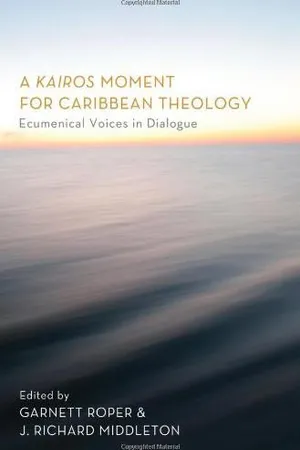
A Kairos Moment for Caribbean Theology
Ecumenical Voices in Dialogue
- 242 pages
- English
- ePUB (mobile friendly)
- Available on iOS & Android
eBook - ePub
A Kairos Moment for Caribbean Theology
Ecumenical Voices in Dialogue
About this book
The project of developing a contextual theology for the Caribbean was first articulated in the early 1970s in Trinidad and Jamaica. In the years since, many evangelical churches and theologians in the Caribbean have been ambivalent about the validity of this project, assuming that an emphasis on context was somehow antithetical to the pure gospel. But the crisis of the times, along with a more mature hermeneutic, has led to a re-evaluation of this assumption.
Here a group of evangelical Caribbean theologians enter the discussion, with substantive proposals for how the gospel addresses the Caribbean context. They are joined by other theologians from mainline Protestant and Catholic traditions in the Caribbean. The result is an ecumenical dialogue on the diverse ways in which orthodox Christian faith may provide both challenge and hope for the Caribbean context. Half the essays in this volume were originally presented at the Forum on Caribbean Theology held in 2010 at the Jamaica Theological Seminary; the rest were invited especially for this volume.
Information
Subtopic
Église chrétiennePart 1
Configuring Caribbean Theology
1
The Caribbean as the City of God
Prophetic Possibilities for an Exilic People
What is Caribbean theology? To begin to answer this question we need to acknowledge that the contextual realities of the Caribbean are the starting point of our reflection upon God.1 Acknowledging these contextual realities requires two fundamental changes from the way theology has been conceived in the Western European tradition. First, we no longer ask the questions that have typically been posed by Western theology; but, beyond that, the interlocutor (the one asking the questions) has changed.
Western theology typically raises questions about whether or not God exists. In some cases, theologians have gone as far as asserting that God is dead. Caribbean theology is not interested in an armchair discussion about metaphysics or ontology, but rather poses questions that are both ethical and existential. It wants to know what kind of God is the God that exists.
The interlocutors are not armchair secularists or academics, but are those from below and they are interested in questions of justice. The interlocutors are the poor and marginalized, along with the pastors and intellectuals who share an organic connection with the marginalized or a commitment to and solidarity with them.2 They want to know, therefore, if the God who exists is a just God, or is on the side of justice for those who have been denied justice. Issues of justice are of paramount importance to Caribbean theology.
While Western theology has been concerned to find ways of speaking about God in relation to non-belief, the issue for Caribbean theology is how to speak about God on behalf of, and in relationship with, those who are non-persons—that is, those whom the prevailing social order does not acknowledge as persons: the poor, the exploited, those systematically and lawfully stripped of their human status, those who hardly know what a human being is.3
Caribbean theology did not originate by the attempt to set out once and for all a system of theology that could be called Caribbean. Historically, there has been a tentativeness that, over time, sought to clarify what the project of Caribbean theology entails and requires. No one analysis of the nature of Caribbean theology is therefore right, to the exclusion of all others. Some are more complete than others, some earlier and others later. Caribbean theology is the combination of voices of Caribbean theologians who speak as they see it, as they attempt to come to terms both with the gospel of God in Jesus Christ and with the realities of the lived experience of the Caribbean.
Identity and Self-Doubt in the Caribbean—The Case of Jamaica
Issues of identity arise in all postcolonial societies, and the Caribbean is no different. However, the circumstances of the Caribbean as a whole combine to make the issue of identity the central and most profound issue of development and selfhood. The problems of the Caribbean may be economic and political, but at their root is the problem of self-understanding and the difficulty of affirming Caribbean selfhood.
The problems of identity are bound up with the learned, entrenched, and reinforced self-doubt of people of African descent, who form the base of the social pyramid in the Caribbean and are the majority demographic grouping. In the case of Jamaica, more than 90 percent of the population is of African descent. Among the black-skinned masses, attitudes still exist that betray a self-contempt and a lack of self-confidence. Rex Nettleford is surely correct: “Herein lies the greatest danger to attempts at finding an identity in terms of race. For a people who do not believe in themselves cannot hope to have others believing in them. The insecurities of this important racial grouping persist with a vengeance.”4
Nettleford notes that while “the black-skinned Jamaican senses that he must compete on the same ground as his brown (Chinese and Indian) and white compatriots, . . . he does not possess such a strong racial memory of great cultural achievements as these European, Chinese and Indian compatriots.”5 Rather, as Nettleford explains, “The Africans, of all the groups which came to the New World, came as individuals and not as part of a group which maintained identity through great religion, or activity through age-old recognizable customs.”6 Instead, all that was original to their culture—the language and customs, the retention of the ancestral past—has been systematically demonized, delegitimized, and discouraged in the new world. Tragically, observes Nettleford, “The obvious answer for the African or black Jamaican is to sink his racial consciousness in the wider, greater aspirations to acquire education and other means of making himself economically viable.”7
The learned inferiority and self-contempt of African-Jamaicans has been reinforced and entrenched by a complex of factors, including the role of the mass media and religion as agents of cultural penetration. This sense of inferiority was co-existent with and in direct contrast to the popular notion of Jamaica as a multi-racial, harmonious society. Jamaica’s ideal of multi-racial nationalism met its fiercest and most positive antagonism from the black activist Rastafarian movement, especially in the 1950s and 60s. Rastafarianism, which combined millenarianism with a revolutionary impulse, arose from within the squatter settlements in West Kingston in the 1930s, building on the teachings of Marcus Garvey as the harbinger of black redemption. Every expression of Rastafari was in protest against the traditional values of what it deemed a Euro-esque society.
Since the 1960s there has been progress in mainstreaming black-skinned Jamaicans. Self-doubt persists, but progress has been made in deepening a self-understanding among the people at the base of the social pyramid.
Identity and Creolization in the Caribbean
The second issue that complicates Caribbean identity is its creolization. This refers to the fact that the Caribbean is an immigrant society. The indigenous Taino, Ciboney, and Carib populations were decimated by the early encounters with the Europeans. Africans, who were transported to the Caribbean for slave labor on sugar cane plantations, are the overwhelming majority. White Europeans came as pirates and then as planters, along with elements from the Middle East, including Jews who became the merchant class, later to be succeeded by Chinese and Indians, who originally came as indentured laborers. All these groups, drawn from each major people group in the human family across the globe, have become the melting pot or perhaps better the pelau that is the Caribbean.8 While the non-African population in the Caribbean formed the minority numerically, they have exercised franchise and dominion over the life of the Caribbean people.9
There are therefore multiple attractions towards the varied cultures from which the minority people groups in the Caribbean originated, and these cultural influences have tended to dominate Caribbean life. But by far European culture trumped all—at least up to the 1960s. Then, in the second half of the twentieth century, the popular culture of the Caribbean came also to be diluted by North American influences. However, the pull has not always been in one direction only. Carnival and Crop Over in the Eastern Caribbean, for example, are festivals that originated in the planter class seeking to indulge itself in the revelry of the underclass. In these, the unmitigated joy of the underclass was copied by the owning class, in a festival of the flesh. Ironically, then, Carnival and Crop Over are disguises of the overlords disguising themselves as the underclass disguised as the upper class!10
The phenomenon of Caribbean migration, with its huge Diaspora in the United Kingdom and the Eastern seaboard of the United States, also provides another source of cultural influence, since Caribbean emigrants also influenced life back home. The Caribbean is, therefore, to a large extent the combination of all these influences. This has resulted in Caribbean art, rhythms, folk wisdom, foods, colors—and more generally patterns of life characteristic of these societies.
There is also a Caribbean historiography, and a Caribbean sociology. What is at issue in both is the telling of the story of the Caribbean from the point of view of the Caribbean. This, however, has only recently (since the 1980s) begun to percolate into Caribbean mass experience as legitimate expressions of our society, rather than being seen as aberrations and distortions.
Caribbean theology in this respect is late in the day. It is playing catch-up with a people that are already ahead of the church’s reflection on the society. The church has so far remained tied to the apron strings of Europe and America. It hardly sings in its liturgy anything but the songs from the metropole and, in general, avoids using the vernacular and accent of the Caribbean in its liturgy. Both song and language are imports from the metropole. Caribbean theology therefore needs to rely on the new historiography and the sociology that seek to give account of the social contours that are crucial strands of Caribbean identity.
Identity and Poverty in the Caribbean
The issue of Caribbean identity is further distorted by the lived experience of persistent poverty in the region. It is the lot and experience of the majority of black-skinned members of Caribbean society that they have not been economically enfranchised—not since they were brought to the region by way of the Middle Passage. Neither have they been compensated for the unpaid labor of their forebears during the three hundred years of their enslavement. For example, they were not given access to land when King George IV signed the Emancipation Act in 1834, nor any time since. Instead, it was the planters who were compensated for the loss of their property (the enslaved) to the tune of fourteen million pounds sterling. Nothing that has happened since adult suffrage or political independence has sought to deal with this issue of reparation in any fundamental way.
The doctrine of African inferiority, which was engendered by the culture of enslavement, colonization, and European dominance, has been reinforced by the economic circumstances and, in particular, the landlessness of the black-skinned masses. It is fair to say that the Afro-Caribbean people are still waiting, in economic terms, for their year of Jubilee.
Economic disempowerment and economic marginalization have a bearing on the understanding of Caribbean identity. The struggle for the ownership and control of the means of their subsistence is a perennial struggle of Caribbean people. It is fundamentally a struggle to become the masters of their own destiny. A black middle class and a black intelligentsia have emerged...
Table of contents
- Title Page
- Foreword
- Preface
- Contributors
- Part 1: Configuring Caribbean Theology
- Chapter 1: The Caribbean as the City of God
- Chapter 2: Language and Identity in Caribbean Theology
- Chapter 3: The Significance of Forgiveness and Reconciliation for Personal and Corporate Relationships
- Chapter 4: Dingolayin’
- Part 2: Interpreting the Bible in the Caribbean
- Chapter 5: Ashley Smith, Carnival, and Hermeneutics
- Chapter 6: Islands in the Sun
- Chapter 7: Jesus’ Healing of the Paralytic
- Chapter 8: Kairos and Kingdom
- Part 3: The Church in the Caribbean
- Chapter 9: Can Jamaica Be Restored?1
- Chapter 10: Evangelicalism as a Sociological Phenomenon?
- Part 4: Caribbean Theology and the Political Sphere
- Chapter 11: Constructing an Egalitarian Society
- Chapter 12: Ideology, Religion, and Public Policy in Jamaica
- Part 5: The Relevance of Caribbean Theology
- Chapter 13: Caribbean Theology
- Chapter 14: The Continuing Relevance of a Caribbean Theology
- Bibliography
Trusted by 375,005 students
Access to over 1.5 million titles for a fair monthly price.
Study more efficiently using our study tools.
Frequently asked questions
Yes, you can cancel anytime from the Subscription tab in your account settings on the Perlego website. Your subscription will stay active until the end of your current billing period. Learn how to cancel your subscription
No, books cannot be downloaded as external files, such as PDFs, for use outside of Perlego. However, you can download books within the Perlego app for offline reading on mobile or tablet. Learn how to download books offline
Perlego offers two plans: Essential and Complete
- Essential is ideal for learners and professionals who enjoy exploring a wide range of subjects. Access the Essential Library with 800,000+ trusted titles and best-sellers across business, personal growth, and the humanities. Includes unlimited reading time and Standard Read Aloud voice.
- Complete: Perfect for advanced learners and researchers needing full, unrestricted access. Unlock 1.5M+ books across hundreds of subjects, including academic and specialized titles. The Complete Plan also includes advanced features like Premium Read Aloud and Research Assistant.
We are an online textbook subscription service, where you can get access to an entire online library for less than the price of a single book per month. With over 1.5 million books across 990+ topics, we’ve got you covered! Learn about our mission
Look out for the read-aloud symbol on your next book to see if you can listen to it. The read-aloud tool reads text aloud for you, highlighting the text as it is being read. You can pause it, speed it up and slow it down. Learn more about Read Aloud
Yes! You can use the Perlego app on both iOS and Android devices to read anytime, anywhere — even offline. Perfect for commutes or when you’re on the go.
Please note we cannot support devices running on iOS 13 and Android 7 or earlier. Learn more about using the app
Please note we cannot support devices running on iOS 13 and Android 7 or earlier. Learn more about using the app
Yes, you can access A Kairos Moment for Caribbean Theology by Garnett Roper,J. Richard Middleton, Roper, Middleton in PDF and/or ePUB format, as well as other popular books in Théologie et religion & Église chrétienne. We have over 1.5 million books available in our catalogue for you to explore.