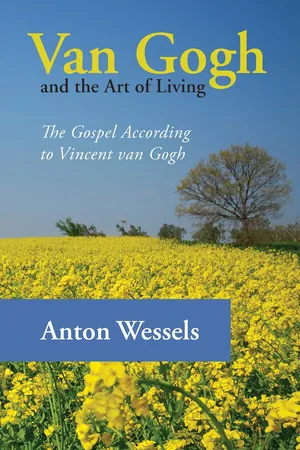
- 200 pages
- English
- ePUB (mobile friendly)
- Available on iOS & Android
eBook - ePub
About this book
Vincent van Gogh believed that one had to learn to read, just as one had to learn to see and learn to live. Van Gogh conveyed a message in his work about the path that he himself followed that was "more true to life," the path that human beings walk in their turbulent existence, the pilgrimage along the various stages of the road of life. He does not speak about the meaning of life but about the true art of living. It is fascinating to see and read the moving way in which he wrestled with the deep human questions of the whence, why, and whither of life. He did not see himself doing this on his own but acknowledged kindred spirits and allies in preachers, preacher-poets, painters, writers, and other artists who also attempted to find their own way through life in a similar fashion.
Van Gogh was aware, like no other, of his duty and task in life: his vocation as human being and artist. That means that he was well acquainted with loneliness, fear, and despair, including suicidal tendencies. Nevertheless, he understood himself as cut out for faith, rather than resignation. Human beings follow their life's path, through storms and dangers, on land and on sea, where the "star of the sea" (the Virgin Mary) helps them and provides light. Van Gogh rejected the unhealthy, sickly forms of religion, electing instead to embrace authentic forms of piety.
Information
Topic
ArtSubtopic
Art GeneralChapter One
Life and Sources of Inspiration
Vincent Willem
Vincent Willem van Gogh was born on 30 March 1853 in Zundert, a small village in the Dutch province of North Brabant close to the Belgian border. His mother, Anna Cornelia Carbentus, was an energetic woman with a zest for life and a great love for nature who was very adept at putting her thoughts down on paper.1 His father, Theodorus van Gogh, was a Dutch Reformed minister. They called their son Vincent Willem; the first name is the same as the one they gave to a child who had been born and died precisely a year earlier, on 30 March 1852. Vincent’s namesake was buried right next to the church in Zundert: Vincent van Gogh 1852. Engraved on the flat stone is the following text (in Dutch): “Suffer the little children to come unto me, for it is to such that the kingdom of God belongs” (Luke18:16).2 While his brother had been given only the one name,3 Vincent himself was also given the name Willem and was thus named after both his grandfathers. On 1 May 1857 his brother Theodorus (Theo) was born, and four sisters and another brother were born in the years following.
A Family of Ministers and Art Dealers
Vincent’s family included several ministers and art dealers. His father, Theodorus, studied theology in Utrecht and was called as a minister to Groot-Zundert in 1849, where he was ordained by his father. He would also later serve the congregations of Helvoirt, Etten, and Nuenen, all small towns in the province of Brabant. Vincent’s uncle on his mother’s side, Johannes Paulus Stricker, would be ordained as a minister in Amsterdam in 1855.4
Vincent was influenced by the piety of his father, who supported the “Groningen school.” This school put life above doctrine, and their emotional piety went contrary to the dry dogmatics of the Dutch Reformed church of that time. The “Groningen school” rediscovered Thomas à Kempis’s Imitation of Christ and emphasized this imitation through love, humility, and social service.5
Vincent did confession of faith at Easter 1871, when he was nineteen years old, in The Hague. Five years later, in England, he still remembered his catechism teacher, Johannes Hillen. He asked Theo, who worked in the art trade in The Hague, to look Hillen up so that he could tell him that Vincent was teaching school in England and, who knows, might later be able to get a position of some kind in a church (July 8, 1876).
Vincent had no less than three uncles who worked in the great internationally renowned art store Goupil & Cie. His godfather, Vincent (Uncle Cent), had a great love for art and literature, and the two of them got along very well. His godfather sold the art shop in The Hague to the Parisian concern Goupil, which also had galleries in Brussels, Paris, and London. Uncle Johannes, who became director of the naval dockyard in 1877 and later vice-admiral, would put Vincent up when he was studying in Amsterdam. After a high school education that he, for reasons that remain unclear, never finished, Vincent worked in the art trade for six years. He was first employed in Goupil’s shop in The Hague but left with a favorable recommendation in June 1873 for the London branch. There he wrote: “I have a rich life here, ‘we have nothing but possess all things’” (2 Corinthians 6:10). While he was in London he began to believe he was becoming a cosmopolitan, i.e. “not a Dutchman, Englishman, or Frenchman, but simply a man” (February 9, 1874). He then worked at the Parisian branch, where he was let go, however, on 1 April 1876 because it was felt he “had no ambition for his profession.” The reason he was dismissed was that he visited his parents in Etten for a few days during the busy Christmas season (July 22, 1878). But Vincent no longer felt happy in the trade and had already considered leaving. Ultimately, however, his work in the art trade gave him a knowledge of art, and artists became very important for him.
Teacher and Evangelist in England
Vincent’s father was happy when he was able to get a position in the seaside resort town of Ramsgate in southeast England. He taught French, German, and maths in a small boys’ boarding school in return for board and lodging (April 4, 1876). Vincent was going through an intense religious period in his life at that time and emphasized religious education in the work he did at that school.
At his request Theo sent him two engravings by Ary Scheffer, a painter from Dordrecht whom Vincent greatly admired: Christus Consolator (Christ the Comforter) and Christus Remunerator (Christ the Avenger). He called them “unforgettable paintings.” His pious outpourings in his letters were even too much for his father. The latter wrote to Theo:
Oh, if he would only learn to be simple like a child and not throw Bible texts around so excessively and wildly. The more he does it, the more concerned [Mother and I] become, and I fear that someday he will no longer be suited for practical life. It’s a bitter shame . . . . If he wants to become a servant of the Gospel, then he should be willing to do the preparatory work and enroll in the necessary university program. Then I would be more confident about it.
Vincent’s dream began to come true in October: he was required to teach until 1:00 p.m., but after that he was free to work as an assistant minister in a small church in Turnham Green.
The position Vincent sought was one “between preacher and missionary” among workers in the suburbs of London. He wanted very much to become a “London missionary,” someone whose job it was “to go among the workers and poor to distribute the Bible and, as soon as one had gained some experience, to speak with foreigners who were seeking work.” By way of recommending himself, he wrote to a minister there:
Although I have not been educated for the church, my earlier life of travel, of living in different countries, dealing with various people, poor and rich, religious and not religious, of doing different kinds of work, days of manual labor in between the days of office work, and speaking different languages can partly make up for my lack of education. (June 17 and July 5, 1876)
After a few months of teaching at the boarding school, he went to work as an assistant minister in Isleworth. The Methodist minister he assisted paid him a salary, and they became friends (January 21, 1877). Toward the end of his stay in England he delivered his only completely transmitted...
Table of contents
- Title Page
- Preface
- Introduction
- An Overview of Vincent van Gogh’s Life
- Chapter 1: Life and Sources of Inspiration
- Chapter 2: Sorrowful, yet Always Rejoicing
- Chapter 3: From Darkness to Light
- Chapter 4: The Art of Living
- Bibliography
Trusted by 375,005 students
Access to over 1.5 million titles for a fair monthly price.
Study more efficiently using our study tools.
Frequently asked questions
Yes, you can cancel anytime from the Subscription tab in your account settings on the Perlego website. Your subscription will stay active until the end of your current billing period. Learn how to cancel your subscription
No, books cannot be downloaded as external files, such as PDFs, for use outside of Perlego. However, you can download books within the Perlego app for offline reading on mobile or tablet. Learn how to download books offline
Perlego offers two plans: Essential and Complete
- Essential is ideal for learners and professionals who enjoy exploring a wide range of subjects. Access the Essential Library with 800,000+ trusted titles and best-sellers across business, personal growth, and the humanities. Includes unlimited reading time and Standard Read Aloud voice.
- Complete: Perfect for advanced learners and researchers needing full, unrestricted access. Unlock 1.5M+ books across hundreds of subjects, including academic and specialized titles. The Complete Plan also includes advanced features like Premium Read Aloud and Research Assistant.
We are an online textbook subscription service, where you can get access to an entire online library for less than the price of a single book per month. With over 1.5 million books across 990+ topics, we’ve got you covered! Learn about our mission
Look out for the read-aloud symbol on your next book to see if you can listen to it. The read-aloud tool reads text aloud for you, highlighting the text as it is being read. You can pause it, speed it up and slow it down. Learn more about Read Aloud
Yes! You can use the Perlego app on both iOS and Android devices to read anytime, anywhere — even offline. Perfect for commutes or when you’re on the go.
Please note we cannot support devices running on iOS 13 and Android 7 or earlier. Learn more about using the app
Please note we cannot support devices running on iOS 13 and Android 7 or earlier. Learn more about using the app
Yes, you can access Van Gogh and the Art of Living by Anton Wessels in PDF and/or ePUB format, as well as other popular books in Art & Art General. We have over 1.5 million books available in our catalogue for you to explore.