eBook - ePub
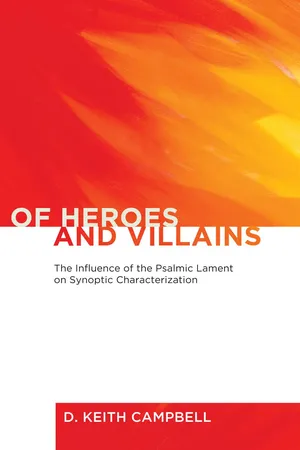
Of Heroes and Villains
The Influence of the Psalmic Lament on Synoptic Characterization
- 212 pages
- English
- ePUB (mobile friendly)
- Available on iOS & Android
eBook - ePub
Of Heroes and Villains
The Influence of the Psalmic Lament on Synoptic Characterization
About this book
Gripping stories, whether modern or ancient, always include heroes and villains. The Synoptic Gospels, chock full of villains (religious leaders and others) in pursuit of an emerging hero (Jesus), are no different. Drawing first-century Jews into their familiar past and beckoning modern readers to join in its appreciation, these writers employ a literary tactic that intensifies this conflict; they depict these characters as Old Testament heroes and villains. To enter this fascinating, intertextual character portrayal, this book, in building on eighty years of lament studies, advances our understanding of the Synoptists's literary and rhetorical use of the Psalmic Lament in relation to other Old Testament motifs to characterize Jesus and his opponents. Other contributions made along the way, including insights into the Synoptists's literary appropriation of Isaiah's Servant, are all geared toward helping us better understand how Matthew, Mark, and Luke characterize their hero and villains.
Information
Topic
Theology & ReligionSubtopic
Biblical Commentary1
Introduction
The influence of the OT on the Synoptic Gospels, especially their passion accounts, can hardly be understated. The numerous, interlaced, OT threads, often detectable only via faint echoes, that weave through their narratives are quite difficult for modern exegetes to untangle, but, in order to understand them more accurately, attempts must be made. This book isolates and investigates one such thread—the Synoptists’ appropriation of the psalmic lament, specifically in how they characterize their hero (Jesus) and his villians (Jesus’ oppenents).
The following five introductory discussions in this chapter set the stage for this investigation: (1) A brief history of research on the psalmic lament provides the necessary background to discuss (2) my contributions to it. (3) Next, I delineate and define the psalmic lament in order to demarcate precisely what is under investigation. Then, in order to guard against anachronistically reading into the Synoptics something that is not there, (4) I explore to what degree the Synoptic writers recognize the core elements of the psalmic lament genre. Finally, before asking how Mark (chapter 2), Matthew (chapter 3), and Luke (chapter 4)1 appropriate the psalmic lament in establishing some of their characters, (5) I present a methodology for the task.
Research on the Psalmic Lament
Old Testament
Hermann Gunkel, the founder of OT form criticism, was writing his groundbreaking Einleitung in die Psalmen when he died in 1932. Joachim Begrich completed Gunkel’s work, publishing it in 1933, and it was translated into English in 1998.2 Among Gunkel’s many contributions was his demarcation of the lament genre in the Psalms, a key focus in much of his work. Gunkel identified common trends in certain psalms that he labeled as laments. This monumental (re)discovery laid the groundwork for eighty years of subsequent research.
Begrich (1934) and Sigmund Mowinckel (1951), among others,3 continued exploring the psalmic lament, focusing especially on its Sitz im Leben. Begrich took interest in the lamenter’s abrupt turn-to-praise that is common in many laments, while Mowinkel tried to explain what he thought was more central to interpreting them—namely, their cultic purposes.4 Claus Westermann advanced the conversation in the 1960s and 1970s by establishing the structure, history, and role of the lament in OT theology.5 He determined that structurally there are three determinate elements of the lament (discussed below in detail). Historically, the lament spanned three predominant periods: the primitive (unstructured), middle (most structured), and later years (wherein they fell into disuse).6 Theologically, the lament gains its primary significance by giving a voice to the one who suffers.7 Westermann’s contributions triggered a theological conversation about the OT lament that has continued for forty years.
The late 1980s and 1990s saw an increased interest in the OT lament. Westermann, continuing his work, argued that the polarities “plea and praise” best describe the psalmic literature,8 while Craig C. Broyles retorted that “plea and complaint” better describe it.9 Paul Ferris explored the form, function, and motivations of the communal lament (1992),10 while Walter Bouzard compared those of Mesopotamia and Israel and concluded that both share similar themes, motifs, and images (1991).11 Patrick Miller, in a 1993 article, argued that the psalmic laments’ rhetoric and form suggest that they are prayers for help; the petitioners, that is, seek to persuade God by motivating him to action.12 Miller followed this article in 1994 by arguing at length that the psalmic petitioners authentically believed that prayer effects change in how God deals with his people.13 Ingvar Fløysvik in 1997 wrote a monograph on the lament psalms arguing that God’s wrath lies at the center of the lamenter’s problem and the cause of their current distress.14
Inquiry into the psalmic lament in the twenty-first century has not abated. F. W. Dobbs-Allsopp investigated the generic evolution of the communal lament15 while Carleen Mandolfo introduced the concept of a “didactic dialogic tension” (what she calls “multivoicing”) in the lament psalms.16 Richard Bautch continued Dobbs-Allsopp’s interests in the generic evolution of the lament by comparing similar and dissimilar traits between post-exilic penitential prayers and the psalms of communal lament, suggesting that both interacted with the other in mutually transforming ways.17 Then, in 2007 William Morrow, building on Westermann’s work, argued that Israel’s lament began informally (impromptu prayers), then developed into a formal stage (the height of the structured lament tradition), before falling out of use during the exiles.18
These OT scholars provided the necessary groundwork for NT scholars to explore how NT writers appropriate the psalmic lament.
New Testament
As OT lament studies gained momentum after Gunkel, lament studies in the NT slowly began to appear. C. H. Dodd, for example, suggested that the lament psalms (which he called “psalms of the righteous sufferer”) provide the plot for the gospel writers to understand Jesus’ death and resurrection.19 Barnabas Lindars argued that the lament psalms function apologetically for the gospel writers by showing that Jesus did not die as a result of God’s displeasure and that they provide a category for understanding the suffering of Jesus.20 Douglas Moo demarcated the gospel writers’ intertextual dependence upon the lament psalms, concluding that it is best to view their use of this literature as typology.21 Donald Juel explored how they used the lament psalms as midrash to explain Jesus’ messiahship22 while Joel Marcus, examining the trajectory of the interpretation of Psalm 22 in post-biblical Judaism, suggested that the lament psalms function in Mark eschatologically to depict Jesus as a warrior king who had to suffer as a righteous one.23 Then, Adela Collins examined the lament psalms in Mark with an eye toward whether Mark accurately appropriated Jewish Scriptures.24
These scholars were primarily interested in the methods the gospel writers used in appropriating the OT (e.g., apologetically, midrash, typologically) and were less interested ...
Table of contents
- Title Page
- Acknowledgments
- Abbreviations
- Chapter 1: Introduction
- Chapter 2: Mark’s Appropriation of the Psalmic Lament
- Chapter 3: Matthew’s Appropriation of the Psalmic Lament
- Chapter 4: Luke’s Appropriation of the Psalmic Lament?
- Chapter 5: Conclusion
- Bibliography
Trusted by 375,005 students
Access to over 1.5 million titles for a fair monthly price.
Study more efficiently using our study tools.
Frequently asked questions
Yes, you can cancel anytime from the Subscription tab in your account settings on the Perlego website. Your subscription will stay active until the end of your current billing period. Learn how to cancel your subscription
No, books cannot be downloaded as external files, such as PDFs, for use outside of Perlego. However, you can download books within the Perlego app for offline reading on mobile or tablet. Learn how to download books offline
Perlego offers two plans: Essential and Complete
- Essential is ideal for learners and professionals who enjoy exploring a wide range of subjects. Access the Essential Library with 800,000+ trusted titles and best-sellers across business, personal growth, and the humanities. Includes unlimited reading time and Standard Read Aloud voice.
- Complete: Perfect for advanced learners and researchers needing full, unrestricted access. Unlock 1.5M+ books across hundreds of subjects, including academic and specialized titles. The Complete Plan also includes advanced features like Premium Read Aloud and Research Assistant.
We are an online textbook subscription service, where you can get access to an entire online library for less than the price of a single book per month. With over 1.5 million books across 990+ topics, we’ve got you covered! Learn about our mission
Look out for the read-aloud symbol on your next book to see if you can listen to it. The read-aloud tool reads text aloud for you, highlighting the text as it is being read. You can pause it, speed it up and slow it down. Learn more about Read Aloud
Yes! You can use the Perlego app on both iOS and Android devices to read anytime, anywhere — even offline. Perfect for commutes or when you’re on the go.
Please note we cannot support devices running on iOS 13 and Android 7 or earlier. Learn more about using the app
Please note we cannot support devices running on iOS 13 and Android 7 or earlier. Learn more about using the app
Yes, you can access Of Heroes and Villains by D. Keith Campbell in PDF and/or ePUB format, as well as other popular books in Theology & Religion & Biblical Commentary. We have over 1.5 million books available in our catalogue for you to explore.