- 284 pages
- English
- ePUB (mobile friendly)
- Available on iOS & Android
eBook - ePub
About this book
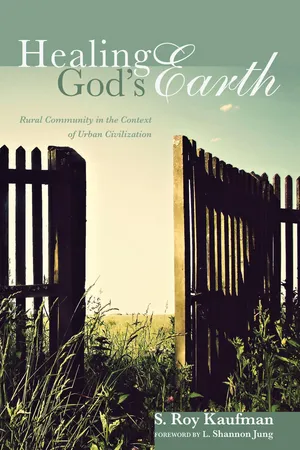
Rural communities and traditional cultures throughout North America and around the world are being systematically dismantled by the forces of urban civilization. It is no new phenomenon. For over four millennia, the powers of urban civilization have been playing God, oppressing people, and exploiting the earth. This long history has brought us to the brink of disaster in the current economic, ecological, and energy crises confronting the dominant global culture.
This book reads the Bible through the lenses of rural communities. The Bible has something to say about the origin and character of urban civilization and the dynamic of its relationship to rural communities. Both Israel in the Old Testament and Jesus in the New Testament were engaged in the formation of rural communities of faith living as alternatives to the dominant cultures of the urban civilizations in which they lived.
It turns out that local, face-to-face communities, both rural and urban, along with traditional cultures of all stripes, are God's chosen instruments for the subversive, nonviolent disarming of urban civilization and the healing of God's earth.
Information
Topic
Teologia e religioneSubtopic
Chiesa cristianaChapter 1
God’s Original Mandate
To Till and Keep the Earth (Gen 2:15)
The Human Place within Creation
By God’s design, everything in creation is connected, from the atomic particles and atoms and molecules that comprise the stuff of the universe, to the galaxies and stars and planets that are the context for life, to the cells and tissues and organs that constitute the organisms of life, to the chemical reactions and natural cycles and biospheric conditions that govern all life forms, to the cultures and institutions and civilizations that shape human history, to the divine beings and spiritual powers, created and uncreated, that underlie the material universe of time and space.
Within the created order, the human family occupies a unique role. We are made from the earth as mortal creatures, sharing life along with all the myriad forms of life here on earth. Yet we are also made in God’s image and have the capacity to share in the eternal life of God. Our lives are bound by the constraints of creaturely existence, and yet we are free to participate in God’s creative purpose in shaping creation and history. We have both the ability and the need to relate to one another, to the natural world of God’s creation, and to the divine personhood of God. These three relationships form the context for our lives as humans.
We are called by God our Creator to represent the divine presence here on earth, to reflect the divine image clearly in our own lives. In this way we are called to assume responsibility on God’s behalf for all forms of life here on earth. This is how we function as stewards, caretakers of a world that belongs to God. We are called to care for the earth as the source upon which the life God has created depends, including our own lives. We are called “to till it and keep it [the earth]” (Gen 2:15).
The Biblical Story
The Human Measure
Having lived for some years in Greece and Canada, I’m familiar with the metric system of measurements. It has always seemed to me an eminently simple and useful system of measurement, using multiples of ten to relate larger or smaller units. I value the meter stick I brought with me from our years in Canada.
The meter is the basic unit of length in the metric system. It seems an appropriate measure for humanity. Humans are typically between one and two meters tall. Our physical world is defined by the metric units of length to the third power. In other words, we can only easily see things larger than a millimeter (thousandths of a meter) or nearer than a kilometer (thousand meters) away. We need the assistance of a microscope or telescope to see things smaller than a millimeter or farther away than a kilometer.
The meter, a little longer than the English yard, has its origin in relation to the size of Earth, being one ten-millionth (10-7) of a quadrant of Earth’s circumference of about forty thousand kilometers. If you consider that the meter is one long step for humans, this puts humanity in a measurable relationship with Earth. If you set off in a particular direction and did not diverge for mountains or seas, after forty million steps of a meter each, you would come back very nearly to the place where you began. As a walker with short legs, I struggle to make each step a meter in length. However, it is possible even for me. So by walking five kilometers an hour (five thousand steps of a meter each), for eight hours a day (forty kilometers or twenty-five miles), for five days a week (two hundred kilometers), for fifty weeks a year (ten thousand kilometers), for four years (forty thousand kilometers), one could walk around Earth in four years. Now to be sure, forty million is a lot of steps, but it is conceivable. We live in a comprehensible world, with Earth as our home.
One of my favorite books is Powers of Ten. At the center of this book is a picture of a couple having a picnic on the lawn of a park in Chicago. That picture is one meter square. Before and after this picture are pages that progress by the power of ten—decameter, hectometer, kilometer, etc.; decimeter, centimeter, millimeter, etc. In other words, the picture on every page is ten times larger or smaller than the picture on the adjacent page. Using this device, the book moves in forty-two pages from the outer fringes of the universe to the atomic particles that comprise the blood in the man’s hand. As humans, we are roughly halfway in size between our solar system (1013 meters) and the nucleus of an atom (10-13 meters).2 Of course, the universe is much larger than our solar system, with our sun being only one of some hundred million stars in the Milky Way galaxy, and our Milky Way galaxy only one of some hundred million galaxies in the universe. Still this image gives us a sense of our place in the scheme of God’s creation. “What are human beings that you are mindful of them, mortals that you care for them?” (Ps 8:4).
It is humbling to realize that life on Earth, including our own life, is the result of cosmic events transpiring over billions of years. Current scientific theory holds that at its birth, the universe expanded at just the right pace—fast enough that it did not collapse upon itself before the stars and galaxies could form but slow enough that stars could form before there would only have been a sterile scattering of matter into space. We are told that the ninety-two naturally occurring elements that are required for life were shaped by the death of a first generation of stars within the universe, leading to a new generation of stars, including our Sun.3 As we explore our own solar system, it becomes obvious that life could only emerge on a planet strategically distanced from the sun for life-giving water to be present. What coincidences are these that give birth to the profusion of life we see around us?
The Human Origin
As humans we are preoccupied with questions of our origin and our destiny. This seems to be especially true of Christian people. Creation and end times, or eschatology, are subjects Christians ponder, sometimes to the exclusion of more pertinent subjects having to do with our faithfulness to God. Sometimes, these issues become most polarizing and divisive, both within the church and in the world. We are often confronted with a choice between a secular evolutionary model of life origins and a religious creationist model, as though these were the only options available. Both of these models focus on how we humans came to be.
In the biblical understanding, the answer to the question of where we come from is focused quite differently and quite simply. We come from God and we return to God! It is that simple! God is the origin and the destiny of both human life and creation as a whole, because God is the Creator, the one through whom all things have come into being, the one in whom we and all things “live and move and have our being” (Acts 17:28). The Bible, in other words, is unrelentingly theocentric in its outlook.
I would venture that our preoccupation with origins has to do with the ambiguous and unique character we have as humans within creation. On the one hand, we were clearly made from the earth and share a creaturely existence along with all the other forms of life God created. After all, we were created on the sixth day along with all the other creatures that live upon the land (Gen 1:24–31). We, like all these other creatures, were brought forth from the earth (Gen 1:24). We, like all these other creatures, were given “every green plant for food” (Gen 1:30). The green plants, which were the crowning achievement of the first three days of creation (Gen 1:12), become the source of sustenance and life for the crowning achievement of the last three days of creation—land animals and human beings (Gen 1:29).
And indeed, it is so! Whether directly or indirectly, human life, like that of all other life forms in the animal kingdom, depends on energy derived from the process of photosynthesis occurring within green plants utilizing the energy of the Sun. We are clearly creatures dependent upon the earth generally, and green plants specifically. We, like all other creatures and life forms God has created, are mortal. We have a natural cycle of life, with birth, growth, maturation, reproduction, and death being the normal state of affairs. Within that normal cycle of life, we, like all other creatures, are subject to natural disasters (storms, floods, droughts, fires, volcanoes, earthquakes), illnesses and diseases and disabilities, accidents, and violent predation by other animals or humans, any one of which can interrupt and end the cycle of life abruptly. Whether cataclysmic or through the normal aging process, we can count on death as the final closing of our earthly life.
As if to emphasize the point, Genesis 2 goes on to affirm that we humans are made “from the dust of the ground” (Gen 2:7). “You are dust, and to dust you shall return” (Gen 3:19). We are humans (adam), made from the dust of the ground (adamah). In Hebrew, it is the same wordplay found in English, when we say that humans are made from humus. If that were not enough to confirm our origin and our composition, we come to life and live only by the breath of God (Gen 2:7). This of course is true not only for humans but for all living things. “When you hide your face, they are dismayed; when you take away their breath, they die and return to their dust. When you send forth your spirit [breath], they are created; and you renew the face of the ground” (Ps 104:29–30). We are clearly mortal creatures dependent not only upon the earth but directly upon the Spirit of God for the gift of life. We cannot live apart from either the earth or the breath of God who made us.
Still, this is not all that needs to be said about our origin as humans. We are also the only creatures made in the image of God. “Let us make humankind in our image, according to our likeness” (Gen 1:26). Whatever else it may mean to be made in God’s image and likeness, it surely means that we have the capacity to relate to God in a self-conscious manner, and thus to participate with God in the unfolding of creation and history. While not explicitly identified as such, the God speaking in Genesis 1:26 is a triune God—Father, Son and Holy Spirit—who lives as three persons in full mutuality and interdependence in a perfect communion of love. As Catholic theologian Catherine LaCugna says, this God, intimately known to us as Father, Son and Holy Spirit, is revealed as relational in the divine being itself. “God’s way of being in relationship with us—which is God’s personhood—is a perfect expression of God’s being as God. . . . God for us is who God is as God.”4
If we are made in the image of this God, then what sets us apart from other creatures is our ability to relate self-consciously to others, to God, and to God’s creation. Self-consciously means, of course, by choice. All other creatures, so far as we know, have little if any choice about how they govern their lives, being limited by the confines of heredity and instinct. While heredity and instinct also play a role in shaping human life, it is the human ability to choose that seems to set us apart from all other forms of life God has created. Other creatures exist to praise and glorify the Creator by their being. Human beings choose whether or not they will praise and glorify their Creator.
If we try to put ourselves into the mind of God, we might imagine the Creator God wishing to have one creature in creation that brings praise and glory to the Creator not as a matter of course but as a matter of choice. Being a relational God, I desire to be in relationship with one of my creatures that is not determined by creation but which comes as the free and loving response of the creature. Of course, being such creatures and knowing our history, we might object that such a project was fraught with peril! If a mortal creature was free to praise and glorify God by choice, it would also be free to withhold such praise and glory. Yet, God, being a relational God of love, took such a risk, determined to enter into such a relationship with a mortal creature, no matter what it might cost in the end. Ironically, it is our freedom to choose that marks us as made in God’s image. We are made as free moral agents, capable of relating to the divine being, and thus capable of participating in eternal life, mortal creatures though we are.
If it is this ambiguous and unique character that leads to our preoccupation with our origin and our destiny, it is important to understand that our mortality and our uniqueness must both be affirmed and held in tension. Creationists are right in rejecting views of humanity that deny the uniqueness of humankind created in God’s image. But they are wrong if and when their high view of human uniqueness leads them to minimize or deny the reality of our creaturely identity and mortality, and thus also to distort the human role within God’s creation. Evolutionists are right in affirming the human bond with all other life forms. They are wrong if they use their theories about the development of life on Earth to deny the possibility that humans are uniquely created in the image of God.
The Human Vocation
The unique character of human life on Earth points toward the role humans have within God’s plan. Humans have the ability to name and order God’s creation, as we see in Genesis 2:19–20, where God brings all the creatures to the human being to see what he would name them. “The man gave names to all cattle, and to the birds of the air, and to every animal of the field” (Gen 2:20). Presumably, the human ability to name the animals extends also to all the other life forms, chemicals, compounds, and elements that make up the world as we know it. We have been busy naming and making order of God’s creation ever since! It is a human propensity, and interestingly, a propensity God respects. “Whatever the man called every living creature, that was its name” (Gen 2:19). God gives us the privilege of naming and ordering God’s creation, and God respects the names that we give to things.
The h...
Table of contents
- Title Page
- Foreword
- Preface
- Introduction and Thesis
- Part A: The Defining Realities
- Chapter 1: God’s Original Mandate
- Chapter 2: Our Original Sin
- Chapter 3: The Powers Unleashed
- Part B: God’s Covenants: Paradigms and Strategic Models of Human Experience
- Chapter 4: The Call of Faith to Live as a Sojourner
- Chapter 5: The Character of Empire
- Chapter 6: On Wilderness and Promised Land
- Chapter 7: The Call to Rural Community
- Chapter 8: Rural Community and Urban Civilization in Conflict
- Chapter 9: The Triumph of Empire and the Persistence of the Rural Vision
- Chapter 10: Exiles and Aliens
- Part C: The Divine Intervention
- Chapter 11: God Made Flesh in God’s Own Self
- Chapter 12: The Restoration of Rural Community in the Person of Jesus Christ
- Part D: The Christian Experience
- Chapter 13: The New Community
- Chapter 14: The Christian Vision
- Chapter 15: An Urban Future or the Garden Renewed?
- Conclusion and Prospect
- Bibliography
Trusted by 375,005 students
Access to over 1.5 million titles for a fair monthly price.
Study more efficiently using our study tools.
Frequently asked questions
Yes, you can cancel anytime from the Subscription tab in your account settings on the Perlego website. Your subscription will stay active until the end of your current billing period. Learn how to cancel your subscription
No, books cannot be downloaded as external files, such as PDFs, for use outside of Perlego. However, you can download books within the Perlego app for offline reading on mobile or tablet. Learn how to download books offline
Perlego offers two plans: Essential and Complete
- Essential is ideal for learners and professionals who enjoy exploring a wide range of subjects. Access the Essential Library with 800,000+ trusted titles and best-sellers across business, personal growth, and the humanities. Includes unlimited reading time and Standard Read Aloud voice.
- Complete: Perfect for advanced learners and researchers needing full, unrestricted access. Unlock 1.5M+ books across hundreds of subjects, including academic and specialized titles. The Complete Plan also includes advanced features like Premium Read Aloud and Research Assistant.
We are an online textbook subscription service, where you can get access to an entire online library for less than the price of a single book per month. With over 1.5 million books across 990+ topics, we’ve got you covered! Learn about our mission
Look out for the read-aloud symbol on your next book to see if you can listen to it. The read-aloud tool reads text aloud for you, highlighting the text as it is being read. You can pause it, speed it up and slow it down. Learn more about Read Aloud
Yes! You can use the Perlego app on both iOS and Android devices to read anytime, anywhere — even offline. Perfect for commutes or when you’re on the go.
Please note we cannot support devices running on iOS 13 and Android 7 or earlier. Learn more about using the app
Please note we cannot support devices running on iOS 13 and Android 7 or earlier. Learn more about using the app
Yes, you can access Healing God’s Earth by S. Roy Kaufman in PDF and/or ePUB format, as well as other popular books in Teologia e religione & Chiesa cristiana. We have over 1.5 million books available in our catalogue for you to explore.