- 110 pages
- English
- ePUB (mobile friendly)
- Available on iOS & Android
eBook - ePub
About this book
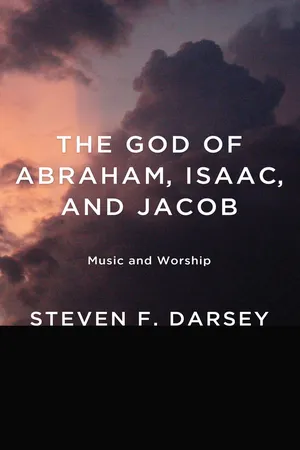
The God of Abraham, Isaac, and Jacob brings readers on a surprising journey from the dawn of divine-human communion to the present, showing how this mysterious, ongoing relationship holds the keys to true worship. Laying a new foundation for understanding worship, the book makes a compelling case for distinguishing the church's practices from those of the world. Recognizing the holiness of worship, the author observes that music itself, apart from language, conveys its own theological meaning; that, similar to Scripture, there is an evolving canon of sacred music; and that, to mitigate idolatry, the spirit of worship must be tested to ensure that it addresses the God of Abraham, Isaac, and Jacob. When this timeless liturgical journey with God is honored with vital commitment, worship will be compelling and transfiguring to all people, at all levels of religious experience.
Information
Topic
Theology & ReligionSubtopic
Christian Rituals & Practice1
Language of Worship
For Christ was in the world, but not of the world.1

We are on a timeless journey with and toward God. We strive to know and serve God, and long for the utility and beauty of living in harmony with God’s will. Coveting this relationship, we search for ways of sharing it with those who don’t know it, we search for ways to increase it for those who do, and we search to deepen it for ourselves.
We dance round in a ring and suppose,
But the Secret sits in the middle and knows.2
But the Secret sits in the middle and knows.2
God is omnipresent. God is with us everywhere, and at all times, beyond place and time. “Where can I go from your spirit? Or where can I flee from your presence”? (Ps 139:7). Of all times and places, however, the time and place of high worship, where humans and God covenant to meet in mutual respect, is sui generis: the most fecund, the sine qua non of the divine-human relationship. There, by mutual consent, we grow in God and God grows in us.
Thus, embodied in and commanded by scripture, and in accord with our deepest instincts, we choose a time and place to worship God in the spirit of holiness, where we maintain our relationship and share mutual love in a committed, disciplined manner. Humans offer their very best on these occasions; and God responds by sharing the scripture, the Holy Spirit, divine guidance and wisdom. There, we also feel the awe and ineffable joy of being in the presence of God, in the beauty of holiness. “I will be your God and you will be my people” (Jer 30:22).
From the dawn of human consciousness, humans have been worshiping God under this mutual covenant. Divine revelations have invoked changes in our understanding of the nature of God and of the practice of our religions; but the liturgy of worship, though manifesting itself in myriad forms over the centuries—truly practiced—has evolved from ancient times in this unbroken dialectical relationship in worship with God.
Through this worship covenant, over the centuries, God and humanity have developed a common language, a language that, granting human limitations and God’s unreachable height, nevertheless enables communication and a growing understanding and relationship. This language is in part didactic, as in scripture and hymns; in part artistic, as in music, art, and architecture; in part communal, for it is done in the presence of others and God; and in part spiritual, as expressed in contemplation and prayer. Each has its unique, essential utility and historic role in divine-human communication, and in combination, they comprise our ongoing language of worship. “His voice was like the sound of many waters” (Rev 1:15).
Thus, evolving in the divine precincts of worship, this is the language by which God and humans recognize and know each other. It is the unique language of worship and is therefore distinct from and alien to the language of the world. There we may learn and practice the secrets unknown to the world that Paul describes in his first letter to the Corinthians.
But we speak God’s wisdom, secret and hidden, which God decreed before the ages for our glory . . . So also no one comprehends what is truly God’s except the Spirit of God. Now we have received not the spirit of the world, but the Spirit that is from God, so that we may understand the gifts bestowed on us by God. And we speak of these things in words not taught by human wisdom but taught by the Spirit, interpreting spiritual things to those who are spiritual. Those who are unspiritual do not receive the gifts of God’s Spirit, for they are foolishness to them, and they are unable to understand them because they are spiritually discerned. (1 Cor 2:7–14)
In the ensuing chapters, I will address means of advancing this shared language and relationship through the art of music.
1. This phrase is commonly used as if it were scriptural, though it is actually an aphorism distilled from John 17:13–16.
2. Frost, “Secret Sits,” 362.
2
Prophecy or Idolatry
The God of Abraham, Isaac, and Jacob. (Exod 3:6)

While a student of sacred music at Yale in the early 1980s, I was privileged to serve as Assistant Music Director for the Church of Christ at Yale. Among my duties was attendance at weekly staff meetings. This was an honor, for I considered every moment in the presence of Chaplain John Vannorsdall ennobling. I was always asking prodigious questions in staff meetings, like “What does it mean that Jesus died for our sins?” He may have dreaded these, but he never showed it and always patiently answered them. Once I asked him why biblical prayers are often addressed to “the God of Abraham, Isaac, and Jacob,” and the like, rather than simply to God. He said they were identifying the God to whom they were praying. This struck me profoundly.
This meant that it was also possible to pray to the wrong god. If it’s possible to pray to the wrong god, it’s possible to address the wrong god in worship—a practice called idolatry. We well know this practice as condemned by biblical prophets, but rarely do we consider that we might practice it ourselves today. Idolatry, however, is alive and well.
Which of today’s liturgical practices might the prophets identify as idolatrous? If we were practicing idolatry, how would we know it? Stating it positively, how do we ensure that our worship is addressing the God of Abraham, Isaac, and Jacob, and not another god? Marva Dawn, in Reaching Out Without Dumbing Down: A Theology of Worship for This Urgent Time, makes clear that everything in worship should be directed to God, and that worship components directed otherwise, however worthily intended, are idolatrous.3 How do we avoid this?
Remembering John Vannorsdall’s answer above, we could simply state this before our prayers and spoken acts of liturgy. But what about other liturgical elements—among them, movement, dance, art, paraments, vestments, architecture, and music? How do we identify the god we are addressing through these media? In music, for example, how do we ensure that our voluntaries, anthems, and hymns are directed to the God of Abraham, Isaac, and Jacob?
On Easter of 2006, my church, Glenn Memorial United Methodist Church (UMC), was blessed with the preaching of Fred B. Craddock. Preparing music to honor the occasion and the high character of his preaching was a blessed challenge. After learning the scripture and the general content of his sermon, I began to look for just the right music to match his sermon and the needs of our congregation as I understood them for this all-important service. I couldn’t find just the right thing, so I decided I had to compose an anthem: a heavy responsibility to place upon oneself for this great day. Where does one go to find the right ideas to express textually and musically for Easter Sunday? I had the scripture and sermon theme and was able to find a text from the Psalms that would work well with the sermon. It’s hard to go wrong with a psalm, but what of the music?
I thought of the important twentieth-century composer Maurice Duruflé, who used Gregorian chant as the foundation for most of his choral music. From this basis, he added melodic ideas and harmonies from his own creative palette. Thus he built on a foundation of words and melodies that had been sung for centuries by his Christian forebears, and brought these into contemporary liturgical parlance via his compositional genius. By quoting text and tune from the ancient Christian liturgy—a musical time-tag ID—he made it unequivocally clear that he was addressing the God of Abraham, Isaac, and Jacob.
Even for an inveterate United Methodist like myself, Duruflé makes a good model, so I looked to the historic Catholic liturgies and found two chants, one from Ascension Sunday, “Psallite Dominus,” and another from Easter, “Surrexit Dominus.” I quoted these two chants literally and composed supporting music and included some additional words in English from Psalm 68, from which comes the text for “Psallite.” While it does not compare to Duruflé, the use of these two time-honored chants made me feel more confident that the piece I presented would have the right things to say, ...
Table of contents
- Title Page
- Guest Preface
- Preface
- Cantate Domino
- Chapter 1: Language of Worship
- Chapter 2: Prophecy or Idolatry
- Chapter 3: Holiness in Worship
- Chapter 4: Holiness in Music
- Chapter 5: Church Music Midrash
- Chapter 6: Church Music Canon
- Chapter 7: Pastoral Leadership
- Chapter 8: Making Decisions
- Chapter 9: Misconceptions
- Chapter 10: God First
- Bibliography
Trusted by 375,005 students
Access to over 1.5 million titles for a fair monthly price.
Study more efficiently using our study tools.
Frequently asked questions
Yes, you can cancel anytime from the Subscription tab in your account settings on the Perlego website. Your subscription will stay active until the end of your current billing period. Learn how to cancel your subscription
No, books cannot be downloaded as external files, such as PDFs, for use outside of Perlego. However, you can download books within the Perlego app for offline reading on mobile or tablet. Learn how to download books offline
Perlego offers two plans: Essential and Complete
- Essential is ideal for learners and professionals who enjoy exploring a wide range of subjects. Access the Essential Library with 800,000+ trusted titles and best-sellers across business, personal growth, and the humanities. Includes unlimited reading time and Standard Read Aloud voice.
- Complete: Perfect for advanced learners and researchers needing full, unrestricted access. Unlock 1.5M+ books across hundreds of subjects, including academic and specialized titles. The Complete Plan also includes advanced features like Premium Read Aloud and Research Assistant.
We are an online textbook subscription service, where you can get access to an entire online library for less than the price of a single book per month. With over 1.5 million books across 990+ topics, we’ve got you covered! Learn about our mission
Look out for the read-aloud symbol on your next book to see if you can listen to it. The read-aloud tool reads text aloud for you, highlighting the text as it is being read. You can pause it, speed it up and slow it down. Learn more about Read Aloud
Yes! You can use the Perlego app on both iOS and Android devices to read anytime, anywhere — even offline. Perfect for commutes or when you’re on the go.
Please note we cannot support devices running on iOS 13 and Android 7 or earlier. Learn more about using the app
Please note we cannot support devices running on iOS 13 and Android 7 or earlier. Learn more about using the app
Yes, you can access The God of Abraham, Isaac, and Jacob by Steven F. Darsey in PDF and/or ePUB format, as well as other popular books in Theology & Religion & Christian Rituals & Practice. We have over 1.5 million books available in our catalogue for you to explore.