It has long been recognized by scholars that aesthetics occupies a central place in Edwards’ thinking. Delattre’s Beauty and Sensibility has often been quoted in academic literature. It is often regarded as the standard work on this topic. Yet, Beauty and Sensibility hardly mentions anything about Reformed doctrines. In Delattre’s study, Edwards is primarily the pioneer of new metaphysics and new theology. Is the Reformed heritage really tangential to Edwards’ thinking, so that Delattre is justified in
ignoring doctrines? Or has Delattre missed something important about Edwards’ thinking on aesthetics? In this study, we shall study the aesthetics from an old and yet new perspective. It is old in the sense that we employ traditional theological topics such as doctrine of God and doctrine of Christ as organizing themes. It is new in the sense that no one yet has approached Edwards’ aesthetics through this angle.4 We hope to integrate Edwards the speculative philosopher with Edwards the Reformed theologian. Only with this integration can we see the true significance of the theological aesthetics of Edwards.
eBook - ePub
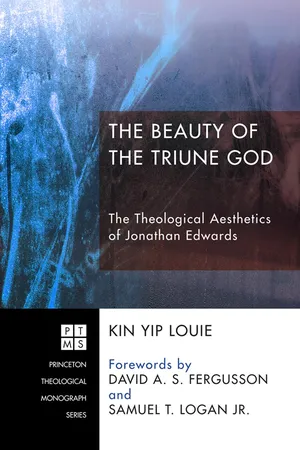
The Beauty of the Triune God
The Theological Aesthetics of Jonathan Edwards
- 246 pages
- English
- ePUB (mobile friendly)
- Available on iOS & Android
eBook - ePub
About this book
The eighteenth-century Puritan theologian Jonathan Edwards has become popular again in contemporary theological discussion. Central to Edwards' theology is his concept of beauty. Delattre wrote the standard work on this topic half a century ago. However, Delattre approaches Edwards mainly as a philosopher, and he does not address how Edwards employs the concept of beauty to explain and defend traditional Reformed doctrines. Recent writings by McClymond, Holmes, and others have shown that defending the Reformed tradition is a fundamental concern of Edwards. This work reveals how Edwards, starting with the common notion that beauty means the appropriate proportional relationship, develops a theological aesthetic that contributes to a rational understanding of major doctrines such as the Trinity, Christology, and eschatology. It shows that Edwards is both an innovative speculative theologian and a staunch defender of Reformed orthodoxy.
Information
Topic
Theology & ReligionSubtopic
Christian Church1
Introduction
Jonathan Edwards is often regarded as the most important American theologian prior to the Civil War.1 He has generated considerable attention in recent scholarship. Born in 1703, Edwards lived through a time of transition. The Puritan heritage still seemed vibrant at his birth. By the time of his death at 1758, the Puritan religion had lost significant ground to the “enlightened” Christianity in American culture. This “enlightened” Christianity rejected the complex dogmatic system of Reformed scholasticism and preferred the simplicity of Christian ethics.2 His importance lies in his creative attempt to hold together old and new elements of his time. On the one hand, he is a staunch defender of the Reformed and Puritan heritage. His Freedom of the Will is famous (or notorious) as a formidable defense of the Reformed doctrine of predestination. On the other hand, he is remarkably familiar (as a pastor in New England) with contemporaneous British theologians and philosophers. Edwards made conscious efforts to get acquainted with the avant-garde thinking of his time. In both published works and private notes, Edwards wrote polemic works to defend Calvinism against liberal thinkers of his day. However, he is much more than just a defender of old traditions. Mostly in his private notes, he mused on the implications of Newtonian physics and Lockean epistemology. In this synthesis of the old and the new, Edwards’ theology is almost unique among American theologians. It combines bold metaphysical speculations with strict adherence to traditional doctrines. It is this combination of the old and the new that makes Edwards so interesting to scholars. Is the new or the old that is the heart of Edwards’ theology?3 Is he the last Puritan or the first modern (or postmodern) American theologian?
First, we need to explain the division between Edwards the philosopher and Edwards the theologian among scholars. As we shall see in the next section, aesthetics is at the center of this story. Before we can explain more about the uniqueness of our approach, we need to look at previous scholarship on Edwards’ aesthetics. This is the topic of our next section.
Theological Aesthetics and Edwards—A Survey
It has long been recognized that aesthetics occupies a central place in Edwards’ thinking. Delattre’s work on this topic in the 1960s has often been quoted in academic literature.5 In this section, we survey past studies of Edwards’ theological aesthetics and offer motives for our new study.
The question of aesthetics, like so many academic questions about Edwards, begins with Perry Miller. Almost sixty years after its publication, Miller’s intellectual biography of Edwards remains today unmatched in its wealth of provocative ideas and graceful prose. Its provocative power comes partly from Miller’s attempt to separate the real Edwards from the superficial Edwards. In the introduction to his seminal work, he writes that “the student of Edward must seek to ascertain not so much the peculiar doctrines in which he expressed his meaning as the meaning itself.”6 For Miller, the Calvinistic doctrines expounded by Edwards are obsolete and boring. These doctrines are merely the husk that hides an original and brilliant kernel. According to Miller, Edwards’ kernel is that: “As a Protestant, he protested against the tyranny of all formalism, especially of that which masquerades as sweet reasonableness. He preached a universe in which the nature of things will permit no interest to become vested.”7
It is a startling conclusion because one can hardly find any explicit protest against formalism or human tyranny in Edwards’ writings. On the surface at least, most of Edwards’ publications and sermons are defenses of traditional Calvinism. They are not writings on general philosophy, even less about political philosophy. The way that Miller comes to such a startling conclusion is a long and winding road. We need to retrace this road briefly in order to understand the currents of contemporary Edwardsian scholarship. Moreover, aesthetics plays a central part in Miller’s reinterpretation of Edwards.
We begin with the reading strategy of Miller. Miller gives a privileged status to the early writings of Edwards. When Miller introduces Edwards’ 1933 sermon A Divine and Supernatural Light (when Edwards was thirty years old), he claims that “it is no exaggeration to say that the whole of Edwards’ system is contained in miniature within some ten or twelve of the pages in this work.”8 He believes that Edwards’ works are “statement and restatement of an essentially static conception, worked over and over, as upon a photographic plate, to bring out more detail or force from it clearer prints.”9 Miller often appeals to Edwards’ early private notes in his creative interpretation of Edwards’ later works.10 For example, he claims that in Edwards’ late work, Freedom of the Will, the question of the free will is really a masquerade for a deeper concern. “The Freedom of the Will is an immense cipher. Intellectually, the hidden meaning is ‘Excellency.’”11 We shall come shortly to the meaning of excellency. The issue here is that Miller believes that Edwards’ doctrinal concerns should be deciphered for its deeper meaning. The key to decipherment lies in Edwards’ early notes. These notes are the most speculative and explicitly philosophical among Edwards’ works. This allows Miller to claim that Edwards’ real concern is really philosophical rather than doctrinal. This interpretive strategy will cast a long shadow over subsequent scholarship.12
What are the central themes of these early notes (and in Miller’s story, of all of Edwards’ works)? The theme is the reconciliation of the Christian religion with the advancement of science: “Locke is, after all, the father of modern psychology, and Newton is the fountainhead of our physics; their American student, aided by remoteness, by technological innocence, and undoubtedly by his arrogance, asked in all cogency why, if the human organism is a protoplasm molded by environment, and if its environment is a system of unalterable operations, need mankind any longer agonize, as they had for seventeen hundred years, over the burden of sin?”13
According to Miller, Edwards learns from reading Locke that the old metaphysics no longer works. Locke claims that the only knowable objects in the human mind are ideas. And ideas are not the things themselves. “Locke amputated consciousness from things.”14 If we cannot know things-in-themselves, then we can verify one idea only with other ideas. It is not a denial of the reality of the external world, since ideas are generated and conditioned by contact with the external world. But we cannot verify ideas by examining things unmediated. Therefore, “truth is a consistent supposition of relations among ideas, not because truth is separable from empirical test, but because only by a consistency of ideas can the mind participate in order and law.”15 If we know things only through ideas, and ideas come only from sensation, then how do we perceive bodiless objects such as God? If consciousness is amputated from things, then how is our mind related to the mechanical world of Newton?
According to Miller, Edwards learns from Newton that the universe is a gigantic web of cause and effect. The four causes of Aristotelian physics are reduced to one efficien...
Table of contents
- Title Page
- Foreword by David Fergusson
- Foreword by Dr. Samuel Logan
- Preface
- Acknowledgments
- Chapter 1: Introduction
- Chapter 2: Definitions of Beauty
- Chapter 3: Metaphysics of Beauty
- Chapter 4: The Beautiful God
- Chapter 5: The Beautiful Christ
- Chapter 6: Eschatological Beauty
- Chapter 7: Conclusion
- Bibliography
Trusted by 375,005 students
Access to over 1.5 million titles for a fair monthly price.
Study more efficiently using our study tools.
Frequently asked questions
Yes, you can cancel anytime from the Subscription tab in your account settings on the Perlego website. Your subscription will stay active until the end of your current billing period. Learn how to cancel your subscription
No, books cannot be downloaded as external files, such as PDFs, for use outside of Perlego. However, you can download books within the Perlego app for offline reading on mobile or tablet. Learn how to download books offline
Perlego offers two plans: Essential and Complete
- Essential is ideal for learners and professionals who enjoy exploring a wide range of subjects. Access the Essential Library with 800,000+ trusted titles and best-sellers across business, personal growth, and the humanities. Includes unlimited reading time and Standard Read Aloud voice.
- Complete: Perfect for advanced learners and researchers needing full, unrestricted access. Unlock 1.5M+ books across hundreds of subjects, including academic and specialized titles. The Complete Plan also includes advanced features like Premium Read Aloud and Research Assistant.
We are an online textbook subscription service, where you can get access to an entire online library for less than the price of a single book per month. With over 1.5 million books across 990+ topics, we’ve got you covered! Learn about our mission
Look out for the read-aloud symbol on your next book to see if you can listen to it. The read-aloud tool reads text aloud for you, highlighting the text as it is being read. You can pause it, speed it up and slow it down. Learn more about Read Aloud
Yes! You can use the Perlego app on both iOS and Android devices to read anytime, anywhere — even offline. Perfect for commutes or when you’re on the go.
Please note we cannot support devices running on iOS 13 and Android 7 or earlier. Learn more about using the app
Please note we cannot support devices running on iOS 13 and Android 7 or earlier. Learn more about using the app
Yes, you can access The Beauty of the Triune God by Kin Yip Louie in PDF and/or ePUB format, as well as other popular books in Theology & Religion & Christian Church. We have over 1.5 million books available in our catalogue for you to explore.