eBook - ePub
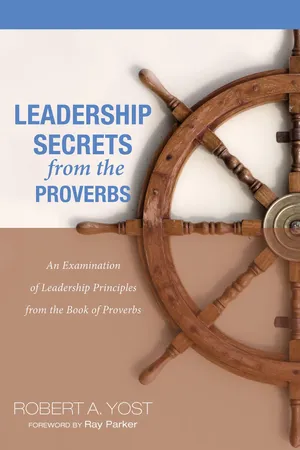
Leadership Secrets from the Proverbs
An Examination of Leadership Principles from the Book of Proverbs
- 186 pages
- English
- ePUB (mobile friendly)
- Available on iOS & Android
eBook - ePub
Leadership Secrets from the Proverbs
An Examination of Leadership Principles from the Book of Proverbs
About this book
The book of Proverbs is a cornucopia of practical wisdom on a variety of topics. The insights and truths covered in this book of ancient Hebrew Wisdom literature run the gamut including the nature of true wisdom and understanding, vices and virtues, relationships and roles, priorities, planning for the future, how to communicate, and how to manage one's resources.
In recent decades, the book of Proverbs has increasingly become the focus of attention for Christians who wish to live lives more in tune with God's principles. In particular, Christian thinkers have begun to correlate biblical principles with the study of effective leadership.
Yost examines the subject of godly leadership by using the book of Proverbs as his springboard. This is a scholarly, yet deeply devotional, study of the leader's priorities, the leader's plans, and the leader's speech. Once you have read this book, you will never look at the book of Proverbs or the subject of leadership the same way again.
Information
Topic
Theology & ReligionSubtopic
Biblical CommentaryChapter 1
Introduction and Overview of the Study
Why Study Proverbs in Connection with Leadership?
The Bible speaks on a plethora of subjects and is a repository of information on a multiplicity of topics not limited to religious and theological ones. It has been revered for millennia for its religious teaching and guidance, its timeless wisdom, and its literary grandeur and majesty. Although the Bible is known primarily as a religious and theological work with elements of law, history, poetry, gospel, epistle, and apocalyptic incorporated, it also has much to say on the subject of leadership. Lorin Woolfe, a leadership consultant who formerly was a leadership specialist at the American Management Association, writes of the Bible, “Read carefully and with another perspective, it is also the greatest collection of leadership case studies ever written, with tremendously useful and insightful lessons for today’s leaders and managers.”1
The book of Proverbs has increasingly become the focus of attention for Christians in recent years. Tremper Longman III and Raymond Dillard write of this phenomenon, “Our age has become increasingly absorbed with interest in ourselves and how we relate to others, and many feel that this book provides divinely given help in understanding human personality and behavior.”2 In like fashion, interest in leadership studies has increased almost exponentially over the past several decades. Christian thinkers have begun to correlate biblical principles with the study of effective leadership. Like grapes of gold set in silver, the book is Proverbs is ripe for plucking.
A Statement of the Problem
As important as the book of Proverbs is in the area of leadership studies, it is noteworthy that there is a lamentable dearth of scholarly resources on this subject. There are a multitude of scholarly materials available on the Proverbs (e.g., books, commentaries, monographs, journal articles), and even more has been published in recent decades on the subject of leadership. There are also many works that seek to discern leadership principles from the Bible as a whole (e.g., Woolfe’s Leadership Secrets from the Bible3 and Manyika’s The Challenge of Leadership4). However, on the subject of leadership principles derived from the book of Proverbs, the landscape is decidedly barren. In recent years, there have been a number of works published on this subject, but these materials have been primarily devotional in nature, not research based. When materials have been published in this area, they have tended to deal primarily with how the book of Proverbs should impact managerial practices (e.g., Zigarelli’s Management By Proverbs5), not leadership, which is an entirely different function. Therefore, there is a definite need for scholarly research to be explored in this very specific area of leadership principles derived from the book of Proverbs and to develop applications that are not just philosophical in nature. This study will critically examine the leadership principles crafted in the book of Proverbs, to discover how the inspired author(s) dealt with leadership issues.
Importance of the Study
Since little has been published in the area of leadership studies in the book of Proverbs, this study will add to the body of literature in this field. The hope is that its findings will assist the contemporary church, para-church, and even Christian and secular business leaders to understand clearly and effectively utilize the inspired proverbial wisdom of the ever current biblical text. This study should result in present day Christian leaders being better able to create a paradigm of effectiveness, efficiency, and edification springing from the font of God’s wisdom.
Organization of the Study
This paper will begin with an Introduction and Overview of the Study, which will outline such introductory elements as Methodology, Delimitations, Definitions, and a brief overview of previous studies. The second chapter will develop The Leader’s Priorities, which are primarily twofold: (1) Relationship to God, and (2) Relationship to Family.
The third chapter will develop The Leader’s Plans, which are also twofold: (1) Partnership with God, and (2) Partnership with Others. The fourth chapter will outline The Leader’s Speech and how it should be used. The chapter is subtitled The Proper Use of the Tongue. This chapter will develop twelve areas: (1) Imparting Knowledge and Wisdom, (2) Encouragement, (3) Protection, (4) Nurture, (5) Healing, (6) Telling the Truth, (7) Pleasant Speech, (8) Praise, (9) Advice, (10) Confessing Sin, (11) Discretion, and (12) Rebuke. The fifth chapter will continue the theme of Chapter 4, The Leader’s Speech, this time focusing on the Improper Use of the Tongue. This chapter will develop ten areas under this heading: (1) Lying, (2) Gossip, (3) Foolish Talk, (4) Slander, (5) Quarreling, (6) Speaking Rashly, (7) Boasting, (8) Flattery, (9) Mockery, and (10) Perverse Talk.
Finally, the sixth chapter will be Summary and Conclusions. This chapter will attempt to summarize the major findings of the paper and offer any conclusions that are suggested by the research.
Methodology
This paper will examine the Old Testament book of Proverbs to attempt to discover the leadership principles that are contained therein. Although many other books of the Bible deal with the subject of leadership, this study will limit itself to the book of Proverbs and allude to other portions of Scripture only as they reinforce the arguments presented from that wisdom book. Furthermore, although some of the apocryphal books may have spiritual and practical value (e.g., The Wisdom of Solomon and Sirach), their non-canonical status precludes them from consideration in this study except as their inclusion may reinforce or supplement its findings. This investigation will follow the o...
Table of contents
- Title Page
- Foreword
- Preface
- Abbreviations
- Chapter 1: Introduction and Overview of the Study
- Chapter 2: The Leader’s Priorities
- Chapter 3: The Leader’s Plans
- Chapter 4: The Leader’s Speech - The Proper Use of the Tongue
- Chapter 5: The Leader’s Speech - The Improper Use of the Tongue
- Chapter 6: Summary and Conclusions
- Appendices
- Bibliography
Trusted by 375,005 students
Access to over 1.5 million titles for a fair monthly price.
Study more efficiently using our study tools.
Frequently asked questions
Yes, you can cancel anytime from the Subscription tab in your account settings on the Perlego website. Your subscription will stay active until the end of your current billing period. Learn how to cancel your subscription
No, books cannot be downloaded as external files, such as PDFs, for use outside of Perlego. However, you can download books within the Perlego app for offline reading on mobile or tablet. Learn how to download books offline
Perlego offers two plans: Essential and Complete
- Essential is ideal for learners and professionals who enjoy exploring a wide range of subjects. Access the Essential Library with 800,000+ trusted titles and best-sellers across business, personal growth, and the humanities. Includes unlimited reading time and Standard Read Aloud voice.
- Complete: Perfect for advanced learners and researchers needing full, unrestricted access. Unlock 1.5M+ books across hundreds of subjects, including academic and specialized titles. The Complete Plan also includes advanced features like Premium Read Aloud and Research Assistant.
We are an online textbook subscription service, where you can get access to an entire online library for less than the price of a single book per month. With over 1.5 million books across 990+ topics, we’ve got you covered! Learn about our mission
Look out for the read-aloud symbol on your next book to see if you can listen to it. The read-aloud tool reads text aloud for you, highlighting the text as it is being read. You can pause it, speed it up and slow it down. Learn more about Read Aloud
Yes! You can use the Perlego app on both iOS and Android devices to read anytime, anywhere — even offline. Perfect for commutes or when you’re on the go.
Please note we cannot support devices running on iOS 13 and Android 7 or earlier. Learn more about using the app
Please note we cannot support devices running on iOS 13 and Android 7 or earlier. Learn more about using the app
Yes, you can access Leadership Secrets from the Proverbs by Robert A. Yost in PDF and/or ePUB format, as well as other popular books in Theology & Religion & Biblical Commentary. We have over 1.5 million books available in our catalogue for you to explore.