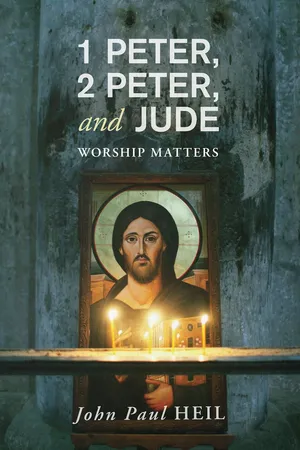
- 374 pages
- English
- ePUB (mobile friendly)
- Available on iOS & Android
eBook - ePub
About this book
This book proposes new and comprehensive chiastic structures as well as new unifying themes for the often-neglected New Testament letters of 1 Peter, 2 Peter, and Jude. In accord with these structures, which organize the oral performance of these letters in a context of communal worship, the subtitle of the book, "Worship Matters," expresses the letters' main concern. By "worship" is meant not only liturgical worship but also the ethical behavior that complements it for a holistic way of worshiping God. "Matters" refers not only to the "matters" or issues regarding worship in these letters but also to the fact that worship "matters" in the sense of making an all-important difference to Christian living, not only for the original audiences of letters, but equally for their contemporary audience. Accordingly, this book proposes that: 1 Peter exhorts its audience to worship for life, both present and eternal, through the sufferings of Jesus Christ; 2 Peter exhorts its audience to worship in the knowledge regarding the final coming of our Lord and Savior Jesus Christ; and Jude exhorts its audience to worship in the mercy and love of God through our Lord Jesus Christ.
Information
Topic
Theology & ReligionSubtopic
Biblical Studies1
Introduction
1 Peter, 2 Peter, and Jude: Worship Matters
This book will present new proposals for the structures and main themes regarding worship of three closely related letters in the New Testament—1 Peter, 2 Peter, and Jude. The first thirteen chapters will be devoted to 1 Peter. Chapters 14–20 will examine 2 Peter, while chapters 21–26 will treat Jude.
Chiastic Structures and 1 Peter, 2 Peter, and Jude
My investigation of the chiastic structures of 1 Peter, 2 Peter, and Jude will be guided by the following list of criteria for detecting an extended chiasm:
- There must be a problem in perceiving the structure of the text in question, which more conventional outlines fail to resolve.
- There must be clear examples of parallelism between the two “halves” of the hypothesized chiasm, to which commentators call attention even when they propose quite different outlines for the text overall.
- Linguistic (or grammatical) parallelism as well as conceptual (or structural) parallelism should characterize most if not all of the corresponding pairs of subdivisions.
- The linguistic parallelism should involve central or dominant imagery or terminology important to the rhetorical strategy of the text.
- Both linguistic and conceptual parallelism should involve words and ideas not regularly found elsewhere within the proposed chiasm.
- Multiple sets of correspondences between passages opposite each other in the chiasm as well as multiple members of the chiasm itself are desirable.
- The outline should divide the text at natural breaks which would be agreed upon even by those proposing very different structures to account for the whole.
- The central or pivotal as well as the final or climactic elements normally play key roles in the rhetorical strategy of the chiasm.
- Ruptures in the outline should be avoided.1
An important and distinctive feature of this investigation is that all of the proposed chiasms are determined mainly by precise linguistic parallels with an objective basis in the text, rather than on thematic or conceptual parallels, which can often be subjective. Indeed, the main criterion for the establishment of chiasms in this investigation is the demonstration of these linguistic parallels. I will seek to determine how the subsequent occurrence(s) of a paralleled word or phrase develops the first occurrence after a central unparalleled element or central parallel elements serve as a pivot from the first to the second half of the chiasm.
Since they are based strictly on linguistic parallels, some of the proposed chiasms may or may not exhibit a balance in the length of the various parallel elements or units—one parallel element or unit may be much longer or much shorter than its corresponding parallel. This may seem odd to a modern audience, but an ancient audience would presumably be attuned to the key linguistic parallels that are heard rather than the balance of length between the elements or units of a given chiasm. The main presupposition of this investigation is that if there are demonstrable linguistic parallels with a pivotal section between them, then a chiasm is operative regardless of a certain lack of balance between various elements or units.
Furthermore, some of the linguistic parallels involve what might be considered by a modern audience as rather ordinary or trivial words, unlikely to be key words in chiastic parallels. But it should be kept in mind that what may seem to be insignificant words or phrases on the surface to a modern audience may have been very significant indeed to the particular rhetorical strategy of the author and the particular situation of the original audience as they listened to the entire oral performances of 1 Peter, 2 Peter, and Jude. In some cases the parallels may be between cognates or between synonyms, antonyms, and/or alliterative terms. And in some cases an identical grammatical form of a word determines the chiastic parallel.
Not all of the proposed chiasms have the same number of elements or units. Some chiasms may exhibit a single unparalleled central element, e.g., A-B-C-B′-A′, while others may exhibit dual, parallel central, or pivotal elements, e.g., A-B-C-C′-B′-A′. Nevertheless, both of these types operate as chiasms in the ears of the implied audience, since they both involve a pivot from the first to the second half of the chiasm. In one type a central unparalleled element serves as the pivot, whereas in the other type two parallel elements together serve as the pivot to the second half of parallel elements. In addition it may often be more accurate to speak of the central element or elements as the pivotal point of the chiasm and the final A′ element as the climax. This is important to keep in mind, lest one think that chiastic patterns are a type of circular or merely repetitive argument rather than exhibiting an ongoing, dynamic development.
Chiastic patterns serve to organize the content to be heard and not only aid the memory of the one delivering or performing a document but also make it easier for the implied audience to follow and remember the content. A chiasm works by leading its audience through introductory elements to a central, pivotal point or points, and then reaching its conclusion by recalling and developing...
Table of contents
- Title Page
- Abbreviations
- Chapter 1: Introduction
- Chapter 2: 1 Peter 1:1–13
- Chapter 3: 1 Peter 1:14–25
- Chapter 4: 1 Peter 2:1–17
- Chapter 5: 1 Peter 2:18–21a
- Chapter 6: 1 Peter 2:21b–25
- Chapter 7: 1 Peter 3:1–7
- Chapter 8: 1 Peter 3:8–17
- Chapter 9: 1 Peter 3:18–22
- Chapter 10: 1 Peter 4:1–11
- Chapter 11: 1 Peter 4:12–19
- Chapter 12: 1 Peter 5:1–14
- Chapter 13: Summary and Conclusion on 1 Peter
- Chapter 14: Introduction to 2 Peter
- Chapter 15: 2 Peter 1:1–15
- Chapter 16: 2 Peter 1:16–21
- Chapter 17: 2 Peter 2:1–16
- Chapter 18: 2 Peter 2:17–22
- Chapter 19: 2 Peter 3:1–18
- Chapter 20: Summary and Conclusion on 2 Peter
- Chapter 21: Introduction to Jude
- Chapter 22: Jude 1:1–4
- Chapter 23: Jude 1:5–11
- Chapter 24: Jude 1:12–20
- Chapter 25: Jude 1:21–25
- Chapter 26: Summary and Conclusion on Jude
- Bibliography
Trusted by 375,005 students
Access to over 1.5 million titles for a fair monthly price.
Study more efficiently using our study tools.
Frequently asked questions
Yes, you can cancel anytime from the Subscription tab in your account settings on the Perlego website. Your subscription will stay active until the end of your current billing period. Learn how to cancel your subscription
No, books cannot be downloaded as external files, such as PDFs, for use outside of Perlego. However, you can download books within the Perlego app for offline reading on mobile or tablet. Learn how to download books offline
Perlego offers two plans: Essential and Complete
- Essential is ideal for learners and professionals who enjoy exploring a wide range of subjects. Access the Essential Library with 800,000+ trusted titles and best-sellers across business, personal growth, and the humanities. Includes unlimited reading time and Standard Read Aloud voice.
- Complete: Perfect for advanced learners and researchers needing full, unrestricted access. Unlock 1.5M+ books across hundreds of subjects, including academic and specialized titles. The Complete Plan also includes advanced features like Premium Read Aloud and Research Assistant.
We are an online textbook subscription service, where you can get access to an entire online library for less than the price of a single book per month. With over 1.5 million books across 990+ topics, we’ve got you covered! Learn about our mission
Look out for the read-aloud symbol on your next book to see if you can listen to it. The read-aloud tool reads text aloud for you, highlighting the text as it is being read. You can pause it, speed it up and slow it down. Learn more about Read Aloud
Yes! You can use the Perlego app on both iOS and Android devices to read anytime, anywhere — even offline. Perfect for commutes or when you’re on the go.
Please note we cannot support devices running on iOS 13 and Android 7 or earlier. Learn more about using the app
Please note we cannot support devices running on iOS 13 and Android 7 or earlier. Learn more about using the app
Yes, you can access 1 Peter, 2 Peter, and Jude by John Paul Heil in PDF and/or ePUB format, as well as other popular books in Theology & Religion & Biblical Studies. We have over 1.5 million books available in our catalogue for you to explore.