- 226 pages
- English
- ePUB (mobile friendly)
- Available on iOS & Android
eBook - ePub
About this book
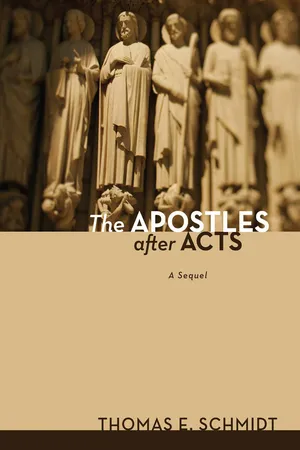
If you could add a book to the Bible, what would it contain? Here is one answer to that question: a "sequel" to Acts, showing the later careers of the Twelve, Paul's final travels before he faces Nero, the commission of the four Gospels, Jerusalem and its temple destroyed, the importance of the family of Jesus, and how close the apostles got to "the ends of the earth" in spreading the gospel. The Apostles after Acts includes a commentary that explains how the text was reconstructed from ancient sources and historical research. Here is a creative approach to the little-known but critical period when the New Testament record stops--and Christianity is just beginning.
Information
Topic
Teología y religiónSubtopic
Estudios bíblicos1
Paul’s Mission to Spain
1In the second book, Theophilus, I wrote about all that the Holy Spirit accomplished from the beginning of the church in Jerusalem, 2how the apostles preached the word of the Lord in many places, from Jerusalem to Rome, and how the number of believers multiplied. 3Now, having seen myself, and also having learned from many eyewitnesses, how the Lord has continued to fulfill his promise to send the word to the ends of the earth, 4I complete my account, trusting that by the truth of these things, the Spirit will make you bold to continue the work that he began through the apostles.
[1–4] Comparison to the prologues in Luke’s Gospel and Acts will reveal similar wording but also some progression. The first two verses summarize the familiar themes of Spirit-guided evangelism, geographic progress, and growth of the church. But now Luke, who is present for many of the key events in this narrative—indeed, perhaps from the beginning of the “we” passages in Acts 161—acknowledges himself as an eyewitness. Furthermore, he cites “many eyewitnesses” to anticipate questions about his reporting on such far-flung events. It is also significant that this prologue ends with a charge to continue the work of the apostles, as if they are past tense—because by AD 75, as we will see, most of them were martyred.
Theophilus, whose name appears in the New Testament only in Luke’s prologues, has not been identified with certainty. He may be a patron who is otherwise unknown, or a pseudonym for someone of influence whose identity Luke wished to protect. Some have suggested the mid-first century high priest Theophilus ben Ananus, who is mentioned by the first-century Jewish historian Josephus (Jewish Antiquities 18.5.3), an identification which may account for some particulars of content, especially the interest in the temple in the early chapters of the Gospel. Other scholars believe that Luke creates a fictional name for his dedication, in which case Theophilus (“lover of God”) is a kind of “everyman” designation meant to apply to any Gentile reader. For the purposes of this narrative, Theophilus is a real character who sponsors Luke’s writing (see chapter 8 below).
5In the seventh year of Nero, when Paul had been preaching the word of the Lord unhindered in Rome for more than a year, Pudens, the son of a senator, heard the word of the Lord from Paul and believed, along with many of his household. 6Pudens brought Paul into his own house, and he welcomed believers there from all over Rome. 7And many more were added to the number of believers because of him.
8When Paul had been in Rome two years, and the Jews from Jerusalem had not yet appeared to accuse him before the emperor, the charges against him were dismissed.
[5] The seventh year of Nero is AD 61, midway through the period most scholars assign to Paul’s Roman imprisonment. Literally the last word in Acts is “unhindered,” a term that occurs only once in the New Testament and makes a strong statement that Paul was completely free to preach. The point is not only to show that Paul’s activity is legal but also that Rome, up to this point, is showing tolerance for Christian missionary activity.
The large role for Pudens in Paul’s last days is plausible for several reasons. He is a biblical character, mentioned among the Romans in Paul’s last letter (2 Tim 4:21). Historically, he is identified as the son of Quintus Cornelius Pudens, a Roman senator. Tradition states that the wife of the elder Pudens, Priscilla, was converted by Peter and provided shelter for him and others. Her family and many Christians were buried in the northeastern part of the ancient city in the catacombs beneath her house, which are preserved today. As chapter 4 will recount, the daughters of Pudens may have continued to aid believers during persecutions. The evidence is strong, therefore, that the family of Pudens was influential in the early Roman church, and it is reasonable to suppose that Pudens himself was able to offer protection to Paul, and to survive himself at least until Nero’s persecution, when tradition states that he was martyred.
Reference to Pudens in 2 Timothy 4:21 introduces the issue of Paul’s authorship of 1–2 Timothy and Titus, the Pastoral Epistles. In chapters 1–5 of this reconstruction, an attempt is made to harmonize Paul’s movements as recorded in Acts with information garnered from these letters, especially the personal details at the end of 2 Timothy. This follows from the assumption stated in the introduction that Paul wrote these letters, or at least the parts of them containing travel details, and that he did so after the events recorded in Acts.2 Those who regard the Pastoral Epistles as forgeries from the late first century will need to put the next few chapters in “square brackets” and either move up the date of Paul’s death or account some other way for the last several years of his life.
[6–7] This is the first of many references in this account to a “house church,” already familiar from Acts (e.g., 2:44–46, 16:11–15, 17:1–9), which usually involved a well-to-do convert providing space for worship, instruction, and sometimes safety.3 The “church” as a separate building was not common until the fourth century.
[8] Roman law required that accusers appear at a trial, and there may have been a two-year statute of limitations for Paul’s opponents to appear in Rome.4 Paul’s release, however, did not constitute his innocence, and he was subject to re-arrest. The supposition here, that Pudens guarantees his return, is a more formal or controlled version of these circumstances.
9Pudens also sent word to the emperor that he would commit to surety for Paul. 10Because Paul had obeyed all the laws of Rome, and because Pudens promised houses and lands to ensure Paul’s appearance at the will of the emperor, Paul was given over to Pudens. 11Immediately Pudens determined to help Paul fulfill his desire to preach in Spain, providing for Paul and those who accompanied him out of his own possessions. 12He sent with Paul as his steward his slave Quintipor, who was a believer. 13Paul summoned Timothy from Ephesus and Titus from Corinth, and he also took with him Urbanus and Stachys from Rome.
[9–10] “Entrustment to surety”5 was a form of confinement in which a prisoner, usually of high rank or importance, was released to the care ...
Table of contents
- Title Page
- Introduction: A Hard Acts to Follow
- The Apostles after Acts
- Chapter 1: Paul’s Mission to Spain
- Chapter 2: Paul Returns to Greece and Asia Minor
- Chapter 3: Nero’s Persecution
- Chapter 4: Paul before Nero
- Chapter 5: Martyrdom of Paul
- Chapter 6: Martyrdom of Peter
- Chapter 7: Simeon Calls the Apostles to Jerusalem
- Chapter 8: The Gospels are Commissioned and Apostles Sent Out
- Chapter 9: The Family of Jesus
- Chapter 10: Martyrdom of Matthias and James Son of Alphaeus
- Chapter 11: Jerusalem and the Temple are Destroyed
- Chapter 12: Simeon Addresses the Delay of Christ’s Coming
- Chapter 13: Apostles Martyred prior to the Council
- Chapter 14: North to Ephesus with John
- Chapter 15: John and Mary Magdalene
- Chapter 16: North to Phrygia with Phillip and Bartholomew
- Chapter 17: Bartholomew Martyred in Armenia
- Chapter 18: West to Macedonia and Achaia with Andrew
- Chapter 19: West across Africa with Simon the Zealot and Jude Son of James
- Chapter 20: Simon and Jude in Britain, Gaul, and Persia
- Chapter 21: South to Alexandria and Axum with Matthew
- Chapter 22: East to India with Thomas
- Chapter 23: Martyrdom of Thomas
- Chapter 24: Luke Concludes His Work
- Appendix: Why Does Acts End with Paul Awaiting Trial?
- Questions for Discussion
- Bibliography
Trusted by 375,005 students
Access to over 1.5 million titles for a fair monthly price.
Study more efficiently using our study tools.
Frequently asked questions
Yes, you can cancel anytime from the Subscription tab in your account settings on the Perlego website. Your subscription will stay active until the end of your current billing period. Learn how to cancel your subscription
No, books cannot be downloaded as external files, such as PDFs, for use outside of Perlego. However, you can download books within the Perlego app for offline reading on mobile or tablet. Learn how to download books offline
Perlego offers two plans: Essential and Complete
- Essential is ideal for learners and professionals who enjoy exploring a wide range of subjects. Access the Essential Library with 800,000+ trusted titles and best-sellers across business, personal growth, and the humanities. Includes unlimited reading time and Standard Read Aloud voice.
- Complete: Perfect for advanced learners and researchers needing full, unrestricted access. Unlock 1.5M+ books across hundreds of subjects, including academic and specialized titles. The Complete Plan also includes advanced features like Premium Read Aloud and Research Assistant.
We are an online textbook subscription service, where you can get access to an entire online library for less than the price of a single book per month. With over 1.5 million books across 990+ topics, we’ve got you covered! Learn about our mission
Look out for the read-aloud symbol on your next book to see if you can listen to it. The read-aloud tool reads text aloud for you, highlighting the text as it is being read. You can pause it, speed it up and slow it down. Learn more about Read Aloud
Yes! You can use the Perlego app on both iOS and Android devices to read anytime, anywhere — even offline. Perfect for commutes or when you’re on the go.
Please note we cannot support devices running on iOS 13 and Android 7 or earlier. Learn more about using the app
Please note we cannot support devices running on iOS 13 and Android 7 or earlier. Learn more about using the app
Yes, you can access The Apostles after Acts by Thomas E. Schmidt in PDF and/or ePUB format, as well as other popular books in Teología y religión & Estudios bíblicos. We have over 1.5 million books available in our catalogue for you to explore.