- 176 pages
- English
- ePUB (mobile friendly)
- Available on iOS & Android
eBook - ePub
About this book
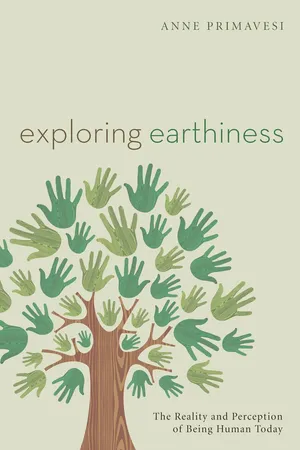
If we see ourselves as Earth rather than Earth as existing for us our perspective is transformed. A variety of religious, philosophical, cultural, and political self-perceptions that dominate our sense of human identity are deeply challenged by this shift in perspective. John Locke's doctrine of Earth as human "property" has been central to current presuppositions about our selves: justified on the grounds of our possessing unique, divinely bestowed, rational abilities. But today, the effects of that doctrine on Earth's resource base and on its other-than-human creatures directly challenge such assumptions. At the same time contemporary scientific findings about the evolution of earthly life demonstrate that while we belong to Earth and nowhere else, Earth does not belong to us. Exploring this role reversal raises fundamental questions about current theological, philosophical, scientific, and economic presuppositions that underpin the "business as usual" viewpoint and human-centered aims of contemporary policies and lifestyles. It takes us beyond hierarchical Christian and philosophical doctrines toward a deeper, Earth-focused and peace-based understanding of what it means to be human today.
Information
Topic
PhilosophySubtopic
Philosophical Metaphysics1
Resourceful Earth
One by one, pillars of classical logic have fallen by the wayside as science progressed in the 20th Century, from Einstein’s realization that measurements of space and time were not absolute but observer-dependent, to quantum mechanics, which not only put fundamental limits to what we can empirically know but also showed that elementary particles and the atoms they form are doing a million seemingly impossible things at once.1
The pillars of classical logic may appear to have fallen into ruins like the Pergamon Frieze. But their mythic and religious strength continues to support a vertical, hierarchical view of our relationship with Earth, seemingly based on our own observations and presuppositions about ourselves. Our measurements of space and time have, it is true, expanded the limits of our knowledge. But this has not, as yet, shattered the human mental categories supporting a vertical vision of our being “in charge” of Earth: whether through divine appointment or by exercising our unique talents.
These latter have now brought us a realization that elementary particles and the atoms they form are not only the very “stuff” of Earth’s body but also the “stuff” of our bodies also. And that just some of the seemingly impossible things they do at once are keeping us firmly balanced on Earth’s surface while enabling us to take in the oxygen we need to breathe and the food (supplied by Earth) that our bodies need to survive. Generally speaking, we take these relationships between Earth and ourselves for granted.
Also taken for granted by most of us nowadays are our evolutionary origins within the planetary community of life. Modern science and technologies enable us to see Earth as a whole; as one cosmic body that, over eons of time, has given life to a diversity of creatures that include ourselves. If asked, we would generally agree that these facts underpin the radical oneness and evolution of earthly life, including our own, from its beginnings to the present day. Our widespread use of the term “globalization” signals an increased appreciation that Earth’s planetary systems have worked and continue to work as a whole in sustaining the lives of its multiplicity of beings.
Now, however, “globalization” also signals our failure to react positively to the implications of these scientific observations by reducing our demands on Earth’s shared resource base. This is the dark side of human “globalizing”: one that requires the reassessment of our own institutions and lifestyles, of their increasing pressure on shared resources and on Earth’s ability to sustain life. Underpinning this dark side is a self-image of humans as “owners” and of these resources as our “property.” This has led to a type of development worldwide in which what is really the common property of all species (the earthly commons) is being appropriated and gradually destroyed by us through the process of accumulating monetary wealth.
Peter Brown exposes the historic European origins of this process:
Since the time of Hesiod and the great grain silos of the Bronze Age, the storage and sale of foodstuffs was an unchanging feature of the landscape of the Mediterranean. What changed significantly in the fourth century AD was the manner in which the tax system of the Roman Empire created a situation in which the rich were able to change food into gold to their great advantage. To sum up a complex development: from Constantine onward, the Roman state flooded the economy with gold. The gold solidus became the symbol of a new order.2
The later progress of this new order, known today as capitalism, will be followed up in some detail in later chapters. An important point made here by Brown is that by the end of the fourth century, a “poverty line” had come to be drawn in the social imagination of contemporary society: between the area of society where the mighty solidus circulated and a bleak social hinterland where the solidus was either absent or difficult to obtain. Translated into today’s monetary terms, this is now the largely accepted and legally endorsed capitalist “life process” of civil and “civilized” societies worldwide. As such, it ignores the internal reality of our social relationships as well as our interactions with the “earthly” commons that, in scientific terms, constitute the planetary resource base below and above land and sea that sustains all earthly life.
The global abuse of those resources now demonstrates that capitalism takes no account of our total dependence on their durability and stability. At the same time, we are beginning to learn their parameters, which scientist Johan Rockström has defined in terms of planetary “boundaries.” Within these (and nowhere else) we (and implicitly, all other creatures) can safely live and operate. They include climate change; ocean acidification; stratospheric ozone; biogeochemical nitrogen; phosphorus inflow to oceans; global freshwater use and the rate at which biological diversity is lost.3 All of these contribute to and are essential for earthly life, including our own. Together, they are the common property of all life on Earth.
These boundaries that make life sustainable are set by the very nature of the Earth itself. However, they have been and are being broken through by us, most clearly by human population growth. This, together with our increasing consumption and consequent depletion of resources, has reached a level where not only our own future, but that of all life on Earth depends on a commitment from us to decrease our overuse of them. Rockström’s scientific overview keeps many different projects in play; but the important point here is the fact that evolution by natural selection is a property of the whole planet, not just of its organisms alone: and certainly not of our species alone. This raises fundamental questions about the planetary nature and impact of our lives and lifestyles, questioning the motivations behind them and justifications for them.
These are questions that the natural sciences traditionally ignore. So scientific acceptance of this planetary overview is not enough to change attitudes, important and informative as it may be. On its own, it may even obscure the need for radical change in all of us and fail to challenge the presuppositions behind the “business as usual” and “at all costs” conduct of major world economies. To a very limited extent, the visible effects of passing one planetary boundary, that of climate change, have begun to influence global political and economic policies. But prevailing cultural norms, implicitly supported by pervasive mental and religious categories, ensure that we remain almost impervious to its practical and personal demands on us.
One important reason for this is that, like the Romanized Christian Empire, we regard all Earth’s resources as potential sources of increased monetary wealth. This conviction is all the more powerful for now being implicit. As is its underlying assumption that, as a species, we are in a superior and therefore different category to all others. A corollary to that is the assumption that all other species and our shared resource base are there primarily to serve us and our “special” interests. This claim to superiority through species’ distinctiveness is now generally based on perceptions of our intellectual capacities and our ability to use them to our own individual and collective advantage.
Reactions to the NGO Earth Charter showed that such a claim, although usually unquestioned, is bolstered culturally and religiously by the assumption that the faculty of reason and/or the possession of an immortal soul have been given to our species alone. So while our belonging to Earth in the same way as all other earthly creatures is an obvious fact at one level, our fundamental earthly oneness with them has been sidelined by analyzing it into a vertical value system.
According to this system, no less effective for being tacit, while some species are rated higher than others, we deem ourselves highest of all. Those “below” us are graded according to their usefulness to us. Lowest of all are those that inhabit the soil. Underpinning this hierarchical categorization are two presuppositions that work to the advantage of those distinguished by financial, religious, or political power. The first is that each subordinate level is not to be valued for its own sake but only in terms of its usefulness to those above it on the hierarchical scale. The second is that relationships of domination and subordination are written into human nature.
In regard to us, these presuppositions function on the basis of race, gender, wealth, and creed. In regard to other species, it means we rate them practically and economically; that is, in terms of what monetary return we may make from or with them, generally through global industrialized processes. It is taken for granted that Earth itself and its resources exist for the sake of those of us who, through economic, political, or military force, may appropriate and claim them as property: that is, with an entitlement to use them for financial wealth.
In Christian cultures, God is at the apex of this hierarchical pyramid, indeed is deemed its Creator. Earth and all other-than-human species form its base and are, therefore, assumed to be furthest from God. By definition, angels are bodiless and so closest to God. But as “earth-embodied souls,” we deem ourselves next closest to “Him”; on the grounds that our souls make us “like to God.” While the average churchgoer today would not use the term “paradigmatic” for this self-assessment, its religious and philosophical underpinnings have shaped and informed public and private ways of integrating different aspects of our lives into a coherent whole. Its verticality both validates and maintains a privileged place for us—or rather, for some of us—within specific social and economic systems “sanctified” as the proper political or economic order.4
Politically and economically this has functioned as a territorial claim: that Earth and its resources exist for a nation’s use and for the financial benefit of individuals. Or, in contemporary Western economic doctrines, for the particular use and benefit of some “high-net-worth individuals” with liquid assets over a certain sum. This hierarchical presupposition is exemplified in industries built on slave labor where—in fields, mines, and factories—human beings continue to be treated like “dirt”; that is, as another resource base. Such assumptions are so deeply ingrained in the class systems of Western culture that they are taken for granted: without the need to appeal to their philosophical or religious underpinnings. This means that any recognition of our true oneness and interconnectedness, and consequent positive responses to it, have to be learned, understood, accepted, and assimilated within the different levels of our individual and collective existence.
To that end, I shall designate Earthiness as Oneness, defining it as a material, shared global state of being alive; with all life being supported by planetary resources held in common. This distinguishes it from Platonic discourse about “the One” which implies a complete lack of such physical multiplicity in that it infers a level of unity beyond that of any earthly body. In effect, this has been the intellectual basis for and the goal of a thought system that acknowledges a principle of unity beyond the earthy or physical. That is the literal meaning of the term metaphysical. Plato focused attention on this realm: one be...
Table of contents
- Title Page
- Acknowledgments
- Foreword
- Preface
- Chapter 1: Resourceful Earth
- Chapter 2: Disdained Earth
- Chapter 3: Appropriated Earth
- Chapter 4: Reformed Earth
- Chapter 5: Classical Earth
- Chapter 6: Colonized Earth
- Chapter 7: Monetized Earth
- Chapter 8: Devalued Earth
- Chapter 9: Marketized Earth
- Chapter 10: Peaceable Earth
- Chapter 11: One Earth
- Chapter 12: Living Earth
- Afterword
- Appendix 1
- Appendix 2
- Bibliography
Trusted by 375,005 students
Access to over 1.5 million titles for a fair monthly price.
Study more efficiently using our study tools.
Frequently asked questions
Yes, you can cancel anytime from the Subscription tab in your account settings on the Perlego website. Your subscription will stay active until the end of your current billing period. Learn how to cancel your subscription
No, books cannot be downloaded as external files, such as PDFs, for use outside of Perlego. However, you can download books within the Perlego app for offline reading on mobile or tablet. Learn how to download books offline
Perlego offers two plans: Essential and Complete
- Essential is ideal for learners and professionals who enjoy exploring a wide range of subjects. Access the Essential Library with 800,000+ trusted titles and best-sellers across business, personal growth, and the humanities. Includes unlimited reading time and Standard Read Aloud voice.
- Complete: Perfect for advanced learners and researchers needing full, unrestricted access. Unlock 1.5M+ books across hundreds of subjects, including academic and specialized titles. The Complete Plan also includes advanced features like Premium Read Aloud and Research Assistant.
We are an online textbook subscription service, where you can get access to an entire online library for less than the price of a single book per month. With over 1.5 million books across 990+ topics, we’ve got you covered! Learn about our mission
Look out for the read-aloud symbol on your next book to see if you can listen to it. The read-aloud tool reads text aloud for you, highlighting the text as it is being read. You can pause it, speed it up and slow it down. Learn more about Read Aloud
Yes! You can use the Perlego app on both iOS and Android devices to read anytime, anywhere — even offline. Perfect for commutes or when you’re on the go.
Please note we cannot support devices running on iOS 13 and Android 7 or earlier. Learn more about using the app
Please note we cannot support devices running on iOS 13 and Android 7 or earlier. Learn more about using the app
Yes, you can access Exploring Earthiness by Anne Primavesi in PDF and/or ePUB format, as well as other popular books in Philosophy & Philosophical Metaphysics. We have over 1.5 million books available in our catalogue for you to explore.