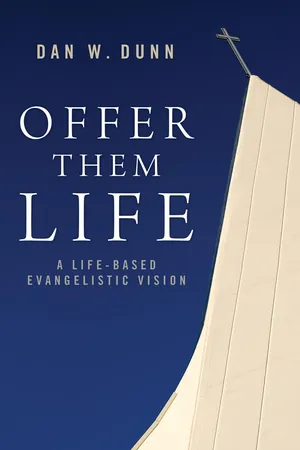
- 168 pages
- English
- ePUB (mobile friendly)
- Available on iOS & Android
eBook - ePub
About this book
In this book Dan Dunn proposes that the biblical theme of life is extremely important and thus provides a helpful foundation for the theory and practice of evangelism. He makes a strong case for Christ-followers to embrace a life-based evangelistic vision as a way to help non-believers choose the full and vibrant life that God intends for them in Jesus. While making this strong case, he also urges readers to avoid casting aside other evangelistic visions (such as those based on discipleship, the kingdom, forgiveness, atonement, etc.). Instead, he invites us to add a life-based evangelistic vision to the possibilities available to us for helping people choose to follow Jesus and thus experience the life He makes possible for them.
Information
Topic
Theology & ReligionSubtopic
Christian Ministry1
Premise and Purpose of This Exploration of a Life-Based Evangelistic Vision
Premise
Life may be viewed as one of the primary themes of the Bible, and as such provides a helpful foundation for the theory and practice of evangelism in the U.S. American context.1
Joseph Dongell proposes that full life be viewed as the macro rubric of Scripture. God is fundamentally the living God (as distinct from other descriptions, such as holy, powerful, or loving). God is vitally alive, and in Christ, God wishes to share this vital experience of life with all of God’s creation, including human beings.2 Hans Klein shares a similar perspective. He contends that the biblical material should be ordered and understood in relation to life (Old Testament) and new life (New Testament).3
The nature of the life that Christ offers his followers has vital implications for evangelism. What is the good news that Christians share with non-Christians, and what kind of new life do they invite non-Christians to embrace?4 George Hunter tells of a young man who once admitted that he believed in Jesus but had never invited him to be the leader of his life. Hunter asked why this was so, and the young man answered that he had learned in his hometown that opening up to Jesus would result in his becoming some kind of fanatic. Hunter replied, “Look, it just isn’t so, and somebody back home once sold you a tragic bill of goods. If you could look into the future and see the man that Christ has in mind for you to be ten years from now, you would stand up and cheer and you would deeply want to be that man. The gospel is not bad news; it is good news. The gospel is congruent with our deepest aspirations for ourselves.”5
I propose that God created the earth, its animal and plant life, and human beings to experience full, vibrant, vital life in relationship with God and one another, and that this experience of life is what God both makes possible and invites us to embrace in following Jesus Christ. This full life that God offers in Christ is the cornerstone of the good news, and offers a valuable foundation for the theory and practice of evangelism.6
Two perspectives underlie the current practice of evangelism in the U.S. American context. The first is one’s understanding of eternal life. The second is basing evangelism on the concept of kingdom.
First Perspective: Understanding of Eternal Life
An important issue in this discussion is our understanding of eternal life. In common Christian usage, eternal refers to chronological time (forever), so that those who believe in Jesus will live with him throughout eternity after physical death. However, the biblical understanding of eternal life is more than chronological eternity; it also includes a fullness and vitality of life here on this earth. Commenting on John’s use of the Greek word for life (zōe), one author says that “in most cases it states expressly that the follower of Jesus possesses life even in this world.”7 Rudolf Bultmann agrees. Commenting on a Greek verb cognate of life (zaō) in relation to its use in John’s Gospel, he writes that “he who believes has already passed from death to life.”8 C. H. Dodd shares this perspective, claiming that John offered an addition to the usual Jewish eschatological understanding, so that our post-resurrection life begins not after our resurrection, but rather as a result of our believing in Jesus. Commenting on the Lazarus story, he writes that “the ‘resurrection’ of which Jesus has spoken is something which may take place before bodily death, and has for its result the possession of eternal life here and now.”9 We see, therefore, that the concept of eternal life includes a life-now dimension as well as a life-then dimension.
If life in Christ is understood primarily in terms of where (or if) we will live during chronological eternity, the focus of evangelism leans toward preparation for life after death. One example of this emphasis is found in the ministry of Evangelism Explosion. In the Evangelism Explosion training material, the two diagnostic questions recommended for Christians to use in witnessing focus on whether the non-Christian will go to heaven. The first question is: “Have you come to a place in your spiritual life where you know for certain that if you were to die today you would go to heaven, or is that something you would say you’re still working on?”10 The second question asks: “Suppose you were to die today and stand before God and He were to say to you, ‘Why should I let you into My heaven?’ What would you say?”11 This focus continues in the section describing the essential gospel to be shared, which is summarized as follows: Heaven is a free gift; it is not earned or deserved; people are sinners and cannot save themselves; God is both merciful and just, so God came down into human flesh, died on the cross and rose from the dead to pay the penalty for our sins and to purchase a place in heaven for us.12 Of particular note is the statement that “the whole Bible is about one great transaction . . . By His grace He freely offers to give to us this gift of heaven.”13
This strong emphasis on the everlasting nature of the life that Christ makes possible for us in heaven is an appropriate focus for the theory and practice of evangelism. Christians should be motivated by a strong interest in helping persons live forever with Christ, and ministries that are effective in sharing this dimension of the gospel are to be encouraged. This is especially true of ministries that have a strong follow-up process to help new believers move from the getting-to-heaven focus toward a focus on a thriving life of discipleship. In this regard, one may agree with George Sweazey, who notes that as long as a congregation is effective in helping Christians grow in their experience of the many dimensions of life in God’s grace, they “can safely make their first appeal through just one aspect of the gospel.”14 Some congregations, however, may find it difficult to make their discipleship and follow-up ministries broader than their evangelism ministries. The dimension(s) of the gospel on which they focus in their evangelism may tend(s) to be the dimension(s) that take(s) precedence in the rest of their ministries.15
Evangelism in the U.S. American context, therefore, should not limit itself to the heavenly dimension of the good news of Jesus Christ. This is especially true when one considers that Christian evangelizing must attend to questions and issues that people are actually addressing, rather than those that Christians think they are (or should be) addressing.16 It is here that a stronger emphasis on the biblical theme of life can inform evangelistic efforts, for people today have far more interest in whether they can experience life now than in whether (or where) they will live for chronological eternity.17
Some of the questions we should attend to in evangelistic theory and practice are:
• In what ways are people seeking life today?
• How much does their battle against death take away from their experience of full life?
• If we assume that they are seeking life, do we make a corollary assumption that their daily experience is more akin to death?
• If so, who or what are the “thieves” that are trying to steal and kill and destroy their lives (based on the language of John 10:10)?
Christians, therefore, must continually discern ways of thinking about and practicing evangelism that honor the strong biblical theme that God wants God’s created humanity to experience life fully (abundantly, according to John 10:10), on this earth, prior to physical death.
When evangelism deals with sin, for example, mutual emphasis could be given to the life-forever benefits of being forgiven through Christ (e.g., access to heaven) and to the life-now benefits of Christ’s forgiveness (e.g., freedom from bondage).18 Likewise, evangelism could endeavor to discover appropriate means for expressing how deeply God is for humanity while at the same time honoring that God is against sin. Similarly, repentance could be accentuated as an important dimension of “getting right with God” in order to prepare oneself for life in the hereafter, but it could also be stressed as a contributing factor to reconciliation and full enjoyment of relationships with people here on earth. The same point could be illustrated in relation to other theological conc...
Table of contents
- Title Page
- Preface
- Chapter 1: Premise and Purpose of This Exploration of a Life-Based Evangelistic Vision
- Chapter 2: Theological Foundation More Fully Developed
- Chapter 3: Old Testament Exploration of the Life Theme
- Chapter 4: The Concept of Life in John’s Gospel
- Chapter 5: Theological Insights Regarding the Life Theme
- Chapter 6: Eight Important Themes
- Chapter 7: What I Learned from Christ-Followers in Local Congregations
- Chapter 8: The Beginning Contours of a Life-Based Evangelistic Vision
- Final Thoughts
- Bibliography
Trusted by 375,005 students
Access to over 1.5 million titles for a fair monthly price.
Study more efficiently using our study tools.
Frequently asked questions
Yes, you can cancel anytime from the Subscription tab in your account settings on the Perlego website. Your subscription will stay active until the end of your current billing period. Learn how to cancel your subscription
No, books cannot be downloaded as external files, such as PDFs, for use outside of Perlego. However, you can download books within the Perlego app for offline reading on mobile or tablet. Learn how to download books offline
Perlego offers two plans: Essential and Complete
- Essential is ideal for learners and professionals who enjoy exploring a wide range of subjects. Access the Essential Library with 800,000+ trusted titles and best-sellers across business, personal growth, and the humanities. Includes unlimited reading time and Standard Read Aloud voice.
- Complete: Perfect for advanced learners and researchers needing full, unrestricted access. Unlock 1.5M+ books across hundreds of subjects, including academic and specialized titles. The Complete Plan also includes advanced features like Premium Read Aloud and Research Assistant.
We are an online textbook subscription service, where you can get access to an entire online library for less than the price of a single book per month. With over 1.5 million books across 990+ topics, we’ve got you covered! Learn about our mission
Look out for the read-aloud symbol on your next book to see if you can listen to it. The read-aloud tool reads text aloud for you, highlighting the text as it is being read. You can pause it, speed it up and slow it down. Learn more about Read Aloud
Yes! You can use the Perlego app on both iOS and Android devices to read anytime, anywhere — even offline. Perfect for commutes or when you’re on the go.
Please note we cannot support devices running on iOS 13 and Android 7 or earlier. Learn more about using the app
Please note we cannot support devices running on iOS 13 and Android 7 or earlier. Learn more about using the app
Yes, you can access Offer Them Life by Dan W. Dunn in PDF and/or ePUB format, as well as other popular books in Theology & Religion & Christian Ministry. We have over 1.5 million books available in our catalogue for you to explore.