eBook - ePub
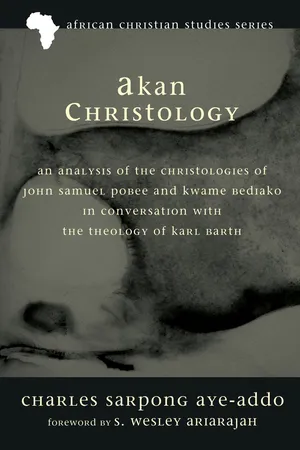
Akan Christology
An Analysis of the Christologies of John Samuel Pobee and Kwame Bediako in Conversation with the Theology of Karl Barth
- 238 pages
- English
- ePUB (mobile friendly)
- Available on iOS & Android
eBook - ePub
Akan Christology
An Analysis of the Christologies of John Samuel Pobee and Kwame Bediako in Conversation with the Theology of Karl Barth
About this book
As Christianity expands and grows in Africa, there is deep new interest in African theology in general, and the way in which some African theologians are interpreting the significance of Christ within African culture, in particular. This volume explores the Christology of two of the foremost African thinkers against the background of the West African Akan culture. The result is a rare and fascinating look at some of the key cultural symbols of African culture, the struggle to reinterpret the "white, blond, blue-eyed Christ" presented by pioneering missionaries to Africa, and the pitfalls and promises that attend the exercise. The selected theologians, John Samuel Pobee and Kwame Bediako, are put into a critical conversation with Karl Barth in order to initiate a dialogue between Western theology and African theology that brings to the fore some of the pertinent issues about the particularity and universality of Christ. The volume, while seeking to make Christ relevant for Africa, moves away from romanticizing African culture and insists on being faithful to the biblical witness to Christ. The result is an attempt to present an engaging piece of work that makes a significant contribution to contemporary debates on Christology and indigenous theology.
Information
Topic
Theology & ReligionSubtopic
Christian Theology1
Akan Cosmology
Cultural anthropologists classify the indigenous people of the West African nation of Ghana into five main groups on the basis of language, culture and geographical location. These groups are the Akan, the Ewe, the Ga-Adangbe, the Guan and the Mole-Dagbani. The Akan group, which this dissertation seeks to study, occupies most of the whole of the south and west of the Black Volta of Ghana. Historically, the Akan group migrated from the north to occupy the forest and coastal belt of the south in the thirteenth century. Some of the Akan ended up in the eastern section of Côte d’Ivoire, where they created the Baule community.
The history of the Akan-speaking people of southern Ghana dates back to the 1600s.1 Much of what we know about ancient Akan customs comes to us in the form of oral histories that have survived for several hundred years. Many of the objects recovered in archaeological studies are still produced in modified form by the Akan peoples today. The rise of the early Akan centralized states can be traced to the thirteenth century and it is likely to be related to the opening of trade routes established to move gold throughout the region.
It was not until the end of the seventeenth century, however, that the grand Asante Kingdom2 emerged in the central forest region of Ghana, when several small states united under the Chief of Kumasi, in a move to achieve political freedom from the Denkyira.3 Apart from the Asante, other Akan groups are the Akwapim in the southeastern part of Ghana, the Akyem and the Kwahu in the eastern part, and the Fante in the central regions of Ghana. The Akan constitutes about half the population of Ghana and their dialects includes Fante (fanti, mfantse) Akuapem (akwapem twi, twi, akuapim, akwapi) Asante (ashante twi, twi, asanti, achanti) Agona, Dankyira, Asen, Akyem bosome, Kwawu, and Ahafo. Benjamin Ray, a scholar and writer on African Religions, in his book, African Religions: Symbol, Ritual and Community, chimes that there are many regional similarities in the cultural and religious lives of Africans. He maintains that:
The Baganda, Banyoro, Banyankole, Bayamwezi, and Banyarwanda of Uganda, Tanzania and Rwanda who live around the Lake Region of East Africa speak closely related languages and share a great many cultural and religious institutions, spirit medium, and kingship among them. The same is true for the Akan peoples of Ghana, even though they are divided into subgroups, such as the Akim, Asante, Fante, Akuapem, Kwahu, Bono and others...they all see themselves as belonging to a broader cultural heritage.4
The Akan people share a common religious heritage generally made up of Christianity, Islam, and Traditional Religion. A minimal percent adhere to Hinduism, Buddhism, Eckankar, Baha’i Faith and others. In addition, to this day, they share the common experience of the consequences of European exploitation, expansionism, colonialism, and slavery. John Mbiti, a leading African theologian, points out that Akans, like all other indigenous Africans, are “notoriously religious.”5 Kofi Opoku Asare, a Senior Research Fellow in the Religion and Ethics Department of the Institute of African Studies at the University of Ghana, Accra, concurs with the statement, and holds that “religion is at the root of African culture and is the determining principle of African life.”6 Another Ghanaian theologian, currently the dean of the Regent Divinity of the Regent University College of Science and Technology, Accra, Ghana, shares analogous sentiments when he stresses the point that “at the heart of the African past is her religion and therefore any meaningful study of the African past must necessarily start with her Indigenous Religion.”7
As we explore the works of these theologians and religionists, we may see some discrepancies in their thoughts. Such differences do not in any way devalue what they present as African thought and philosophy. Rather, it reveals the problem of not having a sacred text, like the Christian Bible or the Muslim Qur’an that set some authoritative boundaries for the explication of the faith. It also shows the inefficiencies related to the absolute dependence on Oral Tradition for the transmission of faith from one generation to another. However, it may be noted, and even be argued, that the overall thought patterns of these writers are, to a large extent, compatible. We would not, however, engage in a critical assessment of their thoughts, because the purpose of this chapter is not to critically analyze the thoughts of different theologians, but to give a synoptic description of some of the main concepts that are central to African religion.
Thus, our concern here is not to justify or glorify African thought, culture and religion. The purpose of this chapter is similar to what Bolaji Idowu, a Professor of Religious Studies in the University of Ibadan, Nigeria, pointed out in the preamble of his book, African Traditional Religion—A Definition: “ . . . to discover what Africans actually know, actually believe, and actually think about Deity and the supersensible world.”8 African Religion has not received an objective assessment from most of the Western missionaries and Christian investigators. This is mainly because their approach to African Traditional Religion was influenced by their attempts to Christianize the indigenous people. The recurrent negative approach to African Religion by Western missionary scholars is pointed out by many African scholars today. For instance, in Quarcoopome’s volume on West African Traditional Religion, he exposes the continuous use of derogatory terminologies such as “primitive, paganism, fetishism, animism, idolatry and polytheism” in designating the Traditional Religion.9
In this section an attempt is made to give a description of Akan traditional concepts that constitutes the Akan Traditional Religion as understood by the Akan theologians we would engage in this dissertation and, indeed, by most African theologians. We shall examine the mythological concepts and explicate how they inform the Akan belief in the Supreme Being who is celebrated as the Creator with all the attributes that go with his supremacy. We shall also study the concepts related to the nature of the universe. Subsequent sections endeavor to elucidate how certain concepts such as spirits, divinities, the living-dead, the powers of evil related to witchcraft, sorcery and magic etc. operate in African Religion. Also of significance is the role of medicine-men who function in their various capacities within the spiritual universe of the Akan.
The Akan believes that the phenomenal world does not exist without the dictating forces of the unseen, intangible, and indestructible world of mystical forces and powers. This will give us the opportunity to understand who the ancestors are and what roles they play in their new unseen, spiritual world. The exploration will be done with religious writing authorities such as Geoffrey Parrinder, Benjamin C. Ray, Bolaji Idowu, T. N. O. Quarcoopome, John Mbiti, and Kofi Asare Opoku. These theologians and religionists have written extensive works on African Traditional Religion over a long period of time.
Under the general heading—the power of evil, we will discuss the effects of witchcraft, sorcery and magic as they relate to the progress of the victims and how traditional religion is able to combat such evil practices. This discussion, among others, will augur well to find a Christology that can deal with such people with evil powers who have such ability to manipulate mystical forces to maim and kill fellow human beings. On the discussions of medicine-men, an attempt will be made to portray their effects as the unorthodox medical personnel and more importantly the deliverers and exorcists of the communities in which they reside.
We hope that this discussion will help us gain a fair understanding of the “spiritual universe”10 o...
Table of contents
- Title Page
- Foreword
- Preface
- Acknowledgments
- Introduction
- Chapter 1: Akan Cosmology
- Chapter 2: Akan Christologies—John Samuel Pobee and Kwame Bediako
- Chapter 3: A Theological Conversation with Karl Barth
- Chapter 4: Conclusion: Towards an Akan Christology
- Appendix A: The “No!” and “Yes!”—To Jesus Christ as Ancestor
- Bibliography
- Index
Trusted by 375,005 students
Access to over 1.5 million titles for a fair monthly price.
Study more efficiently using our study tools.
Frequently asked questions
Yes, you can cancel anytime from the Subscription tab in your account settings on the Perlego website. Your subscription will stay active until the end of your current billing period. Learn how to cancel your subscription
No, books cannot be downloaded as external files, such as PDFs, for use outside of Perlego. However, you can download books within the Perlego app for offline reading on mobile or tablet. Learn how to download books offline
Perlego offers two plans: Essential and Complete
- Essential is ideal for learners and professionals who enjoy exploring a wide range of subjects. Access the Essential Library with 800,000+ trusted titles and best-sellers across business, personal growth, and the humanities. Includes unlimited reading time and Standard Read Aloud voice.
- Complete: Perfect for advanced learners and researchers needing full, unrestricted access. Unlock 1.5M+ books across hundreds of subjects, including academic and specialized titles. The Complete Plan also includes advanced features like Premium Read Aloud and Research Assistant.
We are an online textbook subscription service, where you can get access to an entire online library for less than the price of a single book per month. With over 1.5 million books across 990+ topics, we’ve got you covered! Learn about our mission
Look out for the read-aloud symbol on your next book to see if you can listen to it. The read-aloud tool reads text aloud for you, highlighting the text as it is being read. You can pause it, speed it up and slow it down. Learn more about Read Aloud
Yes! You can use the Perlego app on both iOS and Android devices to read anytime, anywhere — even offline. Perfect for commutes or when you’re on the go.
Please note we cannot support devices running on iOS 13 and Android 7 or earlier. Learn more about using the app
Please note we cannot support devices running on iOS 13 and Android 7 or earlier. Learn more about using the app
Yes, you can access Akan Christology by Charles Sarpong Aye-Addo in PDF and/or ePUB format, as well as other popular books in Theology & Religion & Christian Theology. We have over 1.5 million books available in our catalogue for you to explore.