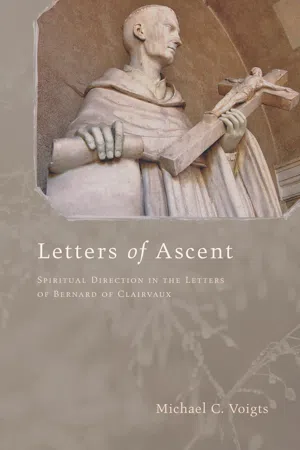
eBook - ePub
Letters of Ascent
Spiritual Direction in the Letters of Bernard of Clairvaux
- 190 pages
- English
- ePUB (mobile friendly)
- Available on iOS & Android
eBook - ePub
About this book
Bernard of Clairvaux is best known by many today for his mystical approach to spirituality and his eloquent sermons on the Song of Songs. In his letters, however, a different Bernard emerges--one who had fled the world for the cloister yet possessed a soaring vision for the Church on earth. By examining select letters and placing them in the larger context of the people and the world around him, we discover a man who loved the Church--but who realized that the Church is comprised of individuals who did not share his ideals and agendas. In Letters of Ascent, we travel to medieval Europe and view society through the eyes of one of history's most passionate ecclesiastical reformers.
Information
Topic
Theology & ReligionSubtopic
Christian TheologyChapter 1
Bernard of Clairvaux in the Twelfth-Century World
Spiritual direction involves two willing participants: a director and a person or persons being directed. It happens more in the reality of life than in esoteric statements in books worth quoting from generation to generation. To understand Bernard of Clairvaux as a spiritual director, a basic understanding of the real Bernard set in time and culture is necessary. Modern readers have very little in common with medieval Europeans; their language, worldview, culture, politics, and economics are foreign to us. Other than an understanding of God, we share with medievals only our human identity. To set in context the spiritual direction Bernard offers in his letters, we must first explore Bernard in the twelfth-century European world.
Bernard as a Child of the church
Some individuals are born before their time. These unique people find themselves in a culture unprepared for their ideas, technological or scientific insights, or philosophical theories. Peter Abelard, the twelfth-century philosopher and theologian, was one of these people. Peter’s contemporary, Bernard of Clairvaux, was not. Bernard de Fontaines (1090–1153) entered a Europe and an ecclesiastical system perfectly suited for him.1 The Roman church was flourishing, medieval European culture was entering the high point in its history, and scholasticism had begun to have its own place in theological debates. This medieval renaissance did not arrive without tension, however, but was full of controversy and occasional violence.
Under the Gregorian Reform of the eleventh century, monasticism was ripe for renewal. The establishment by Pope Gregory VII of an over-arching papal control structure for the church was based, in part, on a supposed rediscovery of the Donation of Constantine, a document purported to demonstrate that a centralized papal authority was an ancient tradition. This centralized power transformed the role of the pope from that of a delegating authority to a ruler involved in the many details of governing a multinational society. While the Gregorian popes enjoyed this new dominance in worldly affairs, it did not come without a price. They now had to endure the daily traffic and long speeches of litigants who each believed their issue was of the utmost importance. As R. W. Southern states, the popes became prisoners of their own machine.2 Gregory wanted more centralized control, and he received it, along with the detailed and miniscule litigation that came with it. Nevertheless, the benefits of papal control outweighed the administrative frustrations. For example, the threat of excommunication was, in these early years of reform, a powerful political tool in a highly superstitious society, as in the excommunication of King Henry IV of Germany.3 Nearly everyone, from the religious to the peasantry, feared the wrath of God in the world to come. Since the clerics wielded control over laity by claiming to be God’s representatives on earth, church leaders wielded considerable power, forcing both king and layperson alike into submission in order to garnish God’s good favor. This supposed freedom from the secular authorities gave the church the enviable position of becoming the dominant force in society as a whole.
European medieval culture lagged behind Byzantium in orderliness, sophistication, and administrative structure. In the East, a unified currency, salaried administrative rulers, and centralized justice provided a greater stability than the Western culture of military allegiances and power, fluctuating church support, and multi-nationalism. Visitors to Constantinople often commented on the dazzling decorative displays of the courts and dress of the rulers. In Europe, the strength of one’s army or number of serfs, not one’s opulence, demonstrated power and authority. Not until European exploration of Byzantium, particularly during the Crusading period, did the nobility of Europe focus their efforts on ornate décor in dress and architecture.
The tenth and eleventh centuries were periods of political maneuvering throughout Europe. In France, the great fiefs of Normandy, Brittany, Flanders, and Burgundy began to take shape, joining Aquitaine as independent nations with their own distinct cultures and customs. These feudal states, ruled by powerful families, became larger and more powerful through strategic political alliances, marriages, and military conquests. In 1066, Normandy became the most powerful state when Duke William added England to his land possessions. In the Holy Roman Empire kings found it difficult to keep order and peace within the kingdom and to keep the pagan nations to the north and east at bay.
This period in the history of the West was an age of experimentation, tolerance, monastic expansion, and enterprise. It has also been called one of the most significant periods both socially and theologically in the history of Christianity.4 Monastic expansion in spirituality, politics, and finance fueled an already expanding economy. This monastic growth was supported by secular society, as benefactors gave their lands for the development of new monasteries. These donors desired the cultivation, safekeeping, and management of their lands that monastic foundations offered, and the prayers of the monks on behalf of their patrons offered a sense of eternal security.
Western Europe was experiencing for the first time a significant growth of cities, commerce, and the development of the burghers. Cistercian monastic establishments on the frontiers of Europe expanded useable lands and territories, opening new areas for civilization. The acceptance of profit-making ushered a new understanding of trade to the medieval world. Monasticism, too, was experiencing the benefits of the accumulation of wealth. The issues of capital, expansion, and commerce became a focus in all strata of society. Western Europe in the early twelfth century was in many ways the pinnacle of the medieval West. Some have even referred to this prosperity and interest in new ideas the so-called “twelfth-century renaissance.”5
Not since the days of Charlemagne had Europe been as politically or financially stable as in the early twelfth century. Great conquesting campaigns were over, and the nobility, peasants, and ecclesiastical leaders desired to take advantage of the expanding economic growth of the period. Despite the positive aspects of this growth and expansion of Europe, however, both the church and temporal society needed restraint and spiritual grounding. They found these qualities in Bernard of Clairvaux.
Most scholars place his birth in 1090 at his father’s estate in Burgundy, a beautiful chateau on a hill overlooking the city of Dijon. He was the middle child in a family of seven children. From all accounts, his parents lived a pious life, faithful to the church. According to the Vita Prima, his father, Tescelin, came from a long established military family. Although Tescelin was a respected member of the lower nobility throughout Burgundy, most of Bernard’s later political connections seemed to come from the family of his mother, Aleth. Although his brothers seemed to delight in training for a knightly occupation like their father, Bernard was more comfortable with books and clearly had a deep affection for his mother. From all accounts, her death, when Bernard was a teenager, had a profound influence on his life.
The story of Bernard, along with thirty members of his family and extended relatives, bypassing the respectable and comfortable Cluny for the struggling and austere Citeaux is well known. How Bernard was able to inspire the others to join him at Citeaux is an example of this man’s will and charisma. Overlooking the city of Dijon, the family’s hilltop home provided security and twelfth-century comfort for young Bernard and his family. That his brothers and he were expected to assume their places in society was no obstacle to the young nobleman. By his pure will and passion, and through his recruiting of others to join him at Citeaux, Bernard demonstrated his ability to inspire others to abandon their personal desires for his agenda. Already at an early age, Bernard was well aware of this personal charism, and he knew how to use it.6
Some have described Bernard as a tall, skeletal person with light golden hair and a reddish beard. He had a peaceful intensity about him that caused others, even those who opposed him, to pause in awe when he entered a room. He also suffered from severe physical maladies from his youth, including headaches and digestive disorders, which regressed to a point at which he could scarcely eat anything at all.7
The Zeal for Reform
Whether or not Citeaux would have closed had not Bernard and his companions arrived is an open question. We know that before the Burgundians arrived Abbot Stephen Harding and the others had questioned their future. The fledgling Cistercian Order began in 1098 as an attempt to regain strict interpretation of both the order and discipline of Benedict’s monastic Rule. Their harsh lifestyle and lack of sophisticated accommodations caused several of these reforming monks to succumb to illness and starvation. Some evidence exists that the arrival of Bernard with his band of men to Citeaux did not save the monastery from extinction but provided the means for the Cistercians to expand to new foundations.8 Regardless of the situation, the revitalization of Citeaux with the admission of the new converts provided Stephen with a healthy opportunity to expand the small order in 1113.
Stephen, impressed by both the determination of the young Bernard to live a life in complete submission ...
Table of contents
- Title Page
- Acknowledgments
- Chapter 1: Bernard of Clairvaux in the Twelfth-Century World
- Chapter 2: Bernard and the Direction of Souls
- Chapter 3: An Introduction to the Letters of Bernard
- Chapter 4: The Letters of Bernard to Monks
- Chapter 5: The Letters of Bernard to Abbots
- Chapter 6: The Letters of Bernard to Bishops
- Chapter 7: The Letters of Bernard to Popes
- Chapter 8: The Letters of Bernard to Laity
- Chapter 9: Bernard’s Letters as a Methodology for Twelfth-Century Ecclesiastical Reform
- Abbreviations for the Works of Bernard of Clairvaux
- Bibliography
Trusted by 375,005 students
Access to over 1.5 million titles for a fair monthly price.
Study more efficiently using our study tools.
Frequently asked questions
Yes, you can cancel anytime from the Subscription tab in your account settings on the Perlego website. Your subscription will stay active until the end of your current billing period. Learn how to cancel your subscription
No, books cannot be downloaded as external files, such as PDFs, for use outside of Perlego. However, you can download books within the Perlego app for offline reading on mobile or tablet. Learn how to download books offline
Perlego offers two plans: Essential and Complete
- Essential is ideal for learners and professionals who enjoy exploring a wide range of subjects. Access the Essential Library with 800,000+ trusted titles and best-sellers across business, personal growth, and the humanities. Includes unlimited reading time and Standard Read Aloud voice.
- Complete: Perfect for advanced learners and researchers needing full, unrestricted access. Unlock 1.5M+ books across hundreds of subjects, including academic and specialized titles. The Complete Plan also includes advanced features like Premium Read Aloud and Research Assistant.
We are an online textbook subscription service, where you can get access to an entire online library for less than the price of a single book per month. With over 1.5 million books across 990+ topics, we’ve got you covered! Learn about our mission
Look out for the read-aloud symbol on your next book to see if you can listen to it. The read-aloud tool reads text aloud for you, highlighting the text as it is being read. You can pause it, speed it up and slow it down. Learn more about Read Aloud
Yes! You can use the Perlego app on both iOS and Android devices to read anytime, anywhere — even offline. Perfect for commutes or when you’re on the go.
Please note we cannot support devices running on iOS 13 and Android 7 or earlier. Learn more about using the app
Please note we cannot support devices running on iOS 13 and Android 7 or earlier. Learn more about using the app
Yes, you can access Letters of Ascent by Michael C. Voigts in PDF and/or ePUB format, as well as other popular books in Theology & Religion & Christian Theology. We have over 1.5 million books available in our catalogue for you to explore.