eBook - ePub
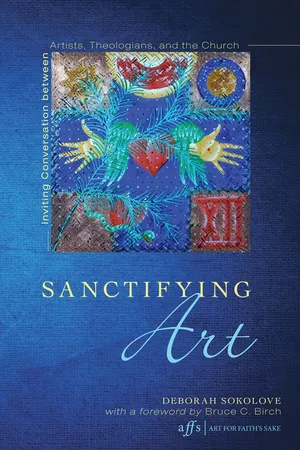
Sanctifying Art
Inviting Conversation Between Artists, Theologians, and the Church
- 202 pages
- English
- ePUB (mobile friendly)
- Available on iOS & Android
eBook - ePub
About this book
As an artist, Deborah Sokolove has often been surprised and dismayed by the unexamined attitudes and assumptions that the church holds about how artists think and how art functions in human life. By investigating these attitudes and tying them to concrete examples, Sokolove hopes to demystify art--to bring art down to earth, where theologians, pastors, and ordinary Christians can wrestle with its meanings, participate in its processes, and understand its uses. In showing the commonalities and distinctions among the various ways that artists themselves approach their work, Sanctifying Art can help the church talk about the arts in ways that artists will recognize. As a member of both the church and the art world, Sokolove is well-positioned to bridge the gap between the habits of thought that inform the discourse of the art world and those quite different ideas about art that are taken for granted by many Christians. When art is understood as intellectual, technical, and physical as well as ethereal, mysterious, and sacred, we will see it as an integral part of our life together in Christ, fully human and fully divine.
Information
Topic
Theology & ReligionSubtopic
Christian Theology1 / Prologue
A theologian friend recently asked me, Why does art matter to you? It was late, and I was tired, so I said that it simply does, and that I didn’t feel the need to enquire any more deeply into that particular question. The next morning, I found an email in which my friend said that, while my answer was all very well, the real question was, “Why should art matter to anyone else?” My friend went on,
I’ve done a little art and I like it. I’ve looked at some art and felt stirred by it, and not just beautiful art but also [disturbing] art . . . Still art clearly does not matter to me in the same way it matters to you. Are you writing just for yourself or are you writing for people like me? If for me, then I need some windows into your world.
This book is an attempt to open up those windows, not just for my friend and me, but for others—especially others in church communities—who are, like us, trying to find a way to talk about art that doesn’t pit experts against neophytes, or lovers of high art against those who never step foot in a gallery, museum, or concert hall.
One of the problems in conversations like this is that artists are often tongue-tied when asked to explain what seems self-evident to them. So, it took a while for me to find the right words, but eventually I was able to say to my friend two, quite different things.
First, my answer to the question, “Why should the art in a museum or gallery matter as much to other people as it does to me?” is, “Maybe it shouldn’t.” Because of my life experience, or simply because of how my mind works, or how my body responds to color and form, I happen to have a taste for certain kinds of high art, much as I have a taste for chocolate. Just as I wouldn’t try to argue my husband into liking chocolate when he prefers vanilla, I have no need to convince anyone to spend time in an art museum when they would prefer to walk on the beach or listen to rap.
On the other hand, an awareness of what is in museums, concert halls, and theaters, and the ways that certain paintings, pieces of music, poems, stories, and other artworks have affected the overall cultural, theological, and spiritual discourse, is part of being an educated human being. Much of what can be known about the church, as well as society at large, in earlier eras is available only through the medium of the arts. To ignore that evidence is to ignore a large part of human experience.
The second thing that I said is that, despite the statement to the contrary, I am aware that art—defined more broadly, at least—does matter to my friend the theologian, as well as to most other churchgoers. To take the most obvious example, the music used in worship is a matter of passionate debate in many congregations. Whether the congregation should sing hymns, praise choruses, or chants from the Taizé community is not simply a matter of taste, but is profoundly formative on individual piety as well as how (or whether) worshippers understand themselves as interdependent members of the Body of Christ. Somewhat less obvious, but nonetheless real, is how the quality, presence, or absence of various kinds of arts within the worship space and the church building overall affects people’s relationship to one another, to the church, and to God.
Beauty and Theology
While my friend was aware that not all art is beautiful, many theologians tend to talk about art and beauty in the same breath. For them, of course, God is both the source and the measure of all Beauty—which they tend to capitalize along with those other transcendental virtues, Truth and Goodness. But it is often a short step for theological aestheticians to move from assertions of the absolute beauty of God to declare that this or that piece of art, or this or that type of art, is not only beautiful, but a sanctified manifestation of the beauty of God.
It wasn’t always so. For nearly 500 years, visual art was suspect in most Protestant churches; drama was largely absent; and dance was considered virtually synonymous with seduction and sin. Music (mostly in the form of hymnody) and poetry (mostly in the form of prayer) were the only arts that were encouraged. Even in those churches that commissioned expensive stained glass windows or elaborate furnishings and decorations, the imagery was largely conventional and the artistry subordinated to the message. Although Roman Catholic churches continued to use statues and paintings as the focus of devotional and worship practices, by the late nineteenth century these had become mostly mass-produced plaster copies of a few accepted forms. While there were, of course, exceptions, by and large Christian worship offered no place for contemporary art by living artists. In the late twentieth century, that began to change.
For a variety of reasons, including but not limited to an experimental attitude toward worship sparked by the Second Vatican Council and the liturgical renewals that followed in both Roman Catholic and Protestant worlds, the arts began to find a new—if still somewhat uneasy—acceptance in Christian life. Much has been written in the last few years about this renewed relationship. Nearly as many books have been written on theological aesthetics in each of the last ten years as in the previous 100 years taken together. Theological seminaries are adding courses on the integration of the arts into Christian education and worship, as well as rewriting courses on Scripture and church history to include the use of the arts as evidence of attitudes and understandings in a variety of historical periods. At the same time, many Christian artists have found a new boldness in using their faith as the basis of their work, seeing their artistic process as spiritual journey and their product as evangelical witness.
What is missing from this growing attention to the arts in Christian circles has been a critical discussion of what art does and does not do, and why we think so. Art has been lauded as a means of apprehending the holy; as a form of prayer; even as revelation, however imperfect, of God’s own beauty and truth. In many ways, the arts, once vilified, are now sanctified; what was once feared as a tool of the devil is now embraced as a means of grace. This volume is an attempt to look at these and other claims that have been made about art, identify the sources of these claims, and consider them in the context of Christian devotion, corporate worship, and theological study so that both artists and the church may take one another seriously as partners in conversation.
Art and Aesthetics
For a variety of historical reasons, the fields of philosophical and theological aesthetics have come to center on the notion of beauty. This is especially true in much current writing on theological aesthetics, which (as I read it) seems to center on the understanding that God is the source of beauty and that any standard of beauty ultimately derives from God. While I have no dispute with these formulations, my own understanding of aesthetics comes less from philosophy and theology than from my practice and education as a visual artist.
When artists speak of aesthetics, they are not usually speaking about beauty, but of the relationships (harmonious or otherwise) among the various elements of an artwork, and of how those relationships express ideas or emotions. The root of the word, aesthetic, after all, derives from a Greek word meaning “perceptible to the senses.” In the singular, an aesthetic is a particular attitude, or set of values, which affects such diverse qualities as color palette, subject matter, medium, attitude, and more. Aesthetics, for artists, is about what can be perceived with the senses, and the effect that such perception has on both emotion and meaning.
A Life in Art
So this book grows out of my life history. While many of the details are quite ordinary, certain particulars will illuminate the source of the concerns that this volume addresses. I have been an artist in my own right for over thirty years. For ten years before I claimed that identity, I was married to a painter. I have worked at various times as craftsperson, fashion designer, graphic designer, and seamstress. I come from a family of musicians, dancers, actors, screen-writers, and artisans. One grandfather designed embroidered skirts for starlets and sequined shirts for Hollywood cowboys; the other was a clarinetist who left the Borscht Belt Klezmer circuit to found the first music store in Southern California. My mother’s mother worked as a mill girl in Poland and became a milliner in the Bronx. I have always made things with my hands. One way or another, my life has always been connected with the arts. For the last thirty years or so, I have been a working artist with an active exhibition schedule and occasional liturgical commissions,
In 1965, the year that I turned eighteen, the Los Angeles County Museum of Art opened its new building on Wilshire Boulevard, not far from where I was living. The first exhibition that I recall was of large, flat planes of color; canvases full of splashed and poured paint; and the silk-screened repetition of giant soup cans. It was all a very long time ago, and my memory may be conflating this with one or more later shows, but what I recall was that I was transfixed by my first sight of works by such artists as Barnett Newman, Kenneth Noland, Willem de Kooning, and Brice Marden. The Andy Warhol works probably came later, some time after the scandalous Back Seat Dodge ’38 by Edward Kienholz, shown to much controversy in 1966. The precise chronology doesn’t really matter. What does matter is the effect these works had on me and my subsequent understanding of what art is, what art does, and why so many people care.
Up until those shows, I probably had a rather conventional understanding of art. To the extent that I thought about it at all, I thought that art was about representation, about drawing things as convincingly as possible. I was never singled out at school or anywhere else as “the artistic one,” even though I was always making things. But sewing up gypsy outfits for my parents to wear to a costume ball, carefully lettering a ten-foot banner for a science project, inventing new plaiting patterns for lanyards at summer camp, or even helping to lay out the junior high school yearbook were not considered “art,” either by me or by anyone else that I knew. Artists were people who drew and painted, effortlessly, with no instruction, as naturally as birds sing.
Drawing wasn’t effortless for me. It was, however, a challenge that I was determined to overcome. In my sophomore year in high school, I nearly failed all my classes because I was drawing, incessantly and obsessively. Mostly, I drew hands. Since it was always available, I would draw my own left hand, over and over, in a variety of poses, trying to make the result as lifelike as possible. Sometimes, if they would agree to sit still long enough, I would draw someone else’s hands. Hands seemed to me somehow more revealing than faces. A face could lie, but a hand was honest, no more and no less than itself. In drawing the same subject repetitively, I was training myself to see, to make may own hand record the small irregularities, the minute, yet infinitely differing relationships of knuckle and nail, of joint and ligament, of palm and finger that make one hand clearly belong to me, and another belong to you. Thinking back on this period now, I think that I was trying to understand both the difference and the connection between self and other. It was a way of knowing something that could not be known in any other way.
Yet even in this year of compulsive drawing, I never thought that I was, or could be, or even wanted to be, an artist. The only art class I had ever taken was one that was required in the seventh grade. Although I secretly longed to know the mysteries taught in the studio, I could not allow myself to admit it. Instead, I filled my schedule with the heavy academics that would lead to college. I worked hard at the things I was interested in, like Latin and geometry, and skated by with low Bs in the subjects that bored me, like biology and civics. Although I knew that I liked to make things, girls weren’t allowed to take drafting or print shop, and somehow I had internalized the message that art classes were for slow learners, those who couldn’t make it through the college prep curriculum. I listened with longing to other students’ tales of what they were learning in art appreciation class, but never could allow myself to admit that that was where I wanted to be. It was only in my thirties that I was able to confess that I wanted to go to art school.
What I learned when I finally got there, besides the technical mysteries of watercolor and lithography; of stretching canvas and kneading clay; of color theory and the elements and principles of design; was that art is a form of discourse, a means of communication, and a record of what humans believe about the nature of the world. Art, the historians in the department taught me, is visual philosophy. Today, I would add that is also visual theology, a way of thinking about the nature of God and the relationship of that God to humankind and to all creation.
Eventually, I earned an MFA and went on to teach art at a state university. Later, I also earned a master’s degree in Theology, and a doctorate in Liturgical Studies. For fifteen years, I was the Curator of the Dadian Gallery at Wesley Theological Seminary, where I now teach and serve as the Director of the Henry Luce III Center for the Arts and Religion. In addition, I am an active member of a small, local church where the arts are an integral part of our worship life.
A Few Definitions
It is this immersion in both the world of art and the world of faith that leads me to question the ways that art is thought about in the church and its related institutions. As I read what theologians, liturgical scholars, church historians, and even self-professed Christian artists have been writing about art, I am frequently struck by the disjuncture between what Christian authors claim as the virtues of art, and how the art world itself views and values its own products and processes.
In saying that, I realize I need to provide some definitions. First, I need to clarify that when I say “the church.” I do not mean any particular church or congregation, or even denomination. Rather, I am referring generically to Christians and their institutions, primarily in the United States. I realize that such a generalization skates over a great many particular differences, but the arguments for and against the arts in worship and other moments in Christian life tend to transcend denominational lines. Influential writers from a variety of disciplines and denominational backgrounds who write about the arts and the church include Frank Burch Brown, Don Saliers, William Dyrness, Jeremy Begbie, Robin Jensen, and the late Doug Adams, just to name a few. While each of them has a particular viewpoint growing out of their experience of both the arts and the church, their writings like mine are generally addressed to the church at large, rather than any particular denomination.
Next, I must define what I mean by art, the arts, and the art world. By art, I mean primarily what are often called the visual or plastic arts1—painting, drawing, sculpture, photography, and the like. Sometimes, however, when I say art, I mean it more generally, including dance, drama, music, cinema, and poetry, as well as the visual arts. I hope that the context will make clear which I mean.
While my perspective is shaped primarily by the visual arts, much of what I have to say is equally true of all the arts. For instance, any artwork, whether visual or not, whether as solid and lasting as a Greek kouros or a medieval cathedral, or as ephemeral as a single performance of John Cage’s “4’33”,” is an expression of its time and place. An artwork, regardless of medium, is, among other things, a record of the social, political, and historical context within which the artist functions. It is only in relatively modern times that art, regardless of medium, began to be understood as the ...
Table of contents
- Title Page
- Foreword
- Acknowledgments
- 1 / Prologue
- 2 / The Problem of Art
- 3 / Visions of Beauty
- 4 / Good Art
- 5 / Art and the Need of the World
- 6 / Art in the Body of Christ
- 7 / A Sanctified Art
- Bibliography
Trusted by 375,005 students
Access to over 1.5 million titles for a fair monthly price.
Study more efficiently using our study tools.
Frequently asked questions
Yes, you can cancel anytime from the Subscription tab in your account settings on the Perlego website. Your subscription will stay active until the end of your current billing period. Learn how to cancel your subscription
No, books cannot be downloaded as external files, such as PDFs, for use outside of Perlego. However, you can download books within the Perlego app for offline reading on mobile or tablet. Learn how to download books offline
Perlego offers two plans: Essential and Complete
- Essential is ideal for learners and professionals who enjoy exploring a wide range of subjects. Access the Essential Library with 800,000+ trusted titles and best-sellers across business, personal growth, and the humanities. Includes unlimited reading time and Standard Read Aloud voice.
- Complete: Perfect for advanced learners and researchers needing full, unrestricted access. Unlock 1.5M+ books across hundreds of subjects, including academic and specialized titles. The Complete Plan also includes advanced features like Premium Read Aloud and Research Assistant.
We are an online textbook subscription service, where you can get access to an entire online library for less than the price of a single book per month. With over 1.5 million books across 990+ topics, we’ve got you covered! Learn about our mission
Look out for the read-aloud symbol on your next book to see if you can listen to it. The read-aloud tool reads text aloud for you, highlighting the text as it is being read. You can pause it, speed it up and slow it down. Learn more about Read Aloud
Yes! You can use the Perlego app on both iOS and Android devices to read anytime, anywhere — even offline. Perfect for commutes or when you’re on the go.
Please note we cannot support devices running on iOS 13 and Android 7 or earlier. Learn more about using the app
Please note we cannot support devices running on iOS 13 and Android 7 or earlier. Learn more about using the app
Yes, you can access Sanctifying Art by Deborah Sokolove in PDF and/or ePUB format, as well as other popular books in Theology & Religion & Christian Theology. We have over 1.5 million books available in our catalogue for you to explore.