- 280 pages
- English
- ePUB (mobile friendly)
- Available on iOS & Android
eBook - ePub
About this book
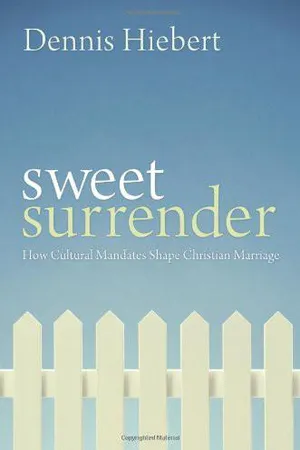
Every culture has a way of perceiving and practicing marriage. Many contemporary Western Christians mistake what their culture prescribes regarding marriage with what the Bible portrays, and thereby take as biblical what is merely cultural. Uncritical conformity to cultural imperatives of marriage then becomes a Christian virtue, and a sweet surrender. Few recognize, much less question this confusion, even when its consequences are unhealthy. In Sweet Surrender Dennis Hiebert challenges Christians to comprehend what is cultural in their view of marriage, hold as optional what is not explicitly required by the Bible, and live out their marriages within the transcendent grace of God. Gaining greater awareness can free marriages from the control of culture for something more simply but deeply Christian. Marriages benefit when they are released from cultural directives that are not biblical callings, even if they choose to retain them as cultural practices. This book is for Christians who are ready to rethink their assumptions about marriage.
Information
Topic
Theology & ReligionSubtopic
Christian MinistryMandate 1
Mate Selection
Should marital partners select each other?
We begin testing the cultural mandates of marriage, and how they may shape Christian conceptions of marriage, by examining how marriages are formed. As noted in the previous chapter, a culture will include a stock of knowledge about how to handle the challenges of collective life. A way of handling a challenge, such as mate selection, will become the way of handling that challenge collectively. Our contemporary Western way of handling this challenge is to have a male and female, soon after they have entered adulthood, go through a series of dating rituals before they themselves decide if they will marry each other. This method of couple formation is taken for granted by current Western Christians and non-Christians alike as the natural or even God-ordained method of mate selection. The term “mate selection” is actually somewhat misleading, as it conjures up images of standing in front of an assortment of choices, like at a vending machine, and pondering which one to choose. “Hmm, let me see, I think I’ll have that one.” In actual practice, the process is more accurately termed “finding a mate,” like searching to find a suitable job. Other than fantasy worlds and melodramatic reality television shows, which are much the same thing, few of us are in a position to select from an array of equally appealing and available choices.
Cultural methods of deciding who should marry involve at least two analytically distinct dimensions: who decides which two people should marry, and on what basis. The current Western norm is that the two persons who will marry each other should decide for themselves, and that they should do so for love. Perhaps the easiest distinction between biblical and cultural mandates regarding marriage is that, though the Scriptures insist that spouses love each other, nowhere do the Scriptures stipulate that potential partners should select each other for marriage because they already love each other. Yet to suggest to Christians in Western society today that two people should marry for any reason other than romantic love would be deemed painfully archaic, pathetically unfeeling, and probably laughable. Little could be more offensive to our cultural belief in the virtues of the passions of the heart, and the right to self-determination, or the natural wisdom of employing those passions to guide our self-determination in mate selection. Tragically, little could make it more difficult to stay in such marriages once begun than those same cultural beliefs. Passions empowered by self-determination can then as readily end a marriage, if those passions reverse direction.
We begin by examining how God’s originally chosen people formed their marriages. How was mate selection conducted in ancient Israel? What were the social conditions that produced those patterns, and what were the social and private consequences to the individuals involved? Marriage by arrangement of someone other than the couple themselves has persisted throughout most of human and Judeo-Christian history until a relatively recent and sudden shift to the alternate cultural mandate and method of self-selection based on love that now predominates Western culture.61 How do young people now do for themselves what used to be done for them? How well are they doing it? Do they still date as their parents did? What should Christians be doing? We will find that God is strangely silent on the issue; the biblical text tells stories of mate selection, but never provides specific guidelines for it. So Christians have simply adopted their cultural norms and practices of mate selection. They have simply surrendered to their culture.
Endogamy and Polygamy
In premodern societies, authoritative third parties arranged marriages.62 Most frequently it was the parents of the couple, usually the fathers, often agreeing when their children were small, and sometimes before they were born. When it was not the parents, the matchmaker was usually a kin of some relation, and when not a kin, it was one or more elders in the community with that designated status and role. The young persons to be wed may not have known each other, or not even known of each other, consequently ruling out love between the two as the criterion for selection. The criteria instead included advantageous economic exchange, political alliance, familial connection, temperament suitability, and other such pragmatic considerations. The predominant criteria were external to the couple themselves, placing the interests of the extended families and community ahead of the personal, subjective interests of the couple. Marriage was not for love but for “money,” or the community assets the marriage produced and protected. It was not as if people lived without interpersonal preferences and passions, just that they were secondary and easily overruled by the practical and often communal demands of life. As Coontz puts it, “I don’t believe that people of the past had more control over their hearts than we do today or that they were incapable of the deep love so many individuals now hope to achieve in marriage. But love in marriage was seen as a bonus, not as a necessity.”63
Two father-son pairings in the Old Testament are well-known examples of arranged marriages. In his advanced age, Abraham sent his servant back east to Mesopotamia to “take a wife” for his son Isaac from his relatives, instead of from the daughters of the Canaanites. When Rebekah drew water from a well for the servant’s camels, unknowingly signifying that she was God’s appointed, the servant negotiated with her father Bethuel and brother Laban, who agreed to send her to Canaan to be Isaac’s wife. As a footnote to the story, it is mentioned that after she became Isaac’s wife he loved her (Gen 24:1–67). Rebekah bore Isaac two sons, Esau and Jacob. After tricking Esau out of his birthright, Jacob fled back to the east and met Rachel, his uncle Laban’s daughter, not surprisingly also at a well. Jacob loved Rachel, and agreed to work for Laban for seven years in order to acquire her as his wife. When the time came, Laban gave Jacob his older, less attractive daughter Leah instead, because of the custom of ensuring that the oldest sibling married first. So Jacob worked for Laban another seven years in order to obtain Rachel, his first love. Initially, Leah was fertile, whereas Rachel was not, leading to jealousies and favoritisms. But eventually Jacob fathered twelve sons, who became the twelve tribes of Israel through Leah and Rachel and their respective maids, all while still living in his uncle Laban’s household (Gen 29:1—30:24).
The other father-son pairing of note is the monarchs David and Solomon. David married Michal (the daughter of King Saul),64 Ahinoam, Abigail (the widow of Nabal who had scorned David), Maacah, Haggith, Abital, Eglah, and Bathsheba (to cover up his infamous adulterous affair with her). He sired many children through his wives and concubines (2 Sam 5:13), and had a beautiful maiden care for him and lie in bed with him to keep him warm as he was dying in old age. Solomon, the second son of David and Bathsheba, was chosen by David as his successor to the throne. When Solomon’s brother Adonijah, who had been passed over by David, asked to marry one of David’s concubines, Solomon immediately ordered Adonijah’s death, seeing it as a political threat. As king of Israel, Solomon is notorious for his seven hundred wives and three hundred concubines. He is said to have loved foreign women, who regrettably turned his heart away from God in his old age (1 Kgs 11:1–8), but it is difficult to imagine meaningfully loving that many women in the full sense of the word. Lust for sex, status, and power is a more likely possibility.
These stories exemplify two characteristic features of ancient arranged marriages: endogamy and polygamy. Endogamy is the practice of marrying someone within one’s own social group or community. Conversely, exogamy means marrying someone outside of one’s group. In short, endogamy is marrying in, exogamy is marrying out. One’s social group can be defined in terms of race, ethnicity, nationality, region, religion, education, social class, and so on. Endogamy has been the predominant pattern of marriage throughout history; indeed, without it there would be no concept or categories of race and ethnicity. However, how relatively tightly or loosely endogamy has been defined and practiced has varied greatly. In most Western societies today, it is illegal to marry siblings or first cousins, and we think of those who do as incestuous. Not so in ancient Israel; Sarah was Abraham’s sister, and Rachel was Jacob’s cousin. Soon the entire nation thought of itself as one large extended kinship group, a “people” that was divided up into twelve “tribes,” each comprised of several “clans,” in turn consisting of the smallest social units, “households.”65 Arranged marriages ensured that they occurred within the clan; to marry outside the clan was to marry exogamously. The driving forces for arranging marriages were economic and social, such as the exchange of money and land that occurred in marriage, the administration of justice, facilitating the terms of the year of Jubilee, ensuring that married women would not live too far from their family of origin, and inhibiting the introduction of foreign elements into the clan community. As such, Jacob’s early endogamy set the pattern for building the nation, whereas Solomon’s later exogamy began the disintegration of the nation.
A second feature of ancient arranged marriages is that they were associated with polygamous marriages. Polygamy, meaning the plurality of spouses, is comprised of two subcategories: polygyny (poly = many, gyne = female; simultaneous marriage to more than one wife) and polyandry (many andros = males; simultaneous marriage to more than ...
Table of contents
- Title Page
- Figures and Tables
- Acknowledgments
- Forms of Surrender
- Reading Culture and the Bible
- Mandate 1: Mate Selection
- Mandate 2: Connectedness
- Mandate 3: Calling
- Mandate 4: Need Fulfillment
- Mandate 5: Love
- Mandate 6: Intimacy
- Mandate 7: Sex
- Mandate 8: Conflict
- Mandate 9: Dissolution
- Mandate 10: Commitment
- Reclaiming Christian Marriage
- Bibliography
Trusted by 375,005 students
Access to over 1.5 million titles for a fair monthly price.
Study more efficiently using our study tools.
Frequently asked questions
Yes, you can cancel anytime from the Subscription tab in your account settings on the Perlego website. Your subscription will stay active until the end of your current billing period. Learn how to cancel your subscription
No, books cannot be downloaded as external files, such as PDFs, for use outside of Perlego. However, you can download books within the Perlego app for offline reading on mobile or tablet. Learn how to download books offline
Perlego offers two plans: Essential and Complete
- Essential is ideal for learners and professionals who enjoy exploring a wide range of subjects. Access the Essential Library with 800,000+ trusted titles and best-sellers across business, personal growth, and the humanities. Includes unlimited reading time and Standard Read Aloud voice.
- Complete: Perfect for advanced learners and researchers needing full, unrestricted access. Unlock 1.5M+ books across hundreds of subjects, including academic and specialized titles. The Complete Plan also includes advanced features like Premium Read Aloud and Research Assistant.
We are an online textbook subscription service, where you can get access to an entire online library for less than the price of a single book per month. With over 1.5 million books across 990+ topics, we’ve got you covered! Learn about our mission
Look out for the read-aloud symbol on your next book to see if you can listen to it. The read-aloud tool reads text aloud for you, highlighting the text as it is being read. You can pause it, speed it up and slow it down. Learn more about Read Aloud
Yes! You can use the Perlego app on both iOS and Android devices to read anytime, anywhere — even offline. Perfect for commutes or when you’re on the go.
Please note we cannot support devices running on iOS 13 and Android 7 or earlier. Learn more about using the app
Please note we cannot support devices running on iOS 13 and Android 7 or earlier. Learn more about using the app
Yes, you can access Sweet Surrender by Dennis Hiebert in PDF and/or ePUB format, as well as other popular books in Theology & Religion & Christian Ministry. We have over 1.5 million books available in our catalogue for you to explore.