- 164 pages
- English
- ePUB (mobile friendly)
- Available on iOS & Android
eBook - ePub
About this book
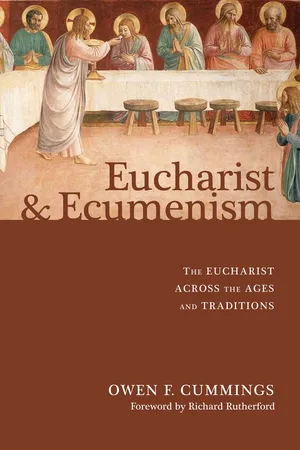
Most Christians worship on a regular basis on the Lord's Day. They have done so from the beginning, and their worship has centered on the Eucharist, following Jesus's words, "Do this in remembrance of me." Over the two millennia of the Christian tradition there have been shifts of emphasis and understanding about the Eucharist. This book attempts to point out, by providing accessible accounts of both liturgies and liturgists across the centuries and traditions, just how much different Christians have in common and how they can benefit from attending to one another's worship. The author's ultimate hope is that in its small way, the book will contribute to Christians worshiping together.
Information
Subtopic
Rituels et pratiques chrétiens1
The Didache and the Eucharist
The “Eucharistic” prayers in chapters 9 f . . . are quite unparalleled. Their strong eschatological flavor and phraseology and the description of Christ as “Thy Servant Jesus” strike a very primitive note.
Frank L. Cross1
In the halcyon days of the early 1970s I was a graduate student reading for the BD in the Anglican School of Divinity of Trinity College Dublin, in fact the first Roman Catholic to graduate with this degree since the foundation of the college by Queen Elizabeth I in 1592. My thesis supervisor was the Rev. Prof. Frederick Ercolo Vokes (1910–2000), Archbishop King Professor of Divinity. Prof. Vokes had published in 1938 The Riddle of the Didache, and this book was my first serious encounter with this early Christian liturgical text.2 It has remained an interest ever since. Still in the early stages of Didache research, Prof. Vokes from our vantage point today got some things wrong, most notably his dating of the document. He provides a very late dating of the text—“in the last third of the second century or first third of the third century.”3 A growing number of scholars, constituting perhaps a consensus, put the origin of The Didache much earlier, before or towards the end of the first century. Nonetheless, with careful attention to philological detail and patristic research at the time, The Riddle of the Didache still repays close reading. The amount of research that has been conducted in the last twenty-five or thirty years on The Didache is overwhelming and indeed sometimes encyclopedic, especially the work of Kurt Niederwimmer and Aaron Milavec.4 My more recent interest in the text has come about through reading the eminently clear and always lively book by the Irish historical and liturgical theologian Thomas O’Loughlin, The Didache: A Window on the Earliest Christians.5
Introducing The Didache
The text of The Didache, in a codex probably to be dated to 1056, was discovered and published by the Metropolitan of Nicomedia, Philotheos Bryennios, in 1883, and that publication has been described as follows: “The discovery of The Didache caused in Victorian Europe and America something of the stir aroused by the discovery of the Dead Sea Scrolls in the Judaean Desert in the years following the Second World War.”6 There may be an element of hyperbole in that description, but it remains beyond doubt that this text has complemented much of what had been known of early Christian worship. As noted above, The Didache is dated in a variety of ways by the scholarly community, but a date in the last quarter of the first century seems to have gained a consensus. This makes the text contemporary with the canonical Gospels. The author is unknown.7
The Didache falls into two parts. Part One, chapters 1–6, is taken up with the “Two Ways”—as in Psalm 1, the Way of Life and the Way of Death—and is concerned with moral teaching and conduct. Part Two, chapters 7–16, focuses for the most part on Christian worship, and provides a description of the Eucharist celebrated on the Lord’s Day. While the great eucharistic theologian and patristic scholar Johannes Betz is accurate in stating that “the famous meal prayers of chapters 9 and 10 are among the most difficult and contested problems of Didache research”—perhaps especially in terms of their origins and in relation to pre-existent euchological forms—the consensus of theological as well as exegetical scholarship today seems content basically to recognize the meal prayers as arising out of the Eucharist.8 It is true that there are problems and particularly the fact that the text begins with the cup, not the bread, which is to say the least very unusual in a eucharistic context. Betz goes on to say that “the sayings in these verses [chapters 9–10] offer a pronounced eucharistic color which can hardly be ignored.”9 Betz solves the problem by proposing that the prayers of Didache 9–10 “were transformed and revalued from original eucharistic prayers to mere agape prayers,” the agape meal being an actual meal celebrated in common by the earliest Christians.10 Scientifically and methodologically Betz may be on the right track. Scholarly and scientific concerns are not locked in opposition to pastoral-liturgical concerns. That would be an impossible situation. But perhaps there is more to be said. While this is not the appropriate place to develop the methodological argument, one might propose that alongside the empirical data of text and ritual there is also what might be called an informal sensus communis fidelium/common sense of the faithful, a constant and continuous tradition of eucharistic worship that provides a “nose” for what empirical liturgical data may not yield. That is the position taken here, that is to say, that in Didache 9–10 we have an agape/community meal in which the Eucharist is celebrated. Still, a real meal was going on after which in all likelihood occurred the celebration of the Eucharist. In point of fact, if this is actually the case, it coheres well with the meal practice of Jesus: “The disciples become the assembly around the table and there bless the Father in the way that they believed Jesus did.”11 Let us acquaint ourselves with this assembly of the Didache around the table for the actual Eucharist.
The Text12
9. Concerning the Eucharist, eucharistize in this way. Begin with the chalice: “We give thanks to thee, our Father, for the holy Vine of thy servant David, which thou hast made known to us through thy Servant Jesus.”
“Glory be to thee, world without end.”
Then over the broken bread: “We give thanks to thee, our Father, for the life and knowledge thou has made known to us through thy Servant Jesus.”
“Glory be to thee, world without end.”
“As this broken bread, once dispersed over the hills, was brought together and became one loaf, so may thy church be brought together from the ends of the earth into thy kingdom.”
“Thine is the glory and the power, through Jesus Christ, forever and ever.”
No one is to eat or drink of your Eucharist but those who have been baptized in the name of the Lord; for the Lord’s own saying applies here, “Give not that which is holy unto dogs.”
10. When all have partaken sufficiently, give thanks in these words: “Thanks be to thee, holy Father, for thy sacred name which thou hast caused to dwell in our hearts, and for the knowledge and faith and immortality which thou hast revealed to us through thy servant Jesus.”
“Glory be to thee for ever and ever.”
“Thou, O Almighty Lord, hast created all things for thine own name’s sake; to all men thou hast given meat and drink to enjoy, that they may give thanks to thee, but to us thou hast graciously given spiritual meat and drink, together with life eternal, through thy Servant. Especially, and above all, do we give thanks to thee for the mightiness of thy power.”
“Glory be to thee for ever and ever.”
“Be mindful of thy church, O Lord; deliver it from all evil, perfect it in thy love, sanctify it, and gather it from the four winds into the kingdom which thou hast prepared for it.”
“Thine is the power and the glory forever and ever.”
“Let Grace come, and this present world pass away.”
“Hosanna to the God of David.”
“Whosoever is holy, let him approach. Whoso is not, let him repent.”
“Maranatha. Amen.”
(Prophets, however, should be free to give thanks as they please.)
14. Assemble on the Lord’s Day, and break bread and offer the Eucharist; but first make confession of your faults, so that your sacrifice may be a pure one. Anyone who has a difference with his fellow is not to take part with you until they have been reconciled, so as to avoid any profanation of your sacrifice. For this is the offering of which the Lord has said, “Everywhere and always bring me a sacrifice that is undefiled, for I am a great King, says the Lord, and my name is the wonder of nations.”
Commentary
What liturgical theologian Arthur Couratin said of the texts of the New Testament applies equally to such texts as The Didache: “The books of the New Testament do not provide us with a handbook to the life of the church of the first century. For the most part they are occasional writings, each produced to meet some particular set of circumstances.”13 In other words, we ought not to look to these ancient texts for what they simply cannot provide. The text immediately has its own challenges. It does not contain, for example, the words of institution that we find in the Synoptic Gospels’ accounts of the Last Supper, as well as in the celebration of the Eucharist today—“This is my body. . . . This is my blood.” That particular challenge is really a false one. “The notion that the Eucharist burst onto the scene at the Last Supper with the formal priesthood, specific words and a fixed theology does not allow for the fact that all religious structures change over time, evolving with some aspects becoming clearer and others more obscure.”14 That is to read into The Didache the concerns of much later Christian generations. What we find through careful attention to the text is that the Eucharist was celebrated in the context of a community meal, much like the situation of St. Paul’s Corinth in 1 Corinthians 11. The cup and the bread are blessed, and when the meal is complete, there are prayers of thanksgiving. There are repeated doxologies, in all likelihood congregational responses, and, as in the Staniforth-Louth edition these doxologies are rendered in italics.
The Jewish dimension of the prayers is very clear. Some examples: “the holy Vine of thy servant David” as a description of the church; the various references to the name of God; the emphasis on the coming kingdom of God. The very first words in chapter 9 are peri tes eucharistias, “concerning the Eucharist.” This word eucharistia literally means “thanksgiving,” and is not necessarily and immediately a reference to the Eucharist as such. However, the context that unfolds with the chapter seems persuasively to suggest that it means here the celebration of the Eucharist. Ronald Jasper, the Anglican liturgist about whom we shall read in chapter 12, and his colleague Geoffrey Cuming maintain that “the liturgical sense is possible,” and that “the rubric at the end of chapter 9 seems more appropriate to a Eucharist.”15 The Eucharist begins interestingly with the chalice in chapter 9. A Trinitarian, or at the very least a binitarian note is struck as thanks are given to the Father for the holy Vine that is the church and by apparent implication the eucharistic wine through his Se...
Table of contents
- Title Page
- Foreword
- Preface
- Chapter 1: The Didache and the Eucharist
- Chapter 2: Justin and the Eucharist
- Chapter 3: The Eucharistic Prayer of Hippolytus
- Chapter 4: The Eucharistic Prayer of Sarapion
- Chapter 5: Eucharistic Prayer of Addai and Mari
- Chapter 6: Baldwin of Ford and Friends
- Chapter 7: The Liturgical Margery Kempe
- Chapter 8: The Eucharistic Richard Hooker (1554–1600)
- Chapter 9: Bishop Lancelot Andrewes (1555–1626), Liturgist
- Chapter 10: The Liturgical Mystic, John Keble (1792–1866)
- Chapter 11: The Eucharist and Frontier Revivalism
- Chapter 12: Eucharistic Father and Son
- Chapter 13: James Dunlop Crichton (1907–2001)
- Chapter 14: Graham Greene and Monsignor Quixote’s Final Eucharist
- Endnotes
- Bibliography
Trusted by 375,005 students
Access to over 1.5 million titles for a fair monthly price.
Study more efficiently using our study tools.
Frequently asked questions
Yes, you can cancel anytime from the Subscription tab in your account settings on the Perlego website. Your subscription will stay active until the end of your current billing period. Learn how to cancel your subscription
No, books cannot be downloaded as external files, such as PDFs, for use outside of Perlego. However, you can download books within the Perlego app for offline reading on mobile or tablet. Learn how to download books offline
Perlego offers two plans: Essential and Complete
- Essential is ideal for learners and professionals who enjoy exploring a wide range of subjects. Access the Essential Library with 800,000+ trusted titles and best-sellers across business, personal growth, and the humanities. Includes unlimited reading time and Standard Read Aloud voice.
- Complete: Perfect for advanced learners and researchers needing full, unrestricted access. Unlock 1.5M+ books across hundreds of subjects, including academic and specialized titles. The Complete Plan also includes advanced features like Premium Read Aloud and Research Assistant.
We are an online textbook subscription service, where you can get access to an entire online library for less than the price of a single book per month. With over 1.5 million books across 990+ topics, we’ve got you covered! Learn about our mission
Look out for the read-aloud symbol on your next book to see if you can listen to it. The read-aloud tool reads text aloud for you, highlighting the text as it is being read. You can pause it, speed it up and slow it down. Learn more about Read Aloud
Yes! You can use the Perlego app on both iOS and Android devices to read anytime, anywhere — even offline. Perfect for commutes or when you’re on the go.
Please note we cannot support devices running on iOS 13 and Android 7 or earlier. Learn more about using the app
Please note we cannot support devices running on iOS 13 and Android 7 or earlier. Learn more about using the app
Yes, you can access Eucharist and Ecumenism by Owen F. Cummings in PDF and/or ePUB format, as well as other popular books in Théologie et religion & Rituels et pratiques chrétiens. We have over 1.5 million books available in our catalogue for you to explore.