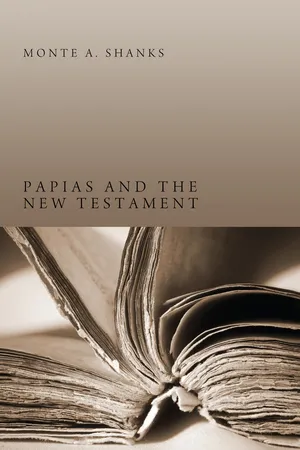
- 324 pages
- English
- ePUB (mobile friendly)
- Available on iOS & Android
eBook - ePub
Papias and the New Testament
About this book
Who was Papias, who did he know, and what did he believe about the writings that now comprise the canonical New Testament? Very little can be objectively known about him, his ministry, and his work, and yet he demands the attention of any scholar, student, or layperson who desires to understand the origins of the New Testament.
This book explores Papias as a source and what he wrote about the origins of certain New Testament books. It also analyzes what other patristic and medieval authors understood about him. Shanks argues that the surviving "Fragments of Papias" are indeed a valuable resource because they document a very early Christian belief that certain books of the New Testament originated from some of the original followers of Jesus Christ. This evidence cannot be quickly dismissed in proposals about the origins of these books.
Information
1
Introduction
The Need for Research
François Bovon suggested, “As the dividing line between Urchristentum and ancient Christianity becomes more and more artificial, New Testament scholarship and the discipline of patristics must join hands.”1 In theory his exhortation is commendable; however, it is unlikely that such a colloquium would bring a significant agreement or clarity to either field simply due to the diversity of approaches and presuppositions within each discipline. Nevertheless, this book is a modest attempt towards Bovon’s bold suggestion. A survey of New Testament and patristic studies concerning the origins of the apostolic writings finds a particular individual repeatedly referenced—he is Papias, an early second-century bishop of Hierapolis. Few if any patristic figures are quoted and/or marginalized as often as Papias, especially with the advent of “higher” critical scholarship. What makes this marginalization so intriguing is that very little can be objectively known about him and his work, yet he demands the attention of any scholar who desires to understand the origins of the New Testament.2
This book researches Papias and what his surviving literary fragments communicate about the apostolic writings, as well as what other patristic and medieval authors understood about him and what he meant concerning the origins of certain books of the New Testament. Its thesis is that the surviving “Fragments of Papias”3 are a valuable resource because they document that some of the New Testament writings originated from some of the original followers of Jesus Christ (i.e., the apostles). Regarding the importance of this thesis with respect to the Papian fragments, Clayton Jefford wrote,
Undoubtedly the most important materials from the witness of Papias related to reminiscences concerning the development of New Testament literature. It was Papias, for example, who preserved the tradition that Mark made note of the recollections of the apostle Peter as a written testimony to the words and deeds of the Lord. And it was also Papias who documented that Matthew recorded the sayings of Jesus in Hebrew in order that each person could translate them into their own language and context. Additionally, the witness of Papias provides a unique link between apostolic tradition and the post-apostolic church, since Eusebius argues Papias had heard John (the apostle) and was a companion of Polycarp. Such fragmentary traditions and testimony to ancient links between scattered Christians have gone a long way toward the development of historical assumptions about the evolution of our New Testament canon and the apostolic witness that it reflects.4
The surviving Papian fragments are also important because they reveal that Papias had an attitude of value and respect toward certain New Testament writings, and that his attitude was consistent with the attitudes of other known leaders of the early orthodox church (e.g., Polycarp). This thesis is worthy of focus because a segment of modern and post-modern scholarship, both liberal and conservative, has depended far too heavily upon Eusebius’s questionable interpretation of Papias’s preface in order to identify who Papias was, those that he might have known, and his knowledge of certain portions of the New Testament. The result of this limited and biased exposure enables some scholars to make conjectures about Papias that are at odds with other patristic statements concerning him, conjectures that ironically are also inconsistent with statements made by Eusebius himself.
This book surveys the selection of patristic and medieval literature commonly referred to as “The Fragments of Papias” in order to address the many misconceptions involving Papias’s knowledge of the apostolic writings. Its thesis regarding Papias’s value for obtaining a greater understanding of the development of the canonical New Testament is defended through a rigorous investigation of the Papian fragments, an investigation that had two goals in mind: The first was to identify the context in which Papias lived and those with whom he associated; and then having identified his proper place within the patristic period it examined his witness concerning the existence of certain New Testament writings and their origins. It is recommended that those who are familiar with Eusebius’s opinion of Papias and his exegesis of Papias’s preface read appendix 1 before proceeding with the rest of this book.
Method of Research
This effort relies significantly upon the Papian fragments as they are found in J. B. Lightfoot’s The Apostolic Fathers, which was edited and revised by Michael W. Holmes in 1999,5 and the edition of the “Fragments of Papias and Quadratus” found in the Loeb Classical Library series.6 It does not, however, completely follow Holmes’s ordering of these fragments. This research also employs additional critical editions that supply and examine individual Papian fragments that are not found in either of these editions.7 As stated previously, this effort had two goals. The first was to discern the time frame in which Papias lived, while the second was to identify Papias’s knowledge and attitude towards any apostolic writings. Identifying Papias’s context is important for determining how close he was to the apostolic period and, consequently, the general trustworthiness of his knowledge and statements about their writings. Some argue that Papias’s proximity or lack thereof to the apostolic generation does not necessarily affect the trustworthiness of his testimony or of the traditions he received regarding the origins of the apostolic writings.8 The fact remains, however, that generally speaking the closer one is to an event or source the more credible that one is perceived, especially if his testimony is contemporaneous with the event to which he testifies. Regarding the importance of contemporaneous testimony in historical studies, James Donaldson wrote, “In regard to testimony, we set out with the principle, that the only proper historical evidence is contemporary testimony. . . . We receive the statements of contemporaries as true, unless there is some reason to look upon them as false. As we move away from the particular period into testimony of a later period, we are not warranted in rejecting it entirely, for the testimony of a later period may be and generally is the testimony of contemporaries handed down from one generation to another. But we must be more cautious.”9
Consequently, Papias’s proximity to the apostolic generation is valuable in determining his credibility as a witness to it and its literature; literature that eventually became part of the New Testament canon. Having determined the likely time period of Papias’s life and ministry, the second goal will be addressed, which is discerning his knowledge of and attitude towards the certain writings of the New Testament. This is accomplished by analyzing specific Papian fragments with special attention given to Papias’s employment, references, or allusions to New Testament passages, as well as his understanding of their origins and his attitudes toward them.10
The reason for predominantly employing the editions of Lightfoot and Holmes is that they provide the most comprehensive collection of Papian material since they not only include actual Papian quotes, but also many other patristic and medieval references and allusions to him and his writings. These additional citations are important because Papias’s work is no longer extant; therefore, this material provides an important witness to the church’s understanding and attitudes towards Papias, as well as their understanding of his writings.11 Although all Papian fragments are found in secondary sources, such as those found in the writings of Irenaeus and Eusebius, they remain valuable sources for discovering the church’s understanding of who Papias was and what he wrote. An added benefit of the editions of Lightfoot and Holmes, and Loeb Classical Library, is that they provide the Greek and Latin texts of the Papian fragments whenever possible.12
Holmes’s order of these fragments, however, is not be entirely employed because it, whether intentionally or unintentionally, inappropriately provides an unjustifiable aid to the bias that has for long plagued a proper understanding of Papias and his meanings. This is observable in Holmes’s decision to begin his compilation of the Papian fragments with three that were preserved by Eusebius, while Irenaeus’s reference to Papias is fou...
Table of contents
- Title Page
- Foreword
- Preface
- Abbreviations
- Chpater 1: Introduction
- Chapter 2: A Survey of the History of Research
- Chapter 3: The Life of Papias
- Chapter 4: The Fragments of Papias
- Chapter 5: Papias and His Witness to the New Testament
- Appendix 1: Eusebius’s Marginalization of Papias
- Appendix 2: Who Has Confused Whom?
- Bibliography
Trusted by 375,005 students
Access to over 1.5 million titles for a fair monthly price.
Study more efficiently using our study tools.
Frequently asked questions
Yes, you can cancel anytime from the Subscription tab in your account settings on the Perlego website. Your subscription will stay active until the end of your current billing period. Learn how to cancel your subscription
No, books cannot be downloaded as external files, such as PDFs, for use outside of Perlego. However, you can download books within the Perlego app for offline reading on mobile or tablet. Learn how to download books offline
Perlego offers two plans: Essential and Complete
- Essential is ideal for learners and professionals who enjoy exploring a wide range of subjects. Access the Essential Library with 800,000+ trusted titles and best-sellers across business, personal growth, and the humanities. Includes unlimited reading time and Standard Read Aloud voice.
- Complete: Perfect for advanced learners and researchers needing full, unrestricted access. Unlock 1.5M+ books across hundreds of subjects, including academic and specialized titles. The Complete Plan also includes advanced features like Premium Read Aloud and Research Assistant.
We are an online textbook subscription service, where you can get access to an entire online library for less than the price of a single book per month. With over 1.5 million books across 990+ topics, we’ve got you covered! Learn about our mission
Look out for the read-aloud symbol on your next book to see if you can listen to it. The read-aloud tool reads text aloud for you, highlighting the text as it is being read. You can pause it, speed it up and slow it down. Learn more about Read Aloud
Yes! You can use the Perlego app on both iOS and Android devices to read anytime, anywhere — even offline. Perfect for commutes or when you’re on the go.
Please note we cannot support devices running on iOS 13 and Android 7 or earlier. Learn more about using the app
Please note we cannot support devices running on iOS 13 and Android 7 or earlier. Learn more about using the app
Yes, you can access Papias and the New Testament by Monte A. Shanks in PDF and/or ePUB format, as well as other popular books in Theology & Religion & Biblical Criticism & Interpretation. We have over 1.5 million books available in our catalogue for you to explore.