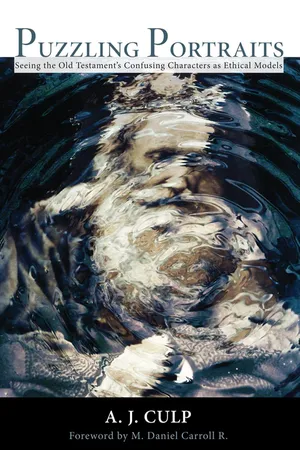
eBook - ePub
Puzzling Portraits
Seeing the Old Testament’s Confusing Characters as Ethical Models
- 146 pages
- English
- ePUB (mobile friendly)
- Available on iOS & Android
eBook - ePub
About this book
How are we to see the Old Testament's characters--typically a tangle of both virtue and vice--as models for our own ethical living? It is clear that Scripture intends for us to embody some qualities while eschewing others, and at times these are immediately obvious: David's wholehearted pursuit of God is admirable, while his adultery with Bathsheba and murder of Uriah are deplorable. But more often than not we are left with shades of gray, not really knowing whether the narrator approves, disapproves, or is indifferent to the behavior of these characters.
The present work seeks to address this issue, situating itself at the fault line of the problem: character portrayal. It argues that often what we take to be the narrator's silence about a character is not silence at all; rather, the narrator is simply speaking in ways that we are not attuned to. By becoming attuned to the voice of biblical narrative and by understanding its role in ethics, therefore, we are better able to understand the characters as resources for our own ethics. This work develops its ideas by leveraging pertinent literary and ethical models, which are then trained upon a particular case in point: the Gideon account in Judges 6-8.
Information
Topic
Theology & ReligionSubtopic
Biblical Commentary1
The Landscape of Old Testament Ethics
Old Testament ethics is an area of study that has many diverse opinions, so to truly do it justice would require a work larger than this one. At the same time, however, it is necessary to establish at least some boundaries and locate this study within them. This will be done by summarizing and discussing four major views that fairly represent a certain spectrum of Old Testament ethics.1 The central idea of this spectrum is that the Old Testament is of enduring ethical value. Each of the four views has its own ideas as to the particulars. Therefore, to outline the shape of the views, summaries will be constructed around three major issues: basic method, locus of study, and what each sees as the bridge between ancient and modern values. Because the larger study centers on narrative, we will note how each of the four views sees narrative fitting in. It will become clear that although some of the approaches forward good ideas regarding narrative, none is entirely satisfactory, and the issue must be considered more fully.
Walter Kaiser
In the world of Old Testament ethics, Walter Kaiser’s approach is one of the simplest.2 Its goal is to uncover enduring ideals and apply them to contemporary situations. The place where he finds these ideals is the express commands of God. The way in which he suggests to bridge Old Testament and Christian ethics is by extracting principles from the texts and reapplying them to modern situations. Of course, such simplicity has brought on a host of critics, some fair and others not. What should be noted, however, is that Kaiser’s system is not simple for the sake of simplicity. It is simple because Kaiser believes this is the theological solution.3 That is to say, for him the biblical idea of humanity is one of damaged intellect, reason, and conscience. Accordingly, humanity cannot be left to its own devices when it comes to ethical choices, but instead must be directed clearly, which is why God issued direct commands to the people of Israel. Thus to use the Old Testament ethically, one must look at God’s express commands to humanity, extract their principles, and apply them to our current situations.
The locus of Kaiser’s approach is in the express commands of the Old Testament, mostly in the Pentateuch, but also in the wisdom and prophetic literature.4 Concerning those found in the legal material of the Pentateuch, Kaiser follows the traditional model of dividing laws into three categories: moral, civil, and ceremonial. Accordingly, he sees only the moral ones as being binding on Christians, not the civil or ceremonial (which were fulfilled in Christ). These commands of God are the primary witness to ethical ideals in the Old Testament.
According to Kaiser, the bridge between Old Testament and Christian ethics is through a process of isolating and extracting principles. Here he draws from the ideas of John Goldingay, in which principles can be extracted from legal texts. Basically, this method looks at a specific command, draws out its underlying general principle, and then works to apply it to a specific contemporary situation by using what he calls the “ladder of abstraction.”5 Therefore, the way in which one can overcome the particularity of Old Testament law and use its essence for contemporary application is by locating and extracting principles.
In summary, Kaiser’s approach focuses on the express commands of God. In practice, this turns out more often than not to be the moral commands of pentateuchal legal texts (rather than, say, the oracles of the prophets). The bridge between the Old Testament ideals and Christians today is the generalizing of principles. By identifying and isolating the general principles underlying the law it is possible to apply them to specific contemporary situations. According to Kaiser’s written work, the role of narrative is very limited.6 However, it should be noted that narrative plays at least two secondary roles.7 First, it establishes the context of the law. And second, it lays the groundwork for creation theology, by which Kaiser justifies his approach to Old Testament ethics.
John Rogerson
John Rogerson’s views on Old Testament ethics are probably the most sophisticated considered here.8 For him, the initial step toward biblical ethics is a proper understanding of Scripture’s contextual nature. To understand the enduring ideals arising from the text, one must discern how cultural factors have shaped and colored them. Another important element for biblical ethics is the motivation for behaving rightly. What reasons does the Old Testament give for moral action? How do they affect Christians today? And the last piece of Rogerson’s approach concerns the formal structures that manifest mercy and grace in society. What sorts of these constructs does the Old Testament mention, and how do they serve as examples for contemporary people of faith? Respectively, Rogerson calls these three foundational elements “natural morality,” “imperatives of redemption,” and “structures of grace.”
Natural morality is the idea that in every time in history there has existed between thoughtful people a common idea of right and wrong.9 However, this moral consensus is not fixed; it changes as people’s sensibilities change. The general movement in history has been toward moral progress.10 These ideas impact Rogerson’s views on Old Testament ethics in a couple of significant ways. First, what the Old Testament reflects is not a single unified ethic, but a mosaic of ideals, specific to individual groups in particular contexts. This contrasts the notion that Scripture reveals the comprehensive, unchanging will of God.11 And two, following the first point, interpreters must adopt methods commensurate with Scripture’s nature. Especially important is the study of the ways in which biblical values are similar to or different from those of the surrounding ancient cultures. That type of inquiry illumines the ethical processes employed by Israel to manifest God’s unique moral demands in his people’s society.
The second element of Rogerson’s approach is the imperative of redemption. It is the reason for ethical behavior given by the Old Testament. The basic foundation for the imperative is located in “those parts of the Old Testament where the motive clause of commandments or instructions mentions God’s deliverance of Israel from slavery.”12 Israelites were to treat each other with grace and mercy because God had done so with them. This notion has particular reference to how those in power should treat the weak and the poor (Deut 5:13).13 What is interesting about the imperative of redemption is how it affects natural morality: the former pushes the latter into deeper sensitivity. Rogerson cites Exodus 21:1–11 and Deuteronomy 15:12–18. He says the chronologically later Deuteronomy passage, which deals more generously with the slave woman, shows that the imperative of redemption caused an increase in sensitivity over time.
The final piece of Rogerson’s method is the structure of grace. Structures of grace are concrete ways in which God’s ideals are lived out institutionally in society. They are meant “to work out graciousness in practical terms, so that both those who administer it and those who benefit are aware of the graciousness implied.”14 The desired effect of these mechanisms is not to give the needy sustenance alone; structures of grace also aim to enable people to become self-sustaining citizens. Rogerson uses Deuteronomy 15 and Leviticus 25 (the Jubilee) as examples. The former addresses the release of slaves, the latter the liquidation of debt and restoration of land. The aim of each is to restore the independence of individuals through practical, quantifiable measures. The locus of Rogerson’s study is not in any particular section of the Old Testament. Rather, his work is spread across a variety of texts and genres. Natural morality is found especially in legal (e.g., Exod 21:28–29) and prophetic (e.g., Amos 1:6) material.15 Imperatives of ...
Table of contents
- Title Page
- Foreword
- Preface
- Acknowledgments
- Introduction
- Chapter 1: The Landscape of Old Testament Ethics
- Chapter 2: The Role and Significance of Narrative
- Chapter 3: The Use of Individual Stories
- Chapter 4: Theme and Characterization
- Chapter 5: Judges 7:15—8:33
- Chapter 6: The Ethics of Judges 7:15—8:33
- Chapter 7: Conclusions
- Bibliography
Trusted by 375,005 students
Access to over 1.5 million titles for a fair monthly price.
Study more efficiently using our study tools.
Frequently asked questions
Yes, you can cancel anytime from the Subscription tab in your account settings on the Perlego website. Your subscription will stay active until the end of your current billing period. Learn how to cancel your subscription
No, books cannot be downloaded as external files, such as PDFs, for use outside of Perlego. However, you can download books within the Perlego app for offline reading on mobile or tablet. Learn how to download books offline
Perlego offers two plans: Essential and Complete
- Essential is ideal for learners and professionals who enjoy exploring a wide range of subjects. Access the Essential Library with 800,000+ trusted titles and best-sellers across business, personal growth, and the humanities. Includes unlimited reading time and Standard Read Aloud voice.
- Complete: Perfect for advanced learners and researchers needing full, unrestricted access. Unlock 1.5M+ books across hundreds of subjects, including academic and specialized titles. The Complete Plan also includes advanced features like Premium Read Aloud and Research Assistant.
We are an online textbook subscription service, where you can get access to an entire online library for less than the price of a single book per month. With over 1.5 million books across 990+ topics, we’ve got you covered! Learn about our mission
Look out for the read-aloud symbol on your next book to see if you can listen to it. The read-aloud tool reads text aloud for you, highlighting the text as it is being read. You can pause it, speed it up and slow it down. Learn more about Read Aloud
Yes! You can use the Perlego app on both iOS and Android devices to read anytime, anywhere — even offline. Perfect for commutes or when you’re on the go.
Please note we cannot support devices running on iOS 13 and Android 7 or earlier. Learn more about using the app
Please note we cannot support devices running on iOS 13 and Android 7 or earlier. Learn more about using the app
Yes, you can access Puzzling Portraits by A.J. Culp in PDF and/or ePUB format, as well as other popular books in Theology & Religion & Biblical Commentary. We have over 1.5 million books available in our catalogue for you to explore.