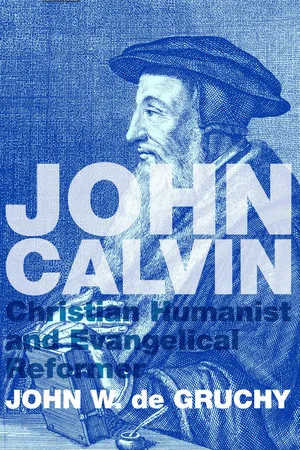
- 240 pages
- English
- ePUB (mobile friendly)
- Available on iOS & Android
eBook - ePub
About this book
2009 is the 500th anniversary of the birth of Calvin, the Reformed theologian whose legacy has played such an important role in the shaping of modern South Africa.
The popular understanding of him as grim moralist, proponent of predestination and a tyrannical God is a caricature, but one that does spring from aspects of Calvin's legacy.
In this book, De Gruchy attempts to restate the Reformed tradition as a transforming force, one that opposed slavery and apartheid and that participated in the struggle for liberation and transformation in this country.
De Gruchy considers Christian humanism to be an alternative to both Christian fundamentalism and secularism, as "being a Christian is all about being truly human in common with the rest of humanity", and has come to the conclusion that there is much to retrieve and celebrate in the Reformed tradition that is of importance for the ecumenical church and global society in the 21st century.
The "evangelical" element in the title refers to the literal meaning of the word - "good news" - which is at the heart of being both Christian and human.
Information
Topic
Theology & ReligionSubtopic
Religious BiographiesCHAPTER 1
TRADITION, CALVIN AND CHRISTIAN HUMANISM
Some historians may prefer to ignore or belittle him, but with a certain insistence, this frail, earnest Frenchman comes back to haunt their researches. At his own request, no stone marks his place of burial, but little of him is really buried there. His fame endures, and his influence will continue to defy time and oblivion … Prejudice and admiration alike have blundered. He was no paragon with the mind of an archangel, nor was he a finished saint. Nor yet was he a malicious and inhuman tyrant, but, rather, a highly gifted and unreservedly dedicated man, whose moral greatness was marred by serious defects of which Calvin himself was only too aware. John T McNeill1
In Calvin studies we cannot keep Calvin to what he once said as though he had nothing more or new to say today! Karl Barth2
ONE EVENING MY WIFE AND I WERE GUESTS FOR dinner at an restaurant in Hermanus, a town near where we live. I parked the car in the street outside and was approached by a parking attendant who indicated that he would take good care of it. I then asked him his name. “Calvin,” he replied. Having spent much of that day writing about Calvin, I was taken aback. “Where did you get your name?” I enquired. “It is,” he said, “the English for Xoliswa.” He then explained that he came from the Transkei and it was there that his parents gave him both names. I knew that Xoliswa is not the Xhosa word for Calvin, but I also knew that several churches of the Reformed tradition, including the Church of Scotland Mission, had had a strong presence in that region of South Africa. So I can only assume that somehow it was that connection that accounted for Xoliswa’s ‘English name’ being Calvin.
This little incident speaks volumes about the way in which a tradition is ‘reinvented’ – as some anthropologists use the term. Imagine the surprise on John Calvin’s face if he had witnessed this little cameo event, or the amazement of Dutch Calvinists in the seventeenth century who debated the question of God’s elect with the Arminians. Yet during that same century, Dutch economic expansion led to the planting of the Dutch Reformed Church in several far-flung regions of the world. Chief amongst them were New Amsterdam (now New York), Brazil, the East Indies and the Cape of Good Hope, and thence on to the Transkei. In this way, supplemented by French Huguenots in search of religious freedom, and followed by other branches of the Reformed family of churches and their mission societies, the tradition spread across the globe. Today, one of the largest concentration of churches of the Reformed faith is to be found in South Korea.
Between Calvin’s day and now, between Switzerland, Holland and the Transkei in South Africa, the tradition we now associate with the Genevan Reformer has not only influenced societies and cultures, churches and institutions, but, as I have suggested, been reinvented. By this I do not mean that those involved started from scratch, as is implied in the phrase ‘reinventing the wheel’. I mean that the inheritors of the legacy appropriated it in ways that were often different from the original, even though shaped by it and retaining a kind of family resemblance. It had to be so because the historical contexts were different. European missionaries of Calvinist orientation had to reformulate in Africa what they had imbibed back home in order to do their work, and the indigenous people whom they served had to do the same in relation to their own inherited traditions, perceptions and needs. I can assure the reader, if he or she does not already know it, that worship in African Reformed, Presbyterian or Congregational churches, while identifiably part of the Reformed family, is qualitatively different in character to that in Calvin’s Geneva or in Puritan England. To take another example: the role of the ancestors or ‘living dead’ is one of the hottest topics amongst Presbyterians in southern Africa today. But few if any ministers, let alone church members, have much knowledge of Calvin’s theology – even if they gave his name to their sons.
Re-forming tradition
Tradition is about handing on from one generation to another something that gives meaning to life and shapes the identity of people and communities. Events and their interpretation, perceived truths, cherished values, significant ideas, institutions, customs and rituals, memorials and works of art, whether on a grand scale or a more local one peculiar to villages, families, sports clubs, schools – all of this and more is what constitutes a particular tradition. And it is handed on by word of mouth, in written texts, constitutions, sacred books, minutes of meetings, as well as through multi-media, sermons and the like.
There is, however, a difference between traditionalism and living tradition. The former is dead, the latter dynamic and changing, always rediscovering itself, though always in continuity with its past. If this transmission stops, a tradition loses its significance except for the archivist and historian, and eventually dies. Retrieving the Christian tradition was what the Reformation was about in sixteenth-century Europe, and Calvin was exceptionally skilled and thorough in pursuing the task.
However loosely or firmly, everyone stands within a tradition. This is true also of those who turn their backs on the tradition that nurtured and formed them, as well as of the hermit who goes into the desert to be alone. Tradition shapes our identity even when we are critical of parts or reject it as a whole; it is our story and inheritance. That is why it is important to recognise that Calvin was a Catholic, born and bred. Such formative influences become deeply embedded, even though one may rebel against them as one passes from childhood through adolescence and into maturity. There are few pages in Calvin’s voluminous writings where he is not engaged in critical discussion with his Catholic heritage. In the same way, his education within the humanist ethos of the Renaissance left an indelible mark upon him, even though he engaged with it critically.
Living traditions are alive because they are always being contested from within and challenged from without. They are vital because, and only when, they embody “continuities of conflict”.3 This is how they are re-invented from one context to the next. Church history, which is the story of the transmission of Christian tradition, is one of unceasing contested interpretations, starting with that between Jewish and Hellenistic converts and reaching through the centuries to our day. Ecumenical engagement and dialogue is one way in which this process can be encouraged and enabled. Central to this process is the place of Scripture and the role it plays as the record of both the events that have generated the Christian tradition, and the way in which the tradition has been understood and interpreted in its formative centuries.
Tradition is a dynamic process. But the new is never totally so; it is always a growth out of the old, like new shoots on a well-pruned tree or bush. Cutting away the dead wood does not kill the plant (unless you cut much too radically); it allows the roots to be refreshed, to generate fresh sap, and to produce new growth. Traditions stay alive precisely because those who share them are in conversation with the past – for Christians, especially the testimony of Scripture – and in debate with each other about their meaning for the present. This may result in strong disagreement – even schism – but it is also the path to renewal. This is how traditions break open to appropriate the new, rather than break down. They are sustained by continual reconstitution. In times of crisis, when their significance is challenged and dependent on fresh formulation and practice, this becomes urgent. Otherwise tradition becomes moribund. Stuck in the past, it ends up distorting and even subverting its original significance. That is when tradition, as the Protestant Reformers claimed, becomes idolatrous custom. Who controls tradition and the interpretation of Scripture, and thus determines whether it is authentic or not, is an issue that goes to the heart of the Reformation controversy, and still divides the churches today.
Christian tradition is itself diverse, starting with the diversity of the strands of tradition in the Bible and reinventing itself through the centuries in a myriad contexts. So we speak rather loosely when we talk about the Christian tradition, the biblical tradition, the Orthodox, Catholic or Reformed traditions, because each is a very complex, sometimes even self-contradictory, set of beliefs, values, institutions, practices and rituals, that have changed over the course of time and continue to do so despite the claim of some that they have retained the tradition intact. Even the claim of Eastern Orthodoxy that it maintains Christian tradition, as embodied in the first seven Ecumenical Councils (those prior to the Great Schism between Constantinople and Rome in 1054), can be true only in so far as that tradition is handed on and embodied in new historical times and geographical locations. But in any case, the decisions of those Councils and the resultant ecclesial structures and practices were themselves developments in early Christian tradition. In principle, pending another Ecumenical Council, the tradition preserved can still be subject to further development – as has been the case within the Roman Catholic Church.
As a result of the Reformation, Western Christendom was not only divided into Catholic and Evangelical or Protestant spheres of influence, but the Evangelical/Protestant sphere was itself divided along Lutheran and Reformed lines, depending on the religious preferences of territorial princes and city magistrates. The Lutherans followed the teaching of the German Reformer and former monk, Martin Luther, whose break with Rome in 1517 set the Protestant movement in motion. The Reformed movement, though strongly influenced by Luther, grew out of the reformation in Switzerland which was led initially by Huldrych Zwingli, a priest and military chaplain, in Zurich, and then later by Calvin, a humanist lawyer turned preacher and evangelical reformer, in Geneva. Lutheran and Reformed had much, but not everything, in common. They have been referred to jointly as the ‘magisterial reformation’ because of the support given to them by secular authorities, in contrast to the more ‘radical reformation’ loosely identified as Anabaptist.4
Both Calvin and the Reformed tradition are open to diverse interpretation, as is evident in the history of Calvin reception and the way in which the Reformed tradition has found expression through the centuries, not least within South Africa. The Reformed tradition has not stood still since Calvin’s day, though some forms of Calvinism have tried to hold tenaciously to times past. Others, claiming to be Reformed, have tied off the umbilical cord and disowned their parents. Yet others again have sought to retrieve tradition in creative ways in relation to our contemporary experience and world. Perhaps the two most illustrious names that represent this last approach are those of Friedrich Schleiermacher,5 whom Karl Barth regarded as the “pioneer of modern theology”, and Barth himself. The fact that Barth disagreed so fundamentally with Schleiermacher, yet did so with such respect, is indicative of the range of interpretation that has marked the retrieval of the Reformed tradition over the past centuries. And it began with Calvin. In Serene Jones’ words:
Calvin took great liberties, often reshaping and reforming the [Christian] tradition so that it might more concretely respond to his co...
Table of contents
- TITLE PAGE
- A PERSONAL PREFACE
- CHAPTER 1: TRADITION, CALVIN AND CHRISTIAN HUMANISM
- PART 1: CALVIN AMONGST THE REFORMERS
- CHAPTER 2: ERASMUS AND LUTHER: THE DOVE AND THE WILD BOAR
- CHAPTER 3: ZWINGLI: HUMANIST, REFORMER, PROPHET and PATRIOT
- CHAPTER 4: THE YOUNG CALVIN: A REFORMER IN THE MAKING
- CHAPTER 5: CALVIN THE GENEVAN REFORMER
- CHAPTER 6: CALVIN AS DOCTOR OF THE CHURCH
- PART TWO: KEY THEMES IN CALVIN’S LEGACY
- CHAPTER 7: WORD AND SPIRIT
- CHAPTER 8: GOSPEL AND LAW
- CHAPTER 9: ELECTION AND GRACE
- CHAPTER 10: LITURGY AND EUCHARIST
- CHAPTER 11: BEAUTY, IMAGES AND CONTEMPLATION
- CHAPTER 12: SOCIAL HUMANISM AND PUBLIC LIFE
- A SOUTH AFRICAN EPILOGUE: The Future of Reformed Tradition
- SELECT BIBLIOGRAPHY
- INDEX OF PERSONS
Trusted by 375,005 students
Access to over 1.5 million titles for a fair monthly price.
Study more efficiently using our study tools.
Frequently asked questions
Yes, you can cancel anytime from the Subscription tab in your account settings on the Perlego website. Your subscription will stay active until the end of your current billing period. Learn how to cancel your subscription
No, books cannot be downloaded as external files, such as PDFs, for use outside of Perlego. However, you can download books within the Perlego app for offline reading on mobile or tablet. Learn how to download books offline
Perlego offers two plans: Essential and Complete
- Essential is ideal for learners and professionals who enjoy exploring a wide range of subjects. Access the Essential Library with 800,000+ trusted titles and best-sellers across business, personal growth, and the humanities. Includes unlimited reading time and Standard Read Aloud voice.
- Complete: Perfect for advanced learners and researchers needing full, unrestricted access. Unlock 1.5M+ books across hundreds of subjects, including academic and specialized titles. The Complete Plan also includes advanced features like Premium Read Aloud and Research Assistant.
We are an online textbook subscription service, where you can get access to an entire online library for less than the price of a single book per month. With over 1.5 million books across 990+ topics, we’ve got you covered! Learn about our mission
Look out for the read-aloud symbol on your next book to see if you can listen to it. The read-aloud tool reads text aloud for you, highlighting the text as it is being read. You can pause it, speed it up and slow it down. Learn more about Read Aloud
Yes! You can use the Perlego app on both iOS and Android devices to read anytime, anywhere — even offline. Perfect for commutes or when you’re on the go.
Please note we cannot support devices running on iOS 13 and Android 7 or earlier. Learn more about using the app
Please note we cannot support devices running on iOS 13 and Android 7 or earlier. Learn more about using the app
Yes, you can access John Calvin by John W. de Gruchy in PDF and/or ePUB format, as well as other popular books in Theology & Religion & Religious Biographies. We have over 1.5 million books available in our catalogue for you to explore.