eBook - ePub
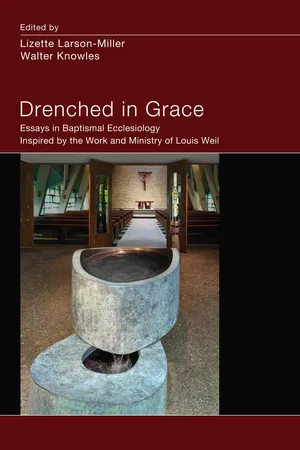
Drenched in Grace
Essays in Baptismal Ecclesiology Inspired by the Work and Ministry of Louis Weil
- 252 pages
- English
- ePUB (mobile friendly)
- Available on iOS & Android
eBook - ePub
Drenched in Grace
Essays in Baptismal Ecclesiology Inspired by the Work and Ministry of Louis Weil
About this book
The importance of baptism within Christian history, theology, and practice is of the first order. Rooted in Christian Scripture, baptism is initiation into Jesus Christ and the sacramental beginning of engagement with the church, the body of Christ. In recent decades, the relationship between baptismal theology and ecclesiology has changed. Rather than focusing solely on the implications of baptism for individuals, the center of theological conversation has moved increasingly to the nature of baptism as formative of the church.
One of the pioneers in exploring this theological issue in the United States has been the Rev. Dr. Louis Weil, who, from the time he helped author the 1979 Book of Common Prayer, has advocated for an approach called "baptismal ecclesiology." In a number of essays since the 1980s, Dr. Weil has encouraged an increasingly ecumenical conversation around this particular approach to ecclesiology. This ecumenical collection of essays by a distinguished and international group of sixteen scholars continues the conversation on liturgy and ecclesiology begun by Fr. Weil.
Information
Subtopic
Rituels et pratiques chrétiensBaptismal History Informing the Present
1
Bodies at Baptism
The sacrament of Baptism is the tangible and corporeal event in which divine grace is being poured out onto bodies in the encounter with Christ. Baptism is the sacrament of deliverance and deep transformation. The human person who is entangled in the powers of sin as alienation from God, neighbor, and the planet Earth is rescued. In Baptism, thus, a saved body emerges through ritual acts that are attentive to words that bear divine promise and to material elements such as water and oil that carry the powers of cleansing, forgiveness, and healing. Both words and elements are directed towards the body being baptized.
There is an intimate dimension to Baptism that lifts up the singularity of the individual person before God: Right before Baptism one’s name is uttered and placed in HaShem, whom Christians confess as the Triune God.1 At the same time Baptism is the initiation rite through which individuals become part of a communal body, the church as the body of Christ. In the rite of Baptism, people are absorbed into the body of Christ through water, Word, and Spirit—a body so porous and fluid that human beings can be immersed in it. Belonging to Christ through Baptism evokes a loss of self as egocentric autopoeisis. This loss is acted out in ritualized gestures that pertain in particular ways to the body. These gestures hint at an eccentric understanding of belonging: a particular name is voiced in the assembly and becomes immediately immersed in Divine Mystery. Even in the act of dying, an eccentric dynamic emerges: those who are baptized die and rise with Christ. In this interrelatedness a new identity emerges that is signified in the wearing of a new garment.
Baptism can thus be perceived as ritual space of Christian identity formation that is intimate, eccentric, communal, and cosmological. The cosmological dimension transpires through the element of water—the connecting tissue between the individual body and the planet; both depend on it as a matter of death or life. Many early depictions of baptismal rites and theologies imply an understanding of the connection between the physical body and the cosmos that is most intriguing for contemporary discussions that seek to emphasize the theological significance of the ecological dimension of this water ritual.2 Dale Martin spells out the connection between the microcosmic body of the individual and the macrocosmic body: they resemble each other in terms of the basic materiality of that they consist. They also bear similarities in terms of the way they function in the creation of a healthy balance.3 These speculations about the micro and the macro body can be found in Plato, pre-Socratic philosophers, and Hippocratic medical theory who converge:
in assuming that the human self (body and soul) was composed of the same elements as the universe: air (pneuma), earth, water, and fire. Thus the dynamics that one saw at work in the external cosmos could be read onto and into the human body, the inner body being buffeted by the same weather as the outer body. . . . As is already apparent, construing the body as really (not just figuratively) a microcosm blurs any boundaries between the inner and the outer body. The workings of the internal body are not just an imitation of the mechanics of the universe; rather, they are part of it, constantly influenced by it.4
In acts of renunciation, anointing, and in immersion the permeability of the microcosmic and the macrocosmic body becomes tangible. What is “inside” the body has an intense relationship to the “outside”—the environment that shapes embodied living every moment as we breathe in and out. For Cyril of Jerusalem, for example, the oil used for exorcisms has the power to drive away the enemy’s power, and the breath of the saints can drive out devils. Oil and breath have the capacity to enter the porous body through the skin and other body openings and to remove evil spirits that hover inside.5
It thus seems to be of pivotal theological significance to pay attention to what happens to bodies in Baptism. The saved body is ritualized into existence; from there meaning making and corporeal interpretation emerge. Drawing on a deconstructivist understanding of embodiment as practice, we are led to ask how the saved body emerges from this ritual as words are sung and spoken over the body and things are done to the body. Interpellations (Anrufungen) that speak particular bodies into existence as well as the gaze of the gathered assembly that rests upon the body to be baptized come into focus.6
A phenomenologically oriented approach to embodiment will also take the subjective dimension into account that explores the felt sense of the participants. Attending to the historical documents that are available to us, we need to acknowledge that there are not very many sources in which participants describe their embodied felt sense of Baptism. One treasured exception is the witness that Ephrem the Syrian (306–73) gave about his own Baptism: “For when the waves of oil lift me up, they hand me over to the sayings about Christ, and then the waves of Christ bear me back to the symbols (mysteries) of oil. The waves meet each other, and I am in their midst.”7 His own Baptism evokes in Ephrem a sense of being overwhelmed; he captures this sense in the wave image: He is carried away on the mighty waves of anointing that evoke an interplay between the teachings about Christ and the sensual experience of anointing. In the dramatic synaesthetic interplay of the audible, the tactile and the olfactory, the baptismal event unfolds.
In what follows, I seek to explore the attention that is given to bodies at Baptism and the theological significance this body awareness might imply. I claim that the performative dimension of bodily engagement in Baptism is pivotal for baptismal theology. I proceed by highlighting two historical examples for the sake of further constructive theological work.
Standing naked without shame
I begin with some glimpses into the Mystagogical Catechesis of Cyril of Jerusalem (fourth century) by focusing on the significance of nakedness. Cyril offers homilies for the neophytes that retrospectively interpret the meaning of the Baptism they had received. The body technologies these homilies reflect are couched in thick descriptions of the tangible quality of the rites themselves. Woven into these descriptions we find intense processes of meaning making, in that the body practices described become an intense field of theological explanation. What is written onto the body becomes almost a site of revelatory knowledge, filled with references to Scripture and theological allusions. Cyril speaks of bodily practices as symbolizing something. Cyril often times juxtaposes symbol and reality in a Platonic way indicating that the symbol is less real than the thing it symbolizes. He nevertheless assumes an ontology of participation that means that the body participates in the reality it signifies.
Cyril explains what happened upon entry into the baptistery:
Upon entering [the baptistery] you took off your clothing, and this symbolised your stripping off of “the old nature with its practices.” Stripped naked, in this too you were imitating Christ naked on the cross, who in his darkness, “disarmed the principalities and powers” and on the wood of the cross publicly “triumphed over them.” . . . This was a remarkable occasion, for you stood naked in the sight of all and you were not ashamed. You truly mirrored our first-created parent Adam who stood naked in Paradise and was not ashamed.8
The interpretation of nakedness these sequences provide is preceded by a reading of Romans 6 that alludes to Baptism into Christ’s death; the cited passage is followed by a description of prebaptismal anointing with exorcistic functions. Then the actual baptismal act happens.
What is written onto the bodies of those who stand naked is the departure of the old nature, of Adam after the fall, a body in whose limbs corrupted desire has lurked. What emerges is Adam in paradise, a body that stands naked and is not ashamed. The naked body right before Baptism is thus already placed in the garden of paradise. The naked body before Baptism does not know shame anymore.9 Also, in the act of standing naked, Christ on the cross is imitated. The place of deepest despair and vulnerability becomes the place of disarming power. Nakedness thus becomes a means for the performance of eccentric identity in relation to Christ and to the garden of creation. It is a technology of the body that initiates transformation with regard to shame and power. The scene as depicted...
Table of contents
- Title Page
- Contributors
- Introduction
- Part 1: Baptismal History Informing the Present
- Chapter 1: Bodies at Baptism
- Chapter 2: Incorporate into the Society of the Spirit
- Chapter 3: “Putting on Christ”
- Part 2: Baptismal Process Making Church
- Chapter 4: Baptism and the Journey of Christian Initiation
- Chapter 5: Confirmation
- Chapter 6: Baptismal Ecclesiology without Baptism?
- Chapter 7: “Be joyful . . . all you little children are invited to the feast.”
- Part 3: Baptismal Faith Healing Division
- Chapter 8: Morgan Dix and the Catholic Revivalin the Episcopal Church
- Chapter 9: The Gorham Controversy and Infant Baptism as an Ecumenical Problem
- Chapter 10: A Primatial Grace for a Baptismal Church
- Chapter 11: Charism, Patrimony, or Ethos?
- Part 4: Baptismal Life Transforming the World
- Chapter 12: Committed to Earth’s Waters for Life
- Chapter 13: Practical Ecclesiology
- Chapter 14: Baptized into the Catholic Future
- Chapter 15: Toward a Baptismal Spirituality
- Chapter 16: Louis Weil
- Selected Lectures and Writings of Louis Weil
Trusted by 375,005 students
Access to over 1.5 million titles for a fair monthly price.
Study more efficiently using our study tools.
Frequently asked questions
Yes, you can cancel anytime from the Subscription tab in your account settings on the Perlego website. Your subscription will stay active until the end of your current billing period. Learn how to cancel your subscription
No, books cannot be downloaded as external files, such as PDFs, for use outside of Perlego. However, you can download books within the Perlego app for offline reading on mobile or tablet. Learn how to download books offline
Perlego offers two plans: Essential and Complete
- Essential is ideal for learners and professionals who enjoy exploring a wide range of subjects. Access the Essential Library with 800,000+ trusted titles and best-sellers across business, personal growth, and the humanities. Includes unlimited reading time and Standard Read Aloud voice.
- Complete: Perfect for advanced learners and researchers needing full, unrestricted access. Unlock 1.5M+ books across hundreds of subjects, including academic and specialized titles. The Complete Plan also includes advanced features like Premium Read Aloud and Research Assistant.
We are an online textbook subscription service, where you can get access to an entire online library for less than the price of a single book per month. With over 1.5 million books across 990+ topics, we’ve got you covered! Learn about our mission
Look out for the read-aloud symbol on your next book to see if you can listen to it. The read-aloud tool reads text aloud for you, highlighting the text as it is being read. You can pause it, speed it up and slow it down. Learn more about Read Aloud
Yes! You can use the Perlego app on both iOS and Android devices to read anytime, anywhere — even offline. Perfect for commutes or when you’re on the go.
Please note we cannot support devices running on iOS 13 and Android 7 or earlier. Learn more about using the app
Please note we cannot support devices running on iOS 13 and Android 7 or earlier. Learn more about using the app
Yes, you can access Drenched in Grace by Lizette Larson-Miller,Walter Knowles, Larson-Miller, Knowles in PDF and/or ePUB format, as well as other popular books in Théologie et religion & Rituels et pratiques chrétiens. We have over 1.5 million books available in our catalogue for you to explore.