eBook - ePub
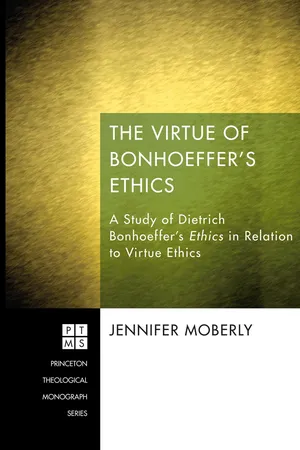
The Virtue of Bonhoeffer’s Ethics
A Study of Dietrich Bonhoeffer’s Ethics in Relation to Virtue Ethics
- 270 pages
- English
- ePUB (mobile friendly)
- Available on iOS & Android
eBook - ePub
The Virtue of Bonhoeffer’s Ethics
A Study of Dietrich Bonhoeffer’s Ethics in Relation to Virtue Ethics
About this book
Does Dietrich Bonhoeffer's Ethics have any affinities with what we have now come to call virtue ethics? If so, what is the relationship between those affinities and the more widely recognized influence of Karl Barth? Moberly seeks to answer these questions through close analysis of the Ethics and engagement with other interpreters of Bonhoeffer, while discussing the nature of virtue ethics in a Christian context. The answers may be surprising, but they are certainly rewarding for anyone wanting to better understand Bonhoeffer and to see how his work could be helpful for current ethical debates.
Information
Topic
Theology & ReligionSubtopic
Christian Theology1
Introduction
The title of this book, “The Virtue of Bonhoeffer’s Ethics,” is meant to suggest the inherent strengths of his work, one of which, I will claim, is the presence of both virtue ethical and divine command modes of ethical discourse. As the subtitle makes clear, however, the central question of this study is how Bonhoeffer’s Ethics is related to virtue ethics. Of course, the question presupposes the possibility of a variety of answers: that the two are utterly unrelated; that there was no intended relationship, even if a reader now may make correlations through her own perspectives that she brings to the reading; that there is an intentional relationship, even if the Ethics is not simply an example of virtue ethics; that Bonhoeffer was unwittingly so influenced by others that his account is one of virtue ethics; or that Bonhoeffer quite purposefully set out to offer a Protestant construal of virtue ethics. In the following book I shall endeavor to discover which of these possibilities accords best with the evidence, and to see what “virtue” this might entail for the current situation in theological ethics.
1.1: Rationale for Study—Introduction
A study such as this must necessarily face difficult questions at the outset: Why should it be undertaken? and, Why should it be read? Given that the aim of this book is to examine the relation of Bonhoeffer’s Ethics to what is now called “virtue ethics,” one might fairly consider that there are already more than enough books on both Bonhoeffer and virtue ethics. Yet although some scholars have seen the possibility of interpreting Bonhoeffer’s Ethics with reference to virtue ethics or have at least identified “conformation” as one of the leitmotifs of the work (and have seen it as in some sense related to virtue ethics), no sustained attention has hitherto been given to the question of how Bonhoeffer’s Ethics as a whole might be related to virtue ethics. Since the existence of this lacuna is not necessarily sufficient justification either to undertake or read such a study, what reason might there be?
One reason, paradoxically, may be the reason mentioned already not to engage in such a project: the sheer number of studies already available about virtue ethics. The impact of Alasdair MacIntyre’s (and others’) work has been such that the central concerns articulated in virtue ethics (the character of the ethical agent, her continuity and development over time, her motives for acting, etc.) have been widely recognized to be of real significance, even by those who do not include them in their primary account of the nature of ethics. To appreciate the impact the resurgence of virtue ethics has had, and the questions emerging from this development (and thereby the potential significance of this study), it may be helpful to consider more generally the theological background of this development.
1.2: A Theological Backdrop
The two actors taking the centre stage of this study will be Bonhoeffer’s Ethics and virtue ethics, but before the reader’s attention is focused solely on these two, it is good to observe the theological backdrop, which provides important clues as to the meaning of the action taking place, as well as parameters and perhaps even constraints for the play as a whole. As with any stage scenery, this is necessarily painted with broad brushstrokes, and should be taken as a general view of the landscape rather than a surveyor’s map.1
1.2.1: Justification by Faith
On one side of the stage, a key doctrine of the Reformation is represented, for the article of faith on which Martin Luther said the church stands or falls—namely justification only by faith, only by grace, and not by works—was to be one of the determining factors for how Christian ethics may be conceived.2 The early Luther followed the Augustinian and Thomist traditions in expecting that God truly makes the believer righteous, but from late 1518 he began to speak of her having an “alien” righteousness through being in Christ.3 She is righteous because God has declared her to be so and has imputed to her the righteousness that belongs to Christ. This came to be called a “forensic” notion of justification because of the courtroom language typically deployed of God as Judge, acquitting the believer. Moreover, the Christian was said to be simultaneously a sinner and righteous, and Luther was unwilling to consider any of her actions as having “merit.” Although Luther did speak of good works as a necessary consequence of faith, these were said to have nothing to do with a sinner being declared righteous, justification.4
Turning to view the backdrop of the other side of the stage, the Roman Catholic understanding of justification as articulated in the Council of Trent was that it consists both of the remission of sins and sanctification. God’s prevenient grace works in a person to dispose her towards conversion, and although she, of course, could not become righteous before God apart from God’s grace, her will is nonetheless to be active so that she co-operates with that grace. Thus the council stated that justification is not by faith only, but faith accompanied by hope and love. Moreover, the believer was expected to grow in holiness (described both in terms of justification and sanctification), and eternal life is both a gift of grace and a reward for her life-long merit. Similarly, although Christ infuses virtue, that virtue can be said to be the believer’s, as can the works (and their merit) that are thus enabled.5 A distinction was made between merit that is appropriate, de congruo, to a human, and merit that is genuinely “worthy,” de condigno, which can only be granted by God’s gracious act.6 Thus a Christian may be said not only to grow in holiness, but also in “merit” (even if merit that is appropriate to a human is limited), and to become by degrees less sinful as she exercises the virtues. In this conception, then, Luther’s language of receiving an “alien” righteousness was all but incomprehensible, and seemed to suggest that God, who is all truth, was party to some pretence or even deceit. Luther was thus seen to impugn God’s character by suggesting that God was involved in some fiction by declaring the believer righteous when she was really a sinner. God, it was insisted, does not declare a person righteous without making her so. Grace is given by God, but must be used aright to do “meritorious” works, which would prove the believer worthy of the grace given.7 The contrast between this position and that espoused by Luther was such that many thought of him as being “antinomian” or allowing for moral anarchy, and indeed the council’s decree on justification concluded with 29 anathemas related to Protestant teachings.8
Yet, returning to the first side of the scenery, Luther was horrified by being labeled an antinomian. In his preaching and teaching he emphasized the change of life that being in Christ certainly must make in the believer. He described faith as being “a divine work in us which changes us and makes us to be born anew of God, John 1. It kills the old Adam and makes us altogether different men, in heart and spirit and mind and powers; and it brings with it the Holy Spirit. O, it is a living, busy, active, mighty thing, this faith. It is impossible for it not to be doing good works incessantly.”9
Yet talk of a supposed growth in holiness or merit in any form made him all the more polemical in his insistence that the believer remains a sinner, and that her only righteousness or merit is what is given her in Christ. Although a careful distinction was made by Roman Catholic theologians between virtue that may be called salvific (which must be given, or “infused” by God) and such virtue that a person may achieve through her own practice and habit, such accounts accorded more place to human effort (and less to God’s sovereign act) than Luther and other Protestants would accept. It was asserted that Roman Catholics in fact believed in “justification by works,” and that Roman moral theology did not take seriously enough the consequences of the Fall, both in terms of its damage to the believer’s ability to choose the good and her capacity to do it.
Naturally enough, on the Catholic side it was felt that Protestants emphasized too little the need for the believer’s will to be aligned with God’s and thus for her to participate by choosing to act well. Furthermore, Roman Catholic moral theology considered at least part of God’s will to be accessible to anyone by rational thought through what is called the natural law.
Against this, the Protestant front upheld not only Augustine’s belief that as a result of the Fall the human will is not free to choose the good, but also that human reason itself is vitiated and incapable of discerning God’s will apart from God’s revelation.
Unsurprisingly, the mutual misreadings, polemical discourse, and a papal bull excommunicating Luther did nothing to bring these two sides together to hear and appreciate how much they had in common.10 Instead a seemingly widening gulf o...
Table of contents
- Title Page
- Foreword
- Preface
- Acknowledgments
- Abbreviations
- Chapter 1: Introduction
- Chapter 2: Bonhoeffer and “Virtue Ethics”
- Chapter 3: Virtue Ethics in the Christian Tradition
- Chapter 4: Bonhoeffer’s Ethics as Virtue Ethical
- Chapter 5: Mode of Ethical Discourse
- Chapter 6: Divine Command and/or Virtue Ethics
- Chapter 7: Conclusion
- Bibliography
- Index
Trusted by 375,005 students
Access to over 1.5 million titles for a fair monthly price.
Study more efficiently using our study tools.
Frequently asked questions
Yes, you can cancel anytime from the Subscription tab in your account settings on the Perlego website. Your subscription will stay active until the end of your current billing period. Learn how to cancel your subscription
No, books cannot be downloaded as external files, such as PDFs, for use outside of Perlego. However, you can download books within the Perlego app for offline reading on mobile or tablet. Learn how to download books offline
We are an online textbook subscription service, where you can get access to an entire online library for less than the price of a single book per month. With over 1.5 million books across 990+ topics, we’ve got you covered! Learn about our mission
Look out for the read-aloud symbol on your next book to see if you can listen to it. The read-aloud tool reads text aloud for you, highlighting the text as it is being read. You can pause it, speed it up and slow it down. Learn more about Read Aloud
Yes! You can use the Perlego app on both iOS and Android devices to read anytime, anywhere — even offline. Perfect for commutes or when you’re on the go.
Please note we cannot support devices running on iOS 13 and Android 7 or earlier. Learn more about using the app
Please note we cannot support devices running on iOS 13 and Android 7 or earlier. Learn more about using the app
Yes, you can access The Virtue of Bonhoeffer’s Ethics by Jennifer Moberly in PDF and/or ePUB format, as well as other popular books in Theology & Religion & Christian Theology. We have over 1.5 million books available in our catalogue for you to explore.