- 118 pages
- English
- ePUB (mobile friendly)
- Available on iOS & Android
eBook - ePub
About this book
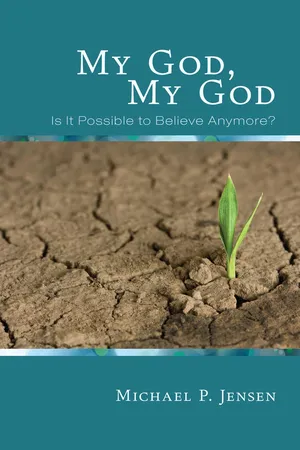
Once upon a time, it was not so difficult to believe. Believing in God was like breathing. It was a second sense of which people were hardly aware. But in an age when our faith is mainly in science and technology, is it possible to believe anymore?
Michael P. Jensen takes a searching look at what makes us believe--or not believe--in God in this contemporary world. He converses with troubled souls, cranks, crackpots, and conspiracy theorists, and even with the devil himself.
This entertaining and stimulating journey through the underworld of our beliefs will have you wondering whether things are always what they seem.
Information
Topic
Theology & ReligionSubtopic
Biblical StudiesOne
Believe It, or Not
. . . I think that I still have some sort of faith or something. But I can’t really pinpoint what that means at this point in time.
Sarah Blasko, musician
I Believing Now and Then
What does it take for a person to have a faith in God in the twenty-first century?
What you are about to read is an attempt to answer this most personal, and for many people most pressing, of questions. But we need to be aware of the context in which this wrestle to believe takes place. Most of us are, at least vaguely, aware that having a religious faith has not been as complex a matter at other points in history as it is today. Some would even argue that to own up to a faith in a deity of any kind is to admit to a kind of intellectual and personal dishonesty. For others, such as the Australian musician Sarah Blasko (1976–), who grew up as the child of evangelical missionaries, faith is still there but somehow indefinable and distant.1
Is “faith”—whatever that is—even possible anymore?
Once upon a time, it was not so difficult to believe. Believing in God was like breathing. It was a second sense of which people were hardly aware. Even with a man as rational as the great English philosopher John Locke (1632–1704) in the seventeenth century, lack of religious belief was an extraordinary and aberrant thing that wasn’t worth tolerating because it must surely lead to social chaos and even treasonable behavior. Philosophers like the great medieval thinkers Anselm of Canterbury (1033–1109) and Thomas Aquinas (1225–74) offered their famous arguments for the existence of God not because they imagined that they would convince a non-believer but because they saw them as confirming what believers (that is, everybody) knew to be already true.
Not only was the world self-evidently the handiwork of the Creator, but it was also the case that it was shot through with his divinity. Divinity oozed from physicality. You could pick up a handful of earth and feel that it had more to it than the solid: that it had in it some spirit. And that was because the dirt crumbling in your fingers and sticking underneath your fingernails was a link, however small, in a great chain of being that had its anchor point on the highest being—namely, God. Human beings too, for all their earthiness, were a part of this great connected whole in which they could actively participate through prayers and other religious acts, mediated through the agency of the church. The “divine” and the “natural” were not separate explanations for the workings of the world.
Today we like to think of believing, as we like to think of many things, as primarily a choice. We think of our religious views as a preference—not a trivial one, it should be granted, but a preference nonetheless. It’s highly personal, as most choices are. What’s more, believing in God has become a highly contested choice, vehemently challenged by some of the most prominent intellectuals of our times.
How has this come about? It would be too easy to say that the rise of the scientific worldview is the culprit. That is a common way of telling the story: as science and technology have enabled us to grasp the world more successfully and efficiently, the less mysterious the world has seemed. Take medicine, for example: once we could talk about bacteria and viruses and their effects, we could start addressing illnesses without supposing that a priest—or a witch—is going to have a great deal to contribute either way. It is true that science has provided alternative explanations of the workings of the world that at many points make it apparently unnecessary to appeal to a divine power. But that would be to miss the story of how the scientific worldview come to prominence in the first place; and how it depended for its emergence on certain changes in the way faith and belief were thought of in Western Europe. The scientific worldview did not cause the change in the nature of believing, since it arose at the same time as the changes themselves took place.
That change had to do with the extraordinary movement within Western Christianity: the Reformation of the sixteenth century. The Reformation was a revolution in the idea of faith itself.2 It took the central notion of “faith” to mean not merely “believing certain propositions to be true and others to be false” but the giving of the whole of one’s self in deep trust to the promises of God. This idea was not entirely novel, but the emphasis put upon it by thinkers like the great Reformer Martin Luther (1483–1546) certainly was. The big thing that connected you to the divine world was now an inward and individual matter, whereas before this the external work of baptism was held to be the ground of your religious life. And this believing, this faith, was part of your life’s story: it was now possible to tell a story of not believing and then believing, of coming to know what trust in the promises of God was as the Spirit of God did its work on you and you changed. Though the Reformers were adamant that faith itself was a work of God in the human person, it was still the case that the human person’s will, reason, and affections were involved in the getting of faith. Even if one ought retrospectively to speak of the illumination of God’s Holy Spirit working in your heart to bring faith to flame, the experience of coming to faith felt certainly as if it involved one’s hearing, understanding, and a moment of decision. At this point, faith became an act of the will—a reality decided upon. It is mine to choose; and mine to reject.
Instead of seeing God’s presence rippling through nature, the Reformers warned of the danger of confusing the created things with the Creator himself. They saw—or rather, heard—God’s voice in the Bible, the Word of God. This was God’s powerful and singular instrument to work on the human heart. And you didn’t have to perform gymnastics of interpretation to hear it. To look elsewhere was to miss the point—to stop up one’s ears to the saving message of God’s love.
But this shift in outlook was extraordinary because it actually empowered the investigation of the world. Peter Harrison (1955–), Research Professor at the University of Queensland and a Senior Research Fellow at the Ian Ramsay Centre in Oxford, writes:
. . . the idea, first proposed in the seventeenth century, that nature was governed by mathematical laws, was directly informed by theological considerations. The move towards offering mechanical explanations in physics also owed much to a particular religious perspective. The adoption of more literal approaches to the interpretation of the Bible, usually assumed to have been an impediment to science, also had an important, if indirect, role in these developments, promoting a non-symbolic and utilitarian understanding of the natural world which was conducive to the scientific approach.3
If anything, the leading theologians of the Protestant movement were keen to emphasize the sheer transcendent otherness of God—his separateness from the world. If anything, the gospel of the bleeding and dying Jesus Christ revealed to humankind the radical alienation of humankind from the divine being. The significance of this separation of God from his creation was that the world’s natural processes became available for study on their own terms, without the confusion of a metaphysical explanation. As Harrison argues, this was the beginning of the scientific revolution, and a revolution in the way people in the West thought about believing in God.
In turn, this new explanation of God is related to the world is crucial to understanding what people generally think themselves to be doing when they accept or reject religious faith in the twenty-first century. The story we most commonly tell ourselves is that religious faith is in rapid decline because scientific knowledge is increasing. And yet the picture is actually more complex. What lies at the heart of the story of belief during the time of post-Christian late modernity is in fact a piece of theological thinking about the nature of God’s relationship to the world and the kind of thing human beings are doing when they say they believe—or don’t believe—in a being like God.
II The Unchooseable Choice
But we need to pause here and retrace our steps somewhat, because there’s a complication to the story—a complication I call the “unchooseable choice” condition. It is true that people today speak of belief in God as something that one chooses for oneself. But there’s a contradiction here, too. People also characteristically speak of being religious or not as something about themselves that they can’t change and that just “is”—like their eye color or race. They will say “I am not a religious person.” Philosopher Alain de Botton (1969–) has spoken of his unbelief as if it was inescapable fact about him that was not at all open to revision or question regardless of any choice he might make:
I cannot be sure why I am a non-believer exactly. Surely much does have to do with the way I was raised in a family of non-believers, and a rational outlook very much at the fore. So the key question for me isn’t whether one should believe or not, but where one goes to—as an atheist—once the non-existence of God is clear.4
Religious beliefs, or the lack of them, are so deeply ingrained in us from childhood that we can close off a conversation about religious matters by simply referring to our particular upbringing. “I was raised a Presbyterian,”5 for example, is what people say when they mean “I really don’t want to talk about religion, thanks just the same.” So, we have a choice that, ironically, many people feel they can’t choose.
Scott Adams (1957–), author of the comic strip Dilbert, makes a perceptive comment about this on his blog.6 He starts with the assertion that “research indicates that some people are born with a natural inclination for belief and some are not.” He puts himself in the latter category: he’s a born non-believer. He is certainly not opposed to religious belief and is even strongly positive about its benefits. Being religious is a very strong indicator of better health and a more satisfying life. He is even happy to consider his lack of ability to believe as something of a handicap. He just can’t shake the impression that all of us (atheists or theists) are deluded about our grasp of “the real” or “the truth.”
This condition is part of a deeper paradox at the heart of the culture of the West. It’s a paradox which reverberates right through Western politics, science, economics, and education, and which has no obvious philosophical solution. It’s this: on the one hand, we exalt the notion of human autonomous free will. It’s a fine idea, all right: liberty is an aspiration which lends the human individual dignity and enables us to talk about the rights and duties we owe each other regardless of skin color or gender. The freedom to pursue happiness is the basis of our consumer economy, and of our system of justice, in which we hold individuals largely responsible for their actions as far as we can. We expect it from each other. And yet at the same time, various branches of human knowledge are offering powerful descriptions of the human condition as entirely and comprehensively determined by factors outside of our control—whether that be genes, natural selection, brain chemistry, our parents, or whatever else. So, the whole idea of free choice may turn out to be a grand illusion. That’s certainly the argument of leading New Atheist Sam Harris (1967–) in his book Free Will. “The facts tell us,” Harris announces like some latter-day Gradgrind,7 “that free will is an illusion.”8 And it is one we would be better rid of, since in Harris’s view it corrupts our moral thinking.
There’s a false dilemma here. True, the idea of picking through the various religious options, testing each as if you were evaluating the ripeness of an avocado in the supermarket, is an appealing myth, but nothing more. We’d love to think of ourselves as standing independently over all the possible choices and selecting one (or none) with a dispassionate logic and complete freedom.
But the reality is of course that we don’t do anything of the kind. We are a bundle of predispositions and preferences, marked by our experiences and relationships and shaped by our genetic makeup. When we choose, we make a decision in media res, in the middle of things, with time ticking away and with event...
Table of contents
- Title Page
- Chapter 1: Believe It, or Not
- Chapter 2: Love, Loss, and Death
- Chapter 3: The Devil He Does
- Chapter 4: The Patience of Faith
- Chapter 5: Living in the World of Experts
- Chapter 6: Getting the Joke
- A Note of Thanks
- Bibliography
Trusted by 375,005 students
Access to over 1.5 million titles for a fair monthly price.
Study more efficiently using our study tools.
Frequently asked questions
Yes, you can cancel anytime from the Subscription tab in your account settings on the Perlego website. Your subscription will stay active until the end of your current billing period. Learn how to cancel your subscription
No, books cannot be downloaded as external files, such as PDFs, for use outside of Perlego. However, you can download books within the Perlego app for offline reading on mobile or tablet. Learn how to download books offline
Perlego offers two plans: Essential and Complete
- Essential is ideal for learners and professionals who enjoy exploring a wide range of subjects. Access the Essential Library with 800,000+ trusted titles and best-sellers across business, personal growth, and the humanities. Includes unlimited reading time and Standard Read Aloud voice.
- Complete: Perfect for advanced learners and researchers needing full, unrestricted access. Unlock 1.5M+ books across hundreds of subjects, including academic and specialized titles. The Complete Plan also includes advanced features like Premium Read Aloud and Research Assistant.
We are an online textbook subscription service, where you can get access to an entire online library for less than the price of a single book per month. With over 1.5 million books across 990+ topics, we’ve got you covered! Learn about our mission
Look out for the read-aloud symbol on your next book to see if you can listen to it. The read-aloud tool reads text aloud for you, highlighting the text as it is being read. You can pause it, speed it up and slow it down. Learn more about Read Aloud
Yes! You can use the Perlego app on both iOS and Android devices to read anytime, anywhere — even offline. Perfect for commutes or when you’re on the go.
Please note we cannot support devices running on iOS 13 and Android 7 or earlier. Learn more about using the app
Please note we cannot support devices running on iOS 13 and Android 7 or earlier. Learn more about using the app
Yes, you can access My God, My God by Michael P. Jensen in PDF and/or ePUB format, as well as other popular books in Theology & Religion & Biblical Studies. We have over 1.5 million books available in our catalogue for you to explore.