eBook - ePub
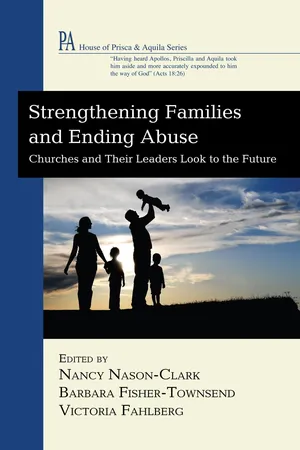
Strengthening Families and Ending Abuse
Churches and Their Leaders Look to the Future
- 322 pages
- English
- ePUB (mobile friendly)
- Available on iOS & Android
eBook - ePub
Strengthening Families and Ending Abuse
Churches and Their Leaders Look to the Future
About this book
Strengthening families of different varieties and ending abuse in the myriad of forms through which it surfaces is God's way of bringing peace and safety to Christian homes across the world. We challenge congregations, their leaders, and the men, women, and youth who faithfully support them to consider their personal role in bringing this vision--inspired by the Scriptures--into reality. Together our voices can be strong.
We are united in our belief that every home should be a safe home, every home a shelter from the storms of life, every home a place where we are supported, treated with respect and dignity, and every home a place where men and women are encouraged to be all they can be. It is a tall order. It is a dream to guide our personal conduct and to measure our congregational and community life. We are far from reaching this goal--but toward it we strive.
Information
Topic
Theology & ReligionSubtopic
Christian ChurchPart I:
Strengthening Families
1
Introduction
In so many ways, this book represents a transitioning phase for us personally and for the work of PASCH—Peace and Safety in the Christian Home—an organization begun by the late Dr. Catherine Clark Kroeger in January of 2004. PASCH reflected the Jewish notion of Passover, the time of new beginnings. To its founder, our beloved Cathie, it drew its strength from the Biblical mandate to bring safety and respite, as well as practical and spiritual resources, to those who were suffering the impact of abuse in their family context.
We were Catherine’s co-laborers in the vineyard of PASCH, as were those whose work is represented in the various chapters of Strengthening Families and Ending Abuse. By her enthusiasm and dogged determination, Dr. Kroeger drew in a wide circle of people to advance the cause of violence in families of faith. She wanted us to speak out against every form of violence and to use our prophetic voices to call religious leaders, ordained ministers, and those who faithfully attend congregational life to do likewise. She challenged us, and by her actions, enabled us to challenge others to offer a wide variety of services and resources to women, men, teens, and children who found themselves caught in the web of abuse.
Over the course of seven years, from its early days in 2004, until the year of her death in 2011, PASCH sponsored five major conferences. These were held in Newport Beach, California (2005), Boston, Massachusetts (2006), Portland, Oregon (2007), Washington, D.C. (2008) and Abbotsford, British Columbia (2011). Based on several plenary sessions and workshops held at these first four events, two edited collections have been published under the titles, Beyond Abuse in the Christian Home: Raising Voices for Change (2008) and Responding to Abuse in the Christian Home: A Challenge for Churches and their Leaders (2011).
The current volume brings together many of the plenary sessions and workshops that were given at the conference held at ACTS Seminary, located in Abbotsford, not far from Vancouver, Canada. There was also a tribute to the life and work of Dr. Catherine Clark Kroeger, the founding President of PASCH, who until her death on February 14th, 2011 continued to serve as its president.
Often there is an element of sadness involved in transitions and to be sure we feel a degree of sadness as we write the introduction to this the third and last edited collection to be birthed by PASCH. In many ways, this book is a tribute to Cathie’s legacy—her tireless energy and her passionate commitment to stopping abuse and teaching churches and pastors what the Bible says about this horrific evil.
At the 2011 Board of Directors meeting following her death, it was decided that the PASCH organization would continue its work until we had completed the edited collection to emerge from the Vancouver conference. With the publication of this volume, PASCH will no longer continue but the work and ministry of responding to the needs of victims, survivors, perpetrators, and their families goes on—in different forms, around the world, much of it having received some degree of support and encouragement from the life and work of Cathie.
We as an editorial team all served on the Board of Directors of PASCH and each of us worked with Cathie in a variety of capacities. We know first-hand of her warmth, her hospitality, her skill and intellect, her love of the Scriptures, and her dedication to those who suffered abuse in any of its ugly forms. Cathie had a passion for social justice, abounding energy, and the gift of hospitality. She had the capacity to speak many languages and to converse with scholars as well as the illiterate. We were amazed by her ability to think quickly, to translate and memorize the Scriptures, and to recall them on demand, and her extraordinary talent to tell the stories of the Bible with wit and tact.
She was a scholar-servant. The torch she carried for Christian equality and for the abused was sometimes misunderstood. We believe that the influence of her scholarship, her writing, and her compassion for people will continue to grow throughout the world, shining as a beacon of light.
It is our hope and desire that this book—one small piece of evidence of her enthusiasm and drive to support peace and safety in the Christian home—will be useful to pastors, advocates, victims, survivors, and men and women who love the church, and who have chosen to follow Jesus of Nazareth.
For the life of our beloved Dr. Catherine Clark Kroeger, wife, mother, grandmother, scholar, philanthropist, mentor, author, teacher, colleague, friend, and servant of the Lord Jesus Christ we give God thanks.
Additional word of thanks:
We are so grateful for the editorial assistance and suggestions of Jean Dimock of the House of Prisca and Aquila. Her attention to detail and helpful feedback have facilitated the editorial process and made our lives so much easier. It has been a pleasure to have three books published under the House of Prisca and Aquila imprint. Thanks are due to Aida Besancon Spencer and William David Spencer.
2
A Woman after God’s Own Heart
The Legacy of Catherine Clark Kroeger
Dr. Catherine Clark Kroeger was an exemplary woman who gave much of her life to the struggle for justice for abused women. Her life’s work reminds me of a parable that Jesus once told his disciples. It too concerned an exemplary woman who did not lose heart in the midst of a struggle for justice. The parable centers on a woman’s relentless pleas for an unjust judge to respond justly. She is a widow struggling with an opponent. And although the unjust judge neither fears God, nor respects people, the widow tirelessly pursues a just verdict, demanding, “Grant me justice against my opponent.” After continued rounds of refusals by the judge, and pleas by the widow, the unjust judge relents. It is not that the judge has come to fear God, or to respect anyone; rather, the widow’s persistence has paid off! Jesus drives home the point: “Will not God grant justice to his chosen ones who cry out to him day and night? Will he delay long in helping them?” (Luke 18:1–8). At the close of the parable, Jesus informs his disciples of their need to pray always, have faith, and not lose heart: God will grant justice.
More than anyone I have known, Dr. Catherine Clark Kroeger demonstrated such faith, never losing heart as she communed with the One who desires to see peace and safety reflected in Christian homes. As Dr. Kroeger’s student and academic assistant at Gordon-Conwell Theological Seminary, I quickly came to see that the pleasant, twinkling-eyed lady was actually a force to reckon with! And it wasn’t long before I noticed that Cathie (as she asked to be called) would not give up seeking justice and restoration for those who suffer any form of prejudice or abuse. Cathie often spoke of her desire to unite God’s people to correct “a terrible evil” that affects so many Christian families.
For several years, I traveled to conferences with Dr. Kroeger to promote awareness about her newly founded organization, Peace and Safety in the Christian Home (PASCH). We conversed with hundreds of people who stopped by the PASCH booth, and Cathie tenaciously spoke of what so many Christians have refused to talk about for so long. She explained that PASCH was moving into an area where few Christians have been willing to go, and those who have experienced “alienation and shame” from church communities are finding “new pathways of faith and self-confidence.” She smiled in the way she always did, and explained that this is a service we are “happy to provide.”
The more time I spent with Cathie, the more I realized the depth of her concerns about domestic abuse and violence in Christian homes. To her, statistics were more than numbers—they pointed at real people who had suffered. Soberly, she explained one-on-one to those who asked, statistics and facts that had been researched and fully referenced in her books: One in three to four women have experienced domestic abuse; more women go to the emergency room due to abuse by an intimate partner than due to mugging, rape, or traffic accidents combined; fourteen to fifteen hundred women in the United States die each year at the hands of intimate partners, and the toll for children is even higher; and the United States Surgeon General has declared domestic violence to be the number one public health problem of women.
Cathie recognized that most Christian leaders do not mean for injustice to occur, or for harm to come to congregants. Rather, many well-meaning evangelical shepherds do not have enough training to recognize and appropriately respond to situations of abuse. She had grave concerns that our seminaries seldom offer biblical teaching, and practical training. Inadequate clergy responses may harm families and drive victims away from the very communities whom God calls to offer compassion and effective assistance. Drawing on materials, referenced in her books or in PASCH newsletters, Cathy would explain: As evangelicals, it is impossible for us to ignore what our Bibles say, and in the spirit of the prophets, we must—although unpopular—first point at evil and, second, bring God’s word to bear upon it, and demand appropriate action. She pointed at over a hundred times in which the Bible says that abuse—whether physical, verbal, emotional or sexual—is wrong. She urged evangelical leaders not only to proclaim God’s truth about domestic abuse but also to act on behalf of those experiencing it. She called attention to the prophet Ezekiel’s words:
But if the watchmen sees the sword coming and does not blow the trumpet to warn the people and the sword comes and takes the life of one of them, that man will be taken away because of his sin, but I will hold the watchman accountable for his blood. (Ez 33:6, NIV)
And to those who allow suffering to continue unchecked among God’s people, she quoted the prophet Jeremiah:
They have healed also the hurt of the daughter of my people slightly, saying ‘Peace, peace’ when there is no peace. (Jer 6:14, KJV)
It troubled Cathie that the unwillingness of many to face this reality results in denying, concealing, minimizing, or ignoring sinful injustice. Dr. Catherine Clark Kroeger intended for Peace and Safety in the Christian Home to sound a prophetic call for leaders to respond, biblically and practically to the prevalence of abuse and violence in Christian communities.
Cathie loved telling women the story of Hagar, the Egyptian slave, who escaped from the abuse of her mistress Sarai, wife of Abram. She explained that Abram and Sarai’s abominable mistreatment of Hagar—forcing her to conceive, carry and deliver a baby for them—included sexual, emotional, mental, and physical abuse. Cathie explained the impossible circumstances that Hagar faced as she fled into the desert, sank at a well, and then discovered that she was not after all alone. Cathie loved pointing out that Hagar is the only person in all of Bible history who gives God a name and although others experienced the revelation of a divine name, Hagar alone discovered that God both hears and sees abused women.
Cathie helped victims see that they do not cause abuse any more than Hagar caused mistreatment by Sarai and Abram. Deeply moved, women listened as Cathie continued the story of God’s intimate care for Hagar after a second experience of abuse by Sarai and eviction, by Abram, to the wilderness. She would note how God commands Hagar to stand up and take her child by the hand. Rather than sinking in self-pity, and helplessness, God wants Hagar to learn survival in the desert. In that moment God opens her eyes and she sees a well of water that she has not seen before (Gen 21:19). Smiling, Cathie would point out the hopeful future ahead—Hagar sends to Egypt for a bride for her son, exercising newfound freedom while living in alliance with the One whose goodness and love she deeply knows (Gen 21:21).
Ministering to vic...
Table of contents
- Title Page
- Contributors
- Part I: Strengthening Families
- Chapter 1: Introduction
- Chapter 2: A Woman after God’s Own Heart
- Chapter 3: Messiah Meets a Woman
- Chapter 4: The Effects of Love on Children
- Chapter 5: Life Stories of Men Who Act Abusively
- Chapter 6: More Than a Simple List
- Chapter 7: A Framework for Understanding Risk and Protective Factors of Intimate Partner Violence within a Larger Social Context
- Part II: Working to Strengthen Individuals within Family Life
- Chapter 8: Realizing the Potential of Second Stage Programming
- Chapter 9: Best Practices for Supporting Victims of Domestic Violence in Rural Communities
- Chapter 10: From the Top
- Chapter 11: Church Leaders and Family Violence
- Part III: Plan for Action
- Chapter 12: Clergy and the Pastoral Response to Domestic Violence
- Chapter 13: Preparing Congregations for Collaborative Work
- Chapter 14: Preparing Seminaries for Collaborative Work
- Chapter 15: Project Esther in New Zealand
- Chapter 16: The Story of Restored
- Chapter 17: Caring for the Caregivers
- Chapter 18: The Dating Game
- Chapter 19: Conclusion
Trusted by 375,005 students
Access to over 1.5 million titles for a fair monthly price.
Study more efficiently using our study tools.
Frequently asked questions
Yes, you can cancel anytime from the Subscription tab in your account settings on the Perlego website. Your subscription will stay active until the end of your current billing period. Learn how to cancel your subscription
No, books cannot be downloaded as external files, such as PDFs, for use outside of Perlego. However, you can download books within the Perlego app for offline reading on mobile or tablet. Learn how to download books offline
Perlego offers two plans: Essential and Complete
- Essential is ideal for learners and professionals who enjoy exploring a wide range of subjects. Access the Essential Library with 800,000+ trusted titles and best-sellers across business, personal growth, and the humanities. Includes unlimited reading time and Standard Read Aloud voice.
- Complete: Perfect for advanced learners and researchers needing full, unrestricted access. Unlock 1.5M+ books across hundreds of subjects, including academic and specialized titles. The Complete Plan also includes advanced features like Premium Read Aloud and Research Assistant.
We are an online textbook subscription service, where you can get access to an entire online library for less than the price of a single book per month. With over 1.5 million books across 990+ topics, we’ve got you covered! Learn about our mission
Look out for the read-aloud symbol on your next book to see if you can listen to it. The read-aloud tool reads text aloud for you, highlighting the text as it is being read. You can pause it, speed it up and slow it down. Learn more about Read Aloud
Yes! You can use the Perlego app on both iOS and Android devices to read anytime, anywhere — even offline. Perfect for commutes or when you’re on the go.
Please note we cannot support devices running on iOS 13 and Android 7 or earlier. Learn more about using the app
Please note we cannot support devices running on iOS 13 and Android 7 or earlier. Learn more about using the app
Yes, you can access Strengthening Families and Ending Abuse by Nancy Nason-Clark,Barbara Fisher-Townsend,Victoria Fahlberg, Nason-Clark, Fisher-Townsend in PDF and/or ePUB format, as well as other popular books in Theology & Religion & Christian Church. We have over 1.5 million books available in our catalogue for you to explore.