- 168 pages
- English
- ePUB (mobile friendly)
- Available on iOS & Android
eBook - ePub
About this book
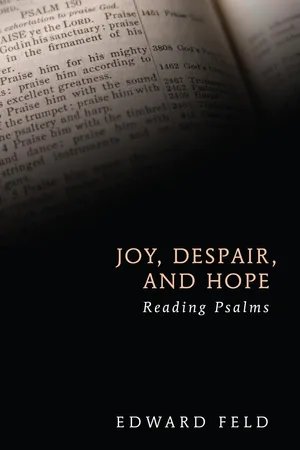
Joy, Despair, and Hope recaptures the power and immediacy of psalms for modern readers, showing how these biblical poems can speak to us yet again. Accompanying the author on his personal spiritual search through psalms, readers find their own inner lives given voice within these texts.
Edward Feld analyzes fifteen personal psalms from the book of Psalms, showing how each provides a different perspective on the life of faith. Feld's insights reveal how individual psalmists struggle with their faith, how they are wracked by doubt and self-questioning, and how they come finally to a greater understanding of faith. This book's clearly articulated analysis is both moving and sophisticated, helping us to enter the spiritual world of these writers, to recognize our own struggles in their ancient words, and to feel these poets alive and walking beside us. Along the way, Feld teaches us how to read psalms as poems and unlocks both their theological message and their literary splendor. Readers emerge with a new appreciation of and connection to the profound religious life and artistry of the biblical psalmists.
Information
Part 1
Joy
1
Psalm 1
Beginning
We begin at the beginning—Psalm 1. There is clear intentionality in the final editing of the book of Psalms and in the placement of this psalm at the very beginning. Psalm 1 opens with the words, “Blessed is the person . . .” and the last line of Psalm 150, the last psalm of the book of Psalms, reads, “May everything that has breath praise God.” Thus the arc of the book stretches from a single person walking with God to a vision of all creation celebrating God. Equally, the very first word of this psalm, Ashrei “blessed” (and in some other translations, “happy”) is a fitting invitation for readers as is hallelujah (“praise God”), a proper ending.
There were other reasons as well for placing Psalm 1 at the beginning of this book. It conveys a common, we might say normative, theme of biblical theology: good people will receive blessing; evil will be destroyed; there is a just order to the universe that is guaranteed by God. This theology did not go unquestioned in the Bible—Job, for one, in his suffering, finds this point of view to be most problematic, saying in effect, “I suffer, but it is not commensurate with any sins I may have committed.” And even many psalms, some of which we shall analyze in later chapters, question the validity of this theology finding it challenged by personal experience. But first the idea needs to be stated before it can be questioned:
| Psalm 1 | |
| 1 | Blessed1 is the person who has not pursued the counsel of the wicked, nor stood with sinners on their way nor sat with the indolent. |
| 2 | Rather, his2 desire is for the teaching of Adonai, intoning his teaching day and night. |
| 3 | For he will be as a tree planted astride streams bearing fruit in season, its leaves never shriveling— everything thriving. |
| 4 | Not so the wicked, who are only like chaff, tossed by the wind. |
| 5 | So, the wicked will not stand up in court nor sinners in the assembly of the righteous, |
| 6 | for Adonai knows the way of the just, but the way of the wicked will be lost. |
The poem is well ordered and direct. There are constant pairings of good and evil. Every statement about good or evil has its immediate counter in its opposite. There are three such pairs, and we progress from an opening delineation of good and evil through an interesting set of metaphors to a final judgment. The poem is tight, well ordered and explicit in its message—the essential opposition of good and evil and the inevitable outcome of each path.
The theology of the psalm is simple enough, but though the fundamental theological conception behind the poem is simple (good will be rewarded and evil will be punished), the work achieves its power through its literary art; the simple message is clothed with all the talent of psalmic craft. There is use of metaphor; in fact we will see that the turn to metaphor in verses 3 and 4 is pivotal in the development of the central ideas of the poem. There are some rhythmic elements, obvious in the Hebrew and not entirely lost in translation—though the rhythm is not constant but changes from verse to verse. But more than the rhythm of the single line is the rhythm of the whole: the continual use of contrast forming a threefold comparison between good and evil that serves to develop a divergent vision as we travel through time.
The basic building blocks of the poem are another biblical poetic device: the use of parallelism, the constant doubling (sometimes tripling) of each thought. A simple theological notion is given depth of meaning through this rhetorical device, and we are invited to enter a world of faithfulness that theology itself could only hint at, but that poetry provides with a concreteness we can touch.
I first studied this poem with a wonderful scholar of the Bible, the late Nahum Sarna. I can never forget his unlocking the sequential development of the first sentence. We are greeted with a set of differing images of evil—ranging from the most culpable to those who are guilty because of the attitudes they foster on the sidelines. First, the poet names the obvious, the “wicked,” active participants in underhanded schemes, people who join in a cabal, consciously plotting wrongful activities. Second are the “sinners,” those who have missed the mark—not the unrepentant evildoer the first phrase suggests, but the everyday flirter with fudging, the people who convince themselves that this act, which breaks the rules, is not so wrong after all, justifying the deed to themselves by saying that everyone does these things, or by thinking of these acts as small and excusable peccadilloes. And lastly, the “indolent,” the slothful, the verbal sideswipers, the ones who sit on the sidelines and scornfully poke fun at everyone else. These last don’t perform any action at all, they are the ones who lazily pass the time sitting in cafes engaged in cynical conversation—their joking creates the conditions of an apathetic society able to suffer corruption, it is their rhetoric, their cynical conversational posture that undercuts the good.
Each of these types is not only delineated by a different noun but by a different verb conveying a different degree of involvement and culpability. The first group includes those who “pursue” the counsel of evil—those who walk the walk—those who enthusiastically join in planning and plotting criminal activity. Then, instead of the active verb we first meet, the second group is said to “stand” with sinners. The people who “stand” on the sidelines, the ones who simply enjoy the company of shady types: there may be a romantic thrill in associating with the underworld—these are people not likely to be considered among the sinister elements of society, they may never outrightly commit a crime, perhaps it’s just that they like others to know that they have friends who are criminals and enjoy the fact that some notoriety rubs off on them, perhaps they like to be close to those who can act on the urges of which they can only dream: they want some of the thrill to rub off on them. But ultimately, this cheering squad—inevitably, at times their transgressions are more than verbal—helps create the social milieu in which nefarious activity is glorified. And last of all, there are those who like to “sit” around, second-guess everyone, and enjoy their ironic view of the vulnerabilities of those who are “out there” trying to do good. It’s an activity that at first glance may seem harmless enough—they just ‘sit’ and it’s just talk, after all . . . These last don’t really see themselves as part of any disreputable gang, but because their lives have no purpose, because they are not actively working to establish that which is good, but rather spend their time playing cards, drinking, shooting the breeze, poking fun at “do-gooders,” they have helped to create a world in which evil can dominate. And it is not only their indolence and apathy that creates the conditions in which the good person feels isolated but most especially their cynicism.
In this first sentence, the author has not only expressed theological axioms, but poetically created a context of believability, a tangible concrete reality that we can enter into and hold on to. And not incidentally, he has widened the circle of culpability so that even the seemingly innocent may be caught in a web of guilt and responsibility.
What has happened in this parallel arrangement is that the less active have been implicated with the conscious criminal: the indolent have been implicated with the evildoers. Had the poet merely expressed that thought in simple prose, as I have, he might not have convinced us; it all would have sounded too “sermonic.” The unfolding poetic parallelism, elaborating just enough, yet articulated with conciseness, forms a tightly wrought argument in which suddenly we realize that we, ourselves, may be implicated, though we never saw the punch coming. In this case, poetry throws a more entangling and convincing net than prose ever could.
Now the poet is ready to offer us, as contrast, the life of the righteous. Interestingly, the verbs used in this new image no longer deal with outer movement—walking, standing, sitting—but the inner life—desiring, thinking. Evil concentrates on outer domination, good on the life of the heart and mind. This may reflect an understanding that the place where a person first finds God is the inner life. It also may be the case that the assertion reflects an observation about the poet’s contemporary social reality: the outside world is dominated by power, corruption, and injustice; the faithful have only one realm in which to find God—the private life of the heart.
Rather, his desire is for the teaching of Adonai,
intoning his teaching day and night.
This second sentence moves from the threefold structure we initially encountered in the poem to a twofold one, perhaps an indication of the greater unity of purpose of the righteous. The inner life is made up of mind and heart, speech and thought, and both are involved in the same activity: the study and appreciation of God’s teaching. The sense of unified existence is concretely emphasized by the poet’s insistence that the righteous engage in this activity “day and night.” Neither time nor the soul is split in the life of the righteous. What is revealed by the light of day is practiced in the darkness of night, the private and the public are one, something usually not true of those who are engaged in nefarious activities, especially those people, public officials, respected burghers, who try to hide their corruption. This unity is further stressed by the ambiguous pronoun in the second part of the verse—his teaching. To be sure, the referent is most likely God, but only a moment before, the same pronoun, his, referred to the devotee—“his desire.” Implied is a unity of the activity of the righteous person and God’s own intent. The words that the righteous utter, his teaching, is one with God’s.
The first two verses of the psalm have presented us with a description of the contrasting lives of the righteous and the evildoers. It has opened up worlds through a poetic concreteness yet with conciseness of language. The next two sentences offer contrasting images for the consequences of these paths, and the poet advances the contrast of good and evil through the telling use of two powerful agricultural metaphors.
For he will be as a tree planted astride streams
bearing fruit in season,
its leaves never shriveling—
everything thriving.
First, there is a four-part development of the metaphor describing the fate of the righteous as a fertile, long-lived tree: firmly planted, bearing fruit in season, not desiccated, a truly successful growth. In the description of the tree that never hibernates but is always lush, we are presented with the most elaborate metaphor within the psalm. We have gone from a three-line description of the ways of the wicked to a tightly packed two-line description of the inner life of the righteous to an outward explosion of the rich life of that righteous person. Most biblical poetic sentences contain just two clauses—the simplest form of parallelism; somewhat less frequently, a sentence will contain three clauses; four is the rarest form. Thus, the verse displays an exuberant description of permanence and fecundity, emphasizing the fullness of blessing reserved for the righteous which is the theme struck by the very first word of the psalm, “Ashrei/Blessed . . .” The constancy of blessi...
Table of contents
- Title Page
- Preface
- Acknowledgments
- Introduction
- Part 1: Joy
- Chapter 1: Psalm 1
- Chapter 2: Psalm 19
- Chapter 3: Psalm 8
- Chapter 4: Psalm 91
- Chapter 5: Psalm 82
- Chapter 6: Psalm 23
- Part 2: Despair
- Chapter 7: Psalm 27
- Chapter 8: Psalm 42
- Chapter 9: Psalm 77
- Chapter 10: Psalm 73
- Chapter 11: Psalm 39
- Chapter 12: Psalm 90
- Part 3: Hope
- Chapter 13: Psalm 92
- Chapter 14: Psalm 150
- Bibliography of Quoted Sources
Trusted by 375,005 students
Access to over 1.5 million titles for a fair monthly price.
Study more efficiently using our study tools.
Frequently asked questions
Yes, you can cancel anytime from the Subscription tab in your account settings on the Perlego website. Your subscription will stay active until the end of your current billing period. Learn how to cancel your subscription
No, books cannot be downloaded as external files, such as PDFs, for use outside of Perlego. However, you can download books within the Perlego app for offline reading on mobile or tablet. Learn how to download books offline
Perlego offers two plans: Essential and Complete
- Essential is ideal for learners and professionals who enjoy exploring a wide range of subjects. Access the Essential Library with 800,000+ trusted titles and best-sellers across business, personal growth, and the humanities. Includes unlimited reading time and Standard Read Aloud voice.
- Complete: Perfect for advanced learners and researchers needing full, unrestricted access. Unlock 1.5M+ books across hundreds of subjects, including academic and specialized titles. The Complete Plan also includes advanced features like Premium Read Aloud and Research Assistant.
We are an online textbook subscription service, where you can get access to an entire online library for less than the price of a single book per month. With over 1.5 million books across 990+ topics, we’ve got you covered! Learn about our mission
Look out for the read-aloud symbol on your next book to see if you can listen to it. The read-aloud tool reads text aloud for you, highlighting the text as it is being read. You can pause it, speed it up and slow it down. Learn more about Read Aloud
Yes! You can use the Perlego app on both iOS and Android devices to read anytime, anywhere — even offline. Perfect for commutes or when you’re on the go.
Please note we cannot support devices running on iOS 13 and Android 7 or earlier. Learn more about using the app
Please note we cannot support devices running on iOS 13 and Android 7 or earlier. Learn more about using the app
Yes, you can access Joy, Despair, and Hope by Edward Feld in PDF and/or ePUB format, as well as other popular books in Social Sciences & Social Science Biographies. We have over 1.5 million books available in our catalogue for you to explore.