eBook - ePub
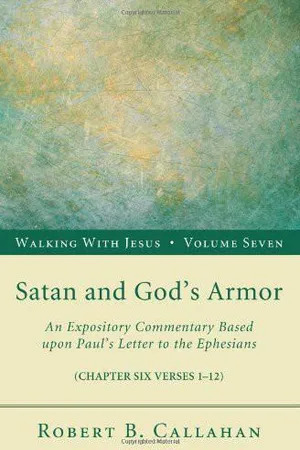
Satan and God's Armor
An Expository Commentary Based upon Paul’s Letter to the Ephesians
- 254 pages
- English
- ePUB (mobile friendly)
- Available on iOS & Android
eBook - ePub
Satan and God's Armor
An Expository Commentary Based upon Paul’s Letter to the Ephesians
About this book
The Apostle Paul leaves no stone unturned as he encourages, enlightens, and informs the Ephesian believers (and us) regarding their duties and responsibilities as Christ's followers. Yes, there are duties and responsibilities for professing Christians, just as there are duties and responsibilities in every phase of life whether it be as children/parents; employee/employer; student/teacher; or whatever field of endeavor one may pursue.
The apostle is addressing those who believe in the Lord Jesus Christ and seek to follow Him, which as Paul knows is not easy. Therefore, in this portion of Scripture he stresses certain truths that will strengthen each and every Christian as they journey through life. The elements may sound simple to learn, but they are difficult to practice day in and day out. What are they? Obedience, discipline, priorities, knowing your heavenly Father (not just knowing about Him), being strong disciples in the faith, and separating ourselves. Developing these traits requires a commitment to adhere to Christ's teachings and commands.
Paul then switches our attention from what we are to do as Christ's followers and states emphatically that we are to be strong in the Lord, and in the power of his might. "Put on the whole armor of God, that ye may be able to stand against the wiles [schemes] of the devil" (Eph 6:1-11). Paul states unequivocally that we are to prepare to wrestle this implacable foe, since we belong to Christ and are His followers. He describes Satan, his evil characteristics and malevolent intentions. Christ recognized him for what he is. Should we do less? Unfortunately, in today's world we ignore him and fail to realize the harm he inflicts on ourselves and others.
Paul concludes this portion of Scripture on a high note. He urges us to be properly prepared; to recognize heresies; to watch and pray; to know the difference between false and true teachings; and to know the Lord Jesus Christ and what He experienced during His earthly ministry.
Information
1
Children, Obey Your Parents
CHILDREN, obey your parents in the Lord: for this is right.
HONOR THY FATHER AND MOTHER; which is the first commandment with promise;
THAT IT MAY BE WELL WITH THEE, AND THOU MAYEST LIVE LONG ON THE EARTH.
And, ye fathers, provoke not your children to wrath: but bring them up in the nurture (training) and admonition of the Lord [Eph. 6:1–4].
Children, obey your parents. What a wonderful phrase! How many people through the ages have made that statement! However, as happens so often, people only quote a portion of a statement, taking it out of context.
The full statement is CHILDREN, obey your parents in the Lord: for this is right [Eph. 6:1]. That is the complete statement. This command has both a qualification and an admonition. The qualification is in the Lord. That is how the children are to obey their parents. The admonition is for this is right. When considering this statement, bear in mind the context in which it is presented. It proceeds naturally from
Walk worthy of the vocation (calling) wherewith you have been called, . . . [Eph. 4:1].
Be filled with the Spirit [Eph. 5:18].
Submitting yourselves one to another in the fear of God
[Eph. 5:21].
[Eph. 5:21].
After examining the teachings about Christ and the church, and husbands and wives in marriage, it is time to proceed to the other important members of the family—the children.
Paul is writing to the children who are members of Christ’s body and have undoubtedly been baptized. Otto Weber says this particular verse [Eph. 6:1] “makes plain that there were children in the community assembly, although their ages are not precisely given.”
In these verses, the children are to obey their parents, but their fathers or parents are to bring them up in the nurture (training) and admonition of the Lord [Eph. 6:4]. There is a definite responsibility for both parties. The children are to obey. They are to listen, attend, and submit to their parents. But the parents have a definite responsibility regarding how they are to raise them.
Why does the Apostle use this word obey instead of other words such as “listen,” “attend,” or “honor”? Calvin supplies the answer when he says, “Obedience is the evidence of that honor which children owe to their parents,” and obedience is much “more difficult; for the human mind recoils from subjection and only with difficulty suffers itself to be forced under the control of another.” This is true of children as well as adults.
“Obey—no stronger word could be used to show that God’s command to parents is to exercise parental authority, and to children to practice implicit obedience. In two places in Scripture God reveals His estimate of the heinousness of disobedience to parents when he places in the list of the most degrading sins of the godless, heathen world . . ., and of the sins of lawlessness that characterize the perilous times of the last days. . . . The child that has never learned to obey parents in the home will not find it easy to obey the law of his government or the commands of his God. The obedience God requires is not merely that of action, but also of attitude, which makes a child ready to listen to his parents, willing to heed their advice and to follow the guidance of more mature minds,” as described by Ruth Paxson.
We should remember that children are in the same category as adults. They are new creatures in Christ. They are to be reminded that there is a distinct difference between those who are in Christ and those outside His body, regardless of their age. Further, we are not talking merely about ethics or morality. The Apostle is discussing a right relationship with God. He is referring to righteousness, obedience, and doing the will of the Father.
Two reasons for a lack of harmony in the home are disobedience and the lack of discipline. All of us have heard much, read much, and seen much about the unruliness, recklessness, and uncontrollableness of children, especially teenagers, and some young people who will not submit to their parents, how they do not want anyone to interfere with their plans, how they want to do their own thing, and do not want to be encumbered by authority, listening to parents, and hearing the counsel of adults.
Children obeying their parents is not merely a phenomenon today. It has been evident for more than two thousand years. That is why Paul wrote about it and undoubtedly preached about it. Paul’s wisdom enabled him to know that both the obedience and the instruction of the children should be according to the will of God. Therefore, Paul uses the phrases in the Lord and of the Lord when telling the children to obey their parents, and the fathers to nurture and admonish their children.
Why did Paul direct his teaching to children and parents? He knew full well that a breakdown in the home had negative effects in the family, which is the basic unit of society. Also, it sent shockwaves to other young people. The people hearing these things would emulate them or try to outdo them, and the entire process would repeat itself.
Paul describes in his letter to the Romans what happens when people ignore God, do not acknowledge Him, and do not obey His commands. He says,
And even as they did not like to retain God in their knowledge, God gave them over to a reprobate (debased) mind, to do those things which are not convenient (fitting) [Rom. 1:28].
Being filled with all unrighteousness, . . . haters of God, despiteful (violent), proud, boasters, . . . disobedient to parents,
Without understanding, . . . without natural affection, implacable (unforgiving), unmerciful:
Who knowing the (righteous) judgment of God, that they which commit such things are worthy of death, not only do the same, but have pleasure in (approve of) them that do them [Rom. 1:30–32].
Paul amplifies upon this in his second letter to Timothy saying,
THIS know also, that in the last days perilous times shall come.
For men shall be lovers of their own selves, covetous, (money lovers) . . . proud, . . . disobedient to parents, unthankful, unholy,
. . . despisers of those that are good,
. . . lovers of pleasures more (rather) than lovers of God;
Having a form of godliness, but denying the power thereof: from such turn away [2 Tim. 3:1–5].
The last days refers to the period from the birth of Christ until He returns in full glory. Both passages contain the phrase disobedient to parents.
Recall that the passages from Paul’s letter to the Romans began with the statement: And even as they did not like to retain God in their knowledge, God gave them over to a reprobate (debased) mind to do those things which are not convenient (considered to be fit) [Rom. 1:28]. And in Timothy it says, Having a form of godliness, but denying the power thereof: from such turn away [2 Tim. 3:5]. Paul reminds us that one of the striking factors during periods of godlessness and apostasy is children being disobedient to their parents. This is true regardless of the ages of the children or parents.
It is interesting to note that Paul specifically talks to both the parents and children when he talks about children being disobedient. There is a connection between disobedience to parents, ungodliness, and indecent behavior. For the wrath of God is revealed from heaven against all ungodliness and unrighteousness of men, who hold (suppress) the truth in unrighteousness [Rom. 1:18]. When you have ungodliness you have unrighteousness. The two go together like ham and eggs.
If you want righteous conduct, it must be preceded by godliness. People tend to confuse morality with righteousness. They are not the same. Morality relates to the principles of right or wrong behavior. Righteousness is being in a right relationship with God, the Father.
When you have righteousness, you have discipline and obedience. However, when you have unrighteousness you have a lack of discipline, you have a dearth of proper instruction resulting in lawlessness, disrespect, and deteriorating conditions.
Many people cannot remember when they began to love, trust, and obey Christ, just as they cannot remember when they began to love, trust, and obey their parents. “Children may obey their parents in the Lord, before they are able to understand any Christian doctrine; they may discharge every childish duty, under the inspiration of the Spirit of God, before they have so much as heard whether the Spirit of God has been given,” as expressed by R.W. Dale. However, that is the exception. If it does exist for a period of time, then there are usually occasions when obedience is lacking or authority needs to be exercised.
When thinking of the relationship between children and parents, we must realize that children go through different phases as they enter the new age groups through which they must pass before becoming adults and parents. The different stages of development can be trying, taxing, difficult, and even heartrending. That is why Paul says,
CHILDREN, obey your parents in the Lord: for this is right [Eph. 6:1].
And, ye fathers, provoke not your children to wrath: but bring them up in the nurture (training) and admonition of the Lord [Eph. 6:4].
Parents have a divine obligation to teach their children, instruct them, direct their paths, and elicit obedience from them, but they are to do it according to the will of God. They are to nurture and admonish their children as Christ does the church.
Ruth Paxson provides additional light regarding parents, disciplin...
Table of contents
- Title Page
- Topical Categories in Walking with Jesus
- Volume Seven: Topical Categories
- Foreword
- Preface
- Acknowledgments
- The Question of Authorship
- Introduction
- Chapter 1: Children, Obey Your Parents
- Chapter 2: Discipline
- Chapter 3: Man’s Relationship to God
- Chapter 4: Priorities
- Chapter 5: Christ’s Slaves
- Chapter 6: Knowing Your Master in Heaven
- Chapter 7: Finally My Brethren, Be Strong . . .
- Chapter 8: Separating Ourselves
- Chapter 9: Strength, Power, and Might
- Chapter 10: To Fall or To Stand
- Chapter 11: Prepare to Wrestle
- Chapter 12: Satan
- Chapter 13: The Combatants
- Chapter 14: The Devil and His Forces
- Chapter 15: The Devil’s Disguises
- Chapter 16: Those Damnable Heresies
- Chapter 17: Road Blocks and Detours
- Chapter 18: Watch and Pray
- Chapter 19: False and True Teachings
- Chapter 20: Truth and Experience
- Outline Questions
- Bibliography
- Scripture Index
Trusted by 375,005 students
Access to over 1.5 million titles for a fair monthly price.
Study more efficiently using our study tools.
Frequently asked questions
Yes, you can cancel anytime from the Subscription tab in your account settings on the Perlego website. Your subscription will stay active until the end of your current billing period. Learn how to cancel your subscription
No, books cannot be downloaded as external files, such as PDFs, for use outside of Perlego. However, you can download books within the Perlego app for offline reading on mobile or tablet. Learn how to download books offline
Perlego offers two plans: Essential and Complete
- Essential is ideal for learners and professionals who enjoy exploring a wide range of subjects. Access the Essential Library with 800,000+ trusted titles and best-sellers across business, personal growth, and the humanities. Includes unlimited reading time and Standard Read Aloud voice.
- Complete: Perfect for advanced learners and researchers needing full, unrestricted access. Unlock 1.5M+ books across hundreds of subjects, including academic and specialized titles. The Complete Plan also includes advanced features like Premium Read Aloud and Research Assistant.
We are an online textbook subscription service, where you can get access to an entire online library for less than the price of a single book per month. With over 1.5 million books across 990+ topics, we’ve got you covered! Learn about our mission
Look out for the read-aloud symbol on your next book to see if you can listen to it. The read-aloud tool reads text aloud for you, highlighting the text as it is being read. You can pause it, speed it up and slow it down. Learn more about Read Aloud
Yes! You can use the Perlego app on both iOS and Android devices to read anytime, anywhere — even offline. Perfect for commutes or when you’re on the go.
Please note we cannot support devices running on iOS 13 and Android 7 or earlier. Learn more about using the app
Please note we cannot support devices running on iOS 13 and Android 7 or earlier. Learn more about using the app
Yes, you can access Satan and God's Armor by Robert B. Callahan Sr. in PDF and/or ePUB format, as well as other popular books in Theology & Religion & Biblical Criticism & Interpretation. We have over 1.5 million books available in our catalogue for you to explore.