eBook - ePub
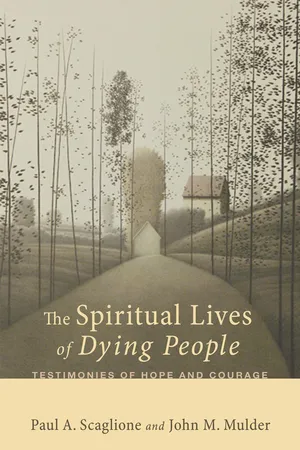
The Spiritual Lives of Dying People
Testimonies of Hope and Courage
- 134 pages
- English
- ePUB (mobile friendly)
- Available on iOS & Android
eBook - ePub
About this book
How do people think about God as they look death squarely in the face? This is the central question in The Spiritual Lives of Dying People. Here are the stories of fifteen people who confront death in their own ways and who find spiritual strength in their faith. This is also the story of a remarkable and gifted priest, one who has made ministry with the chronically ill a special focus of his pastoral life and has guided people not only through their dying but also to God. In this book, readers will find the inspiring stories of people who found hope and courage in life so that they could meet death. Readers will also glean insights into how they might approach their own deaths or care for others who are in the midst of making the last journey of life. This is a book that illuminates how to answer one of life's most important questions: How shall I die?
Information
Topic
Theology & ReligionSubtopic
Christian MinistryConclusion
Listening to the Dying
An Interview of Paul A. Scaglione by John M. Mulder
Mulder: What have you learned from your ministry with dying people, and what has surprised you?
Scaglione: I began my ministry with the assumption that each person’s dying was unique, that each one would have its own characteristics and dynamics. That has proved to be true. You can’t escape the special qualities of each person’s dying. At the same time, what really surprised me was the intensity of how a person made this journey alone and the intensity of my own feelings. I would be as close to them as I could be—emotionally and physically. I would assure them that I was there, that I was walking the path with them. I would hold their hands; I would bend over to put my ear next to their mouths so I could hear them whisper. I knew that I was very close with the person—physically, emotionally, and spiritually—but at the same time I felt a great distance. The intensity in that feeling of distance was a surprise to me, and that experience of deep intimacy and profound distance has always come home to me with everyone I have been with.
I’ve also learned that their journey is not just a pilgrimage of dying. It is a journey of many other elements of their life coming to some new conclusion because of their physical death. I used to think that if a dying person had a strong faith, they would muscle through it and bear the pain. That’s partially true, but what I learned in being with people is that their dying is part of their living. Hosparus (or hospice) has a saying about the way you live is the way you die. I’ve found that to be absolutely true. The people who struggled the most in their dying had great difficulties with some of the most important relationships in their lives. Perhaps they were betrayed in a relationship, or maybe they were harmed by someone physically or emotionally.
What I learned is that when they would struggle with their process of dying, they would reveal to me more and more of their own vulnerability, their lack of trust, their woundedness. If they had lost confidence that they could find healthy relationships or that others could be trusted, then they often assumed that God couldn’t be trusted either. Their struggle with dying wasn’t because they were worried about dying. It was the end point of a journey that had begun long before I had ever met them.
Mulder: How did these struggling people affect you?
Scaglione: They made me unbelievably sad. I often found myself grieving their loss, and I would do that quietly and privately. If there has been an impact on me personally, it would be absorbing that loss for people. What I witnessed was a kind of unclaimed grief that they couldn’t claim for themselves; instead, they described it as being betrayed or hurt by other people. I can’t quantify this, but I know that sometimes I can feel that unexpressed pain, and I can absorb some of the reality they are going through. That has surprised me, and I never thought that was something that would happen to me in this kind of ministry.
Mulder: What do dying people say to you when they talk about God?
Scaglione: I think they’re all trying to make sense of their dying. When I was in college, I read Ernest Becker’s famous book, The Denial of Death. He emphasized that societies try to find meaning in death, and I thought immediately that the same was true for individuals. People seek meaning in their dying. The problem is that some people hold onto a belief system that isn’t helpful to them. For instance, people may believe that if they hold onto an image of God as judge, maybe their suffering from this chronic disease or this terminal disease is partial judgment for what they have done or not done in their life. I wouldn’t try to get people to reject such an image of God. That would violate them and wouldn’t do them any good. Instead, I would hear the struggle and try to help them remember an experience or an image of a different kind of God that suddenly becomes more important and meaningful to them and gives them some solace in the middle of their dying. I find images of God changing a lot as people die.
Mulder: Has your image of God changed?
Scaglione: This is very personal because my understanding of God changed dramatically because of my near-death experience in a diabetic coma. Before that, I was comfortable with pretty formal ideas—for example, Jesus is the second person of the blessed Trinity. Coming out of my coma, I had a different sense, and I’ve used the image of insulin to describe my relationship with God. When I started taking insulin each day, I reflected on how a small amount, a very small amount, of liquid meant life instead of death. That made God much more particular and personal to me. Now God was involved in my ability to take this medicine and to use it in a conscientious way of caring for myself so that my life could continue. I started to have an image of a God who is very much a caregiver to me and has given me an opportunity to live. If God intends me to live, then there is a purpose in my life, and God is going to care for me and sustain me.
Care is the operative word for God for me, not love. I don’t mean to demean the word love, except care sounds better to me. Caring is really how I understand who I am as a minister, and as a result, care is more important to me than what could be a very abstract notion of loving. When you think of caring and you think of people who have been kind and gentle with you, it’s an image you know immediately, and you know the opposite too—when people have been angry and judgmental. So I think the concept of God that is most important is the idea of God as caring. I think it evokes memories of people who have been caring in your life, and those recollections become an inspiration for your thoughts about God.
Let me use an example. I grew up in a heavily Catholic neighborhood. All my friends were Catholics. There was a little store in the neighborhood, and it was run by Orthodox Jews. Here we were, this band of little Catholic boys running around, and we would always stop at the little store for candy. The Jewish couple were always so kind to us, especially the woman behind the counter. She would let us pick out our candy, and she would write down how much it was. Then at the end of the week, my mother would come in and pay for the candy I had bought. That would never happen today, but in my memory, that Jewish couple were people who cared.
Mulder: Did your diabetic coma also change your ideas about death?
Scaglione: Interestingly, what happened to me is that from the moment of my near-death experience, death in my life became less of a concept and much more of a sense of transition to an unknown. That is the metaphor I have for dying well. It is coming up to the point in your struggle where you go through it; you meet it head on. It can be overwhelmingly dark, but when you come out the other side, you are different.
And it isn’t linear; it’s cyclical. My life was always in God from the very beginning of my being created, and my life has never and will never be separate from God. I can go through experiences of darkness, suffering, and pain so that I can understand and come out at the other end—deeper in my relationship with God. I think that people who are able to go through that experience recognize that something fundamentally changes about God. God is not abstract, but personal. God is not distant, but caring.
Mulder: Do dying people talk about hell?
Scaglione: Practically never. They might talk about the concept of being judged, but I can’t really remember many people even using the word hell. They might believe that they have done something in their life that has been atrocious and that somehow their dying, or the way in which they are dying, was a consequence of that. But I don’t hear them speaking about eternal damnation and hell.
Mulder: What do you say to people who feel a deep sense of God’s judgment?
Scaglione: There are people who are locked into a part of their life that is in the past, and they can’t escape it. I can be with that person and give them some safe space where they might want to talk about it. But sometimes they can’t even do that.
I don’t think that God makes judgments upon us. I think that God ultimately wants to bring us to a place of understanding that he is with us. Even when we are judging ourselves or feeling guilty about things that we might have done or could have done better, God is there. So if a person is feeling guilty, I would try to ask them, “Where is the God who loves you or cares for you in this moment? Maybe God is different than you might imagine.” If they can make any progress on that question, then there might be some reconciliation with themselves and their past experience. God can be there for them in a healing way. I try to ask if there is more here that they haven’t looked at or experienced or attempted to know. Because I believe there always is.
Mulder: What about heaven? Do they ever talk about that?
Scaglione: It’s very interesting. Dying people almost never talk about heaven as union with God. Instead, they often talk about it as a reunion with those who have died before them and who are in the company of God. I find that really refreshing because it captures the Christian tradition’s idea of the communion of the saints. John Paul II put it perfectly. About five or six years before he died, he flat out said that heaven is not a place. It’s all about relationships and being reunited with others.
I think that is upsetting to a lot of people because they worry: “Who will I see and how will I relate to them?” So, I ask them, “How do you think you will relate?” Then they might say, “Well, my mother was a great gardener, and when I was a kid, she would teach me how to garden.” I might say, “Maybe that is how you are going to connect.” They might respond, “Oh, really? You really think that? Do you think that is possible?” And I would say, “Why wouldn’t it be possible? What would prevent that from happening?” That always kind of stumps them and at least gets them to think about it and how maybe it might be true.
Mulder: Is there a difference between believers and nonbelievers in facing death?
Scaglione: I have to say that nearly all my ministry has been with people who have had a formal relationship with a religious entity. They have been Catholic or Protestant and in some cases Jewish. So it’s impossible for me to compare how believers face death to how nonbelievers confront their dying.
There’s a popular assumption that all believers face the moment of their dying in the same way, but that’s not true. I find a wide diversity in how believers confront their dying and death. Even though they have been part of formal church structures, they are led to ask questions that maybe their church experience hasn’t addressed or answered. I find people struggling with the human experience of dying. They see all of this coming to an end and they ask, “What is the purpose of all this?” Sometimes they might say, “I know I’m going to a better place.” Caregivers often say that about the dying. Well, how do they know that? That may be their image and hope and desire, but they are imposing that on the other person.
I find that what most people find helpful in terms of religion is the sense of connectedness to others and to God. Somehow that connectedness makes material sense to them in terms of their dying. You can get the gamut from liberal to conservative ways of describing that connection, but when you peel away all the theology, what you find is that relationships are primary.
So even though I have not had much experience in ministering to nonbelievers, I would guess that the same dynamic operates across the board. It is a human dynamic and this is how we are as human beings. What we crave are relationships, and it is through relationships that we find meaning.
Mulder: Do believers fear death?
Scaglione: I think that for believers, the fear of death revolves around a couple of different things. One is simply the unknown of dying. I have been amazed at how people who are very faithful believers and very devoted to their faith and the church will say the same thing as they get closer to their death. They don’t talk about their fear of death; instead, they describe their wonder about the abyss of an unknown. I don’t particularly like the word fear. When people confront death, they don’t know what it will bring, and they hesitate. They wonder; they try to figure out what will happen when they are touched by death.
Apprehension is really a better word. The apprehension of the unknown is primarily where people come to the point where they say that they trust that their not knowing is okay. They trust that somehow God is going to bring this into some kind of order that they can understand, so they are going to let go of their need to understand. I don’t know that it makes them less fearful or apprehensive about the unknown, but I think it goes back to relationships. They become more firmly rooted in trusting God at that moment to lead them through their own dying.
The other fear about death that some people carry is the fear of enduring physical pain. That is very real. When you listen to them, it is clear they are worried that pain medication can lessen their ability to be aware and responsive to people. That becomes a struggle in itself because they want to hold onto their ability to communicate, which is one of the last places of control. Perhaps they have seen someone die in a great deal of pain, and they don’t want that either. So they’re torn. They want to remain alert and alive to others, but they are frightened of the pain that might accompany their dying.
Mulder: What about people who are angry about death?
Scaglione: Anger is a basic human emotion. You don’t get angry over something that is inconsequential in your life. You only get angry over something that is valuable to you. Uncovering that valuable piece of life can be very threatening, and losing that piece or the threat of losing it is what makes people angry. Some people can be quite clear about their anger with God or with other people, but when you actually push them to be more reflective about their anger, that is a hard struggle.
Anger is also very complicated. I remem...
Table of contents
- Title Page
- Preface
- Introduction
- Maria
- Ben
- Sarah
- Jack
- Judy
- Nick
- Mary
- Mildred
- Tom
- Teresa
- Paul
- Rachel
- Joey
- Rosa
- Charlie
- Conclusion
Trusted by 375,005 students
Access to over 1.5 million titles for a fair monthly price.
Study more efficiently using our study tools.
Frequently asked questions
Yes, you can cancel anytime from the Subscription tab in your account settings on the Perlego website. Your subscription will stay active until the end of your current billing period. Learn how to cancel your subscription
No, books cannot be downloaded as external files, such as PDFs, for use outside of Perlego. However, you can download books within the Perlego app for offline reading on mobile or tablet. Learn how to download books offline
Perlego offers two plans: Essential and Complete
- Essential is ideal for learners and professionals who enjoy exploring a wide range of subjects. Access the Essential Library with 800,000+ trusted titles and best-sellers across business, personal growth, and the humanities. Includes unlimited reading time and Standard Read Aloud voice.
- Complete: Perfect for advanced learners and researchers needing full, unrestricted access. Unlock 1.5M+ books across hundreds of subjects, including academic and specialized titles. The Complete Plan also includes advanced features like Premium Read Aloud and Research Assistant.
We are an online textbook subscription service, where you can get access to an entire online library for less than the price of a single book per month. With over 1.5 million books across 990+ topics, we’ve got you covered! Learn about our mission
Look out for the read-aloud symbol on your next book to see if you can listen to it. The read-aloud tool reads text aloud for you, highlighting the text as it is being read. You can pause it, speed it up and slow it down. Learn more about Read Aloud
Yes! You can use the Perlego app on both iOS and Android devices to read anytime, anywhere — even offline. Perfect for commutes or when you’re on the go.
Please note we cannot support devices running on iOS 13 and Android 7 or earlier. Learn more about using the app
Please note we cannot support devices running on iOS 13 and Android 7 or earlier. Learn more about using the app
Yes, you can access The Spiritual Lives of Dying People by Paul A. Scaglione,John M. Mulder in PDF and/or ePUB format, as well as other popular books in Theology & Religion & Christian Ministry. We have over 1.5 million books available in our catalogue for you to explore.