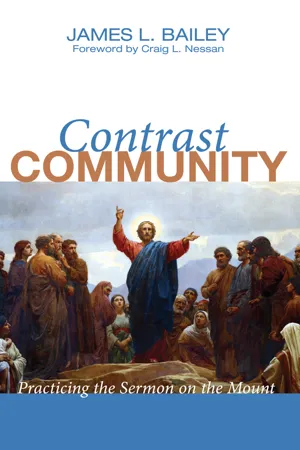
- 194 pages
- English
- ePUB (mobile friendly)
- Available on iOS & Android
eBook - ePub
About this book
No portion of Scripture has been more influential in renewing church and society than Jesus' Sermon on the Mount. This book invites groups and individuals into a transformative engagement with these remarkable teachings of Jesus. Accessible consideration of each major text is complemented by suggestions for multisensory methods by which to enrich the study--quotes, questions, application exercises, songs, and prayers. Faith communities are challenged not only to study the Sermon on the Mount but to begin practicing these radical teachings of Jesus. In addition to use in congregations, this volume is recommended for college and seminary classes that seek holistic methods for engaging biblical texts.
Information
1
Power to Transform Communities
The Sermon on the Mount (SM) in Matt 5:1—7:29 has long captivated me. For over thirty years, I have pondered these words of Jesus with their power to shape the perception and behavior of persons. These teachings can even transform communities into radically faithful followers of Jesus who live differently and have the courage to challenge injustices around them. During the early 1960s, I first read Dietrich Bonhoeffer’s Cost of Discipleship and sensed the daunting challenge, yet deep joy, of following Jesus in the menacing Nazi years. Regarding his growing realization of the transformative power of the Bible, and especially the SM, Bonhoeffer testifies in a letter to a dramatic change in his own life that occurred sometime before 1933:
Back then I was terribly alone and left to my own devices. It was quite awful. Then a change took place, a change that transformed my life and set its course in a new direction to this very day. I arrived at the Bible for the first time. Again, that is a terrible thing to admit. I had already preached quite often, I had seen much of the church, and both talked and written about it. But I had not yet become a Christian. In a wild and untamed way I was still my own master . . . In all my abandonment I was nevertheless quite pleased with myself. It was the Bible which liberated me from this, especially the Sermon on the Mount. Since then everything has changed. I could clearly feel it, and even other people around me noticed it. It was a great liberation. It became clear to me that the life of a servant of Jesus Christ has to belong to the church, and step by step it became ever more evident just how far this had to go . . . The renewal of the church and the ministry became my supreme concern . . .1
For Bonhoeffer, reading and engaging the SM were integral to his liberating experience that led him to see more clearly the radical nature of discipleship and the crucial importance of the church-community.
Faith communities and movements with significant social impact on the history of the last century, which were shaped by serious engagement of Jesus’ teaching in the SM, include: Clarence Jordan and the Koinonia Farm, a racially integrated community in Georgia; Pastor André Trocmé and the Protestant town of Le Chambon in Southern France, who saved thousands of Jewish children and adults during the Nazi occupation; Brother Roger and the Taizé Ecumenical Community in France; and Dr. Martin Luther King Jr. and the civil rights movement in the 1960s.2
A more recent example occurred in East Germany. In 2007 and again in 2012, my wife and I visited St. Nicholas Church in Leipzig and learned of the indispensable role played by the SM in the weekly Prayer Services for Peace initiated by Pastor Christian Führer. These led to the huge, nonviolent street protests that toppled East Germany’s Communist government and brought down the Wall. Horst Sindermann, a member of the Central Committee of the German Democratic Republic, said before his death: “We had planned everything. We were prepared for everything. But not for candles and prayers.”3 I would add—the transformative power of the SM!
Hearing and Doing Jesus’ Teaching
Understanding the Sermon on the Mount involves practicing the SM. It is not enough to hear Jesus’ words or even read and study them. We are to do them. In 7:24–27, Jesus declares that everyone who hears his words and performs them will be like a wise person who builds a house on rock. The foolish person, in contrast, hears Jesus’ words but does not act on them.
Teaching in antiquity was not done primarily for intellectual musing and reflection but as guidance for living. The words of prominent philosophers and teachers mapped out a way of living, wisdom for navigating the threats and unforeseen changes of daily existence. Only by creatively performing these teachings did a community of disciples begin to understand the words of their master. My son can instruct me a great deal about a computer program, but until I actually begin to operate the program I do not really comprehend what he has said. The teaching makes sense only as I am doing it. Likewise, a venerated conductor can interpret a richly-textured musical composition to members of his orchestra, but only when they perform their individual parts together under the maestro’s expressive hands, do they begin to understand the symphony’s magnificence and appreciate his interpretation. It is the performance of the conductor’s interpretation of the musical notes that produces genuine understanding.
My purpose for this book is simple yet demanding—to present Jesus’ teaching in the SM in ways that not only engage the interest and imagination of groups of people but also invite them into a deep dwelling in these extraordinary texts. As they do so, the group, no matter how small, will discover words of Jesus that sustain and stretch them, form and transform them as a community of ordinary people who seek to be life-giving Jesus-people in the places where they dwell. Again and again, Jesus’ words create communities that make a divine difference in the world, striving to be contrast communities that embody an alternative vision and way of life within their host societies.
Jesus’ Teaching for Community
The SM appears in the Gospel of Matthew. This Gospel was designed for house churches, probably in or near the city of Antioch in Syria sometime after the Romans’ devastating destruction of Jerusalem and its temple in 70 CE. Its context is clearly late first-century Judaism in the Roman world.
The overall pattern of Matthew interconnects narrative and teaching sections. Despite different attempts at outlining Matthew, this much seems obvious—the Gospel includes five major blocks of Jesus’ teaching:
1. Sermon on the Mount (5:1—7:29)
2. Mission Instructions (10:1—11:1a)
3. Parables of the Kingdom (13:1–53)
4. Community Instructions (18:1—19:1a)
5. Eschatological Teaching (24:1—26:1a)
The SM has prominence as the first teaching segment in the Gospel. It presents Jesus’ foundational teaching for his followers, words intended to shape their sense of identity and mission. These words offer Jesus’ vision of God’s kingdom and how followers of Jesus are to live their life together.
When you track where the specific teachings of Jesus gathered in the SM appear in the other Gospels, you quickly discover two things. First, some sayings of Jesus appear only in Matthew’s SM (e.g., blessing the meek in 5:5 and pure of heart in 5:8 or Jesus’ words in 5:17–20); and second, other sayings exhibit a different form and/or occur in a quite different narrative context in the Gospel of Luke (e.g., the Lord’s Prayer in Luke 11:2–4 or Love your enemy command in Luke 6:27–36). These discoveries suggest that the collection of Jesus’ sayings in Matt 5:1—7:29 resulted from intentional compositional work. These particular words were gathered, ordered, and designed as the principal teaching of Jesus who speaks with divine authority. They are set on a mountain in Galilee, a place of revelation, and hence are called “The Sermon on the Mount.”
One biblical scholar, Hans Dieter Betz, has argued that the SM corresponds to an epitome (a Greek word literally meaning “cut short” or “reduce”) in the ancient Greco-Roman world.4 Epitome designated a rhetorical, literary work that offered a condensation or summary of the important words of a significant teacher or philosopher. These core teachings of the master were meant to prompt followers to think and act flexibly in order to be faithful to their leader’s vision and instruction in a variety of life situations. In Betz’s own words, the ...
Table of contents
- Title Page
- Foreword
- Acknowledgments
- Abbreviations
- Introduction
- Chapter 1: Power to Transform Communities
- Chapter 2: Who Are the Blessed?—The Unlikely Ones
- Chapter 3: Blessed Community—Called to Be Salt and Light
- Chapter 4: Blessed Community—Freed from Nursing Anger
- Chapter 5: Blessed Community—Challenged to Value Women
- Chapter 6: Blessed Community—Trusted Truth-Tellers
- Chapter 7: Blessed Community—Risking Non-Violent Power
- Chapter 8: Blessed Community—Open to Enemies
- Chapter 9: Blessed Community—Not Flaunting Religious Actions
- Chapter 10: Blessed Community—The Lord’s Prayer as Model for Praying
- Chapter 11: Blessed Community—Replacing Worry with Trust
- Chapter 12: Blessed Community—Freed from Playing Judge
- Chapter 13: Blessed Community—Discerning Prayerfully
- Chapter 14: Blessed Community—Building on Solid Rock
- Appendix: A Strategy for Dwelling in the Word
- Bibliography
Trusted by 375,005 students
Access to over 1.5 million titles for a fair monthly price.
Study more efficiently using our study tools.
Frequently asked questions
Yes, you can cancel anytime from the Subscription tab in your account settings on the Perlego website. Your subscription will stay active until the end of your current billing period. Learn how to cancel your subscription
No, books cannot be downloaded as external files, such as PDFs, for use outside of Perlego. However, you can download books within the Perlego app for offline reading on mobile or tablet. Learn how to download books offline
Perlego offers two plans: Essential and Complete
- Essential is ideal for learners and professionals who enjoy exploring a wide range of subjects. Access the Essential Library with 800,000+ trusted titles and best-sellers across business, personal growth, and the humanities. Includes unlimited reading time and Standard Read Aloud voice.
- Complete: Perfect for advanced learners and researchers needing full, unrestricted access. Unlock 1.5M+ books across hundreds of subjects, including academic and specialized titles. The Complete Plan also includes advanced features like Premium Read Aloud and Research Assistant.
We are an online textbook subscription service, where you can get access to an entire online library for less than the price of a single book per month. With over 1.5 million books across 990+ topics, we’ve got you covered! Learn about our mission
Look out for the read-aloud symbol on your next book to see if you can listen to it. The read-aloud tool reads text aloud for you, highlighting the text as it is being read. You can pause it, speed it up and slow it down. Learn more about Read Aloud
Yes! You can use the Perlego app on both iOS and Android devices to read anytime, anywhere — even offline. Perfect for commutes or when you’re on the go.
Please note we cannot support devices running on iOS 13 and Android 7 or earlier. Learn more about using the app
Please note we cannot support devices running on iOS 13 and Android 7 or earlier. Learn more about using the app
Yes, you can access Contrast Community by James L. Bailey in PDF and/or ePUB format, as well as other popular books in Theology & Religion & Biblical Criticism & Interpretation. We have over 1.5 million books available in our catalogue for you to explore.