- 244 pages
- English
- ePUB (mobile friendly)
- Available on iOS & Android
eBook - ePub
About this book
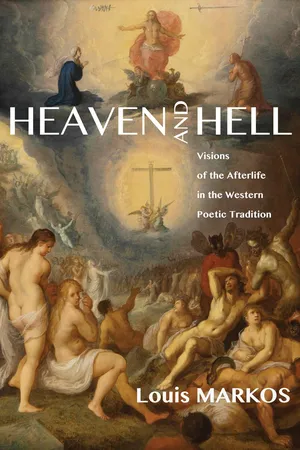
For thousands of years, philosophers, theologians, and poets have tried to pierce through the veil of death to gaze with wonder, fear, and awe on the final and eternal state of the soul. Indeed, the four great epic poets of the Western tradition (Homer, Virgil, Dante, and Milton) structured their epics in part around a descent into the underworld that is both spiritual and physical, both allegorical and geographical. This book not only considers closely these epic journeys to the "other side," but explores the chain of influences that connects the poets to such writers as Plato, Cicero, St. John, St. Paul, Bunyan, Blake, and C. S. Lewis. Written in a narrative, "man of letters" style and complete with an annotated bibliography, a timeline, a who's who, and an extensive glossary of Jewish, Christian, and mythological terms, this user-friendly book will help readers understand how heaven and hell have been depicted for the last 3,000 years.
Information
Topic
Theology & ReligionSubtopic
Literary Criticism1
Introduction
Piercing the Veil of Death
Long ago, before Achilles fought and died at Troy, the Muse Calliope gave birth to a son whose father, some said, was the god Apollo. The name of the boy was Orpheus, and he grew to be the greatest musician of the ancient world. When he played upon his lyre, the trees danced, the winds sighed, and the very stones moved. Drawn by the beauty of his songs, the dryad Eurydice fell in love with the Thracian singer, and, in the following spring, the two were wed. But sorrow soon befell the young lovers. A serpent bit Eurydice on the heel, robbing her of life and casting her soul into Hades.
Grief stricken by the loss of his wife, Orpheus wandered far and wide in search of the hidden doorway to the world below. Guided by love, he found the secret entrance and began his long, slow descent. With each step, the darkness thickened and an aching sense of despair made his limbs feel heavy and old. As he set his foot on the cold floor of Hell, he heard the sound of three ferocious dogs barking in unison. He peered into the gloom to see the dogs, and found, to his horror, that there were not three, but a single mastiff of enormous size with three heads branching out of its thick and sinewy neck. It was Cerberus, three-headed guardian of the realm of Hades, but the sweet song of Orpheus’s lyre overpowered the beast, and he continued safely on his way.
Soon he came to the far bank of that river upon which the gods, having sworn an oath, can never forsake their vow. Knowing that death would carry him away if he tried to wade through the black waters of Styx, he awaited the coming of Charon, the silent, shrouded ferryman of the dead. Charon held out his bony fingers for a coin, and again Orpheus played on his lyre, the same song he had used to overpower the sirens when he had sailed on the Argo with Jason and his men. Charon took him on board, though the weight of the living Orpheus caused the boards to creak and dark water to ooze along the deck.
As the boat glided silently across the Stygian waters, Orpheus saw the souls of the dead massed on the other shore. They looked pale and bloodless, more like shades than men. He could speak with none of them, and so he ventured on alone into the depths of the underworld. Cries of agony soon assaulted his ears, rising upward as from a bottomless pit. Down there, in the depths of Tartarus, the souls of the wicked endured their punishments.
There was Tantalus, suspended in a pool of water while grapes hung in profusion above his head. When he stretched up his hands for the grapes, a wind blew them out of reach; when he bent down his head for a drink, the water rushed out and away from his lips. There was Sisyphus, who must ever push his stone up a hill, knowing that every time he reaches the top, the stone will roll back down. And Tityus, his body stretched out over nine acres while a vulture feeds eternally on his ever-renewed entrails. And Ixion, bound to a wheel that spins without pause. And the sad, sad daughters of Danaus, cursed to carry water in leaky buckets, unable to fulfill the task whose fulfillment alone can win them rest.
And there, with the souls of the damned, lived the Titans, who strove in battle with the Olympian gods and were imprisoned in the lowest pit of Hell by Zeus and his brothers, Poseidon and Hades. There too lived the dreaded Furies, poison dripping from their fangs, their hair a mass of venomous snakes. It is they who drive men mad with guilt and fear and remorse.
In the end, Orpheus found his way to the black throne of Hades. Again and again he begged the Lord of the Underworld to release Eurydice, but the grim monarch refused. For the third time, Orpheus played upon his lyre, but this time he added words to his song. “Lord Hades,” he sang, “all the dead belong to you, and soon all that live will come to your dark kingdom. What do you care if Eurydice should live for another forty years? In the end, she will return to you. Think of your wife, Persephone, how love for her beauty drew you to leave your kingdom and seek her hand. Love, my Lord, is stronger than death, stronger even than you. Take pity on me, and send my beloved back to my waiting arms.”
As Orpheus sang, the whole world below seemed to change. The mist blew away, the moaning ceased, and marvelous things began to happen. The Furies beat their breasts and wept. Tantalus lay down on the grass with a cluster of grapes in his hand. The vulture sat by the head of Tityus, and the two wept together. Ixion’s wheel stopped spinning, and the daughters of Danaus put down their buckets and rested. Sisyphus no longer rolled his stone up the hill but climbed on top of it and sat there listening to Orpheus’s song.
But there was a greater marvel! The song of Orpheus touched the cold and stony heart of Hades. It accomplished what a thousand warriors in arms could not do. It, in the words of Milton, “Drew iron tears down Pluto’s cheek, / And made Hell grant what love did seek.”
“Orpheus,” said Hades, his eyes wet with tears, “You may take your Eurydice away with you, back to the world of men. But listen well. Until you and your bride have stepped out of the cave and have felt the sun on your foreheads, you must not look at her. As you climb the stairs, Eurydice will follow behind you. But if you look back at her, even for a moment, she will be lost to you forever.”
With joy and hope restored, Orpheus began his long, slow ascent. His face fixed forward, his heart yearning to see the light at the end of the long staircase, he pressed onward in silence. But as he neared the mouth of the cave, fear gripped his heart. What if Hades had tricked him? What if his Eurydice were not walking behind him? As the dead make no sound, Orpheus had heard nothing, not even the smallest footfall, to signal the presence of his wife.
“What could it hurt,” he thought, “to take one quick look.” And so the foolish lover turned his head and gazed full upon his wife. Eurydice screamed and held out her hands, but a wind blew down the stairs and carried off her phantom form. For a second, Orpheus saw her robe floating on the air, and then she was gone, swallowed by the darkness below.
For weeks on end, Orpheus wandered along the byroads of Greece, playing his lyre and singing of his pain. Wherever he went, the trees bowed before him, and the dew dripped from their branches like human tears. A group of Maenads, who follow in the train of Bacchus and drink of his wine, were moved by the song, and they implored Orpheus to give them his love. But when the singer rejected their advances, rage filled their hearts, and they seized him by his flowing hair. Made strong by the wine of Bacchus, they tore Orpheus to pieces and scattered his limbs along the countryside of Thrace. His hands and his head and his golden lyre they tossed in the river. And as they floated downstream, the severed hands thrummed the lyre and the dead tongue sang its last song of sorrow.
Hopes and Fears
The tale of Orpheus is a tragic one that seems to offer little hope, and yet, do we not, in a way, envy him his wondrous journey? In every age, in every culture, among every nation and tribe, people have been fascinated by tales of the afterlife. Into these tales they have poured their hopes and fears and dreams. And they have passed them on, generation by generation, to their descendants. All people, from the poet to the scientist, the pauper to the prince, the primitive to the PhD, yearn to pierce the veil and see what lies on the other side of death.
True, there are many today, as there have been in all ages, who say that when we die we die, and that is the end of the matter. Nevertheless, even the most doctrinaire Darwinist, the most stubborn materialist, the most confirmed atheist knows, or at least senses, that there is a part of his or her being that cannot be accounted for by physical nature. Our bodies may be like the beasts, and perhaps even the physical synapses in our brains, but can anyone truly doubt that our consciousness sets us apart from the natural world? Is it not self-evident that our mind is not just quantitatively but also qualitatively different from our brain? Is it not clear that there is a part of us that cannot be reduced to physical mechanisms and natural processes? Once the anatomist has catalogued my body parts, the neurosurgeon has dissected my frontal and parietal lobes, and the chemist has unpacked my genetic code, there is still a part of me that escapes completely their surgical knives and chemical formulae. There is the “me” that transcends the physical, that can even touch on eternity (on timelessness) in a way that no mere element of nature can do.
Only humans can perceive, in glimpses, a time that is outside of time and a space that cannot be contained by the physical limits of nature. More to the point, only humans feel hope or fear at the prospect of their own death. Indeed, as C. S. Lewis points out in The Problem of Pain, we are the only species on Earth that is afraid of its own dead. Tarzan may feel a numinous sense of awe and dread when he enters the graveyard of the elephants, but the elephant on which he rides feels no such emotion. In one sense, the ubiquitous human fear of ghosts is ridiculous, for how can a mere ghost, a diaphanous shade do us any harm? But then, it is not the fear of physical harm that gives us the gooseflesh and makes our hair stand on end. We fear, rather, the prospect of a soul cut off from its body, a mode of existence that lies outside our experience but which we can nevertheless conceive.
The psychiatrists tell us that no human being can imagine his own death: that is to say, we cannot imagine the extinction or annihilation of our personhood. Every part of our being tells us that we—the inner we, the real we—will persist. The fear of ghosts, I believe, comes from the fear that our soul will be trapped in between this world and the next, forced to wander homeless and displaced. In the religions of the East, the soul either returns in a new form (reincarnation) or joins with a larger One Soul into which it empties itself like a drop in the ocean, but in the major Semitic and European religions of the West, the soul travels to a new home—whether that home be positive (Heaven, Valhalla, Paradise, Elysian Fields), neutral (Hades, Sheol), or negative (Hell, Tartarus). Though the fear of eternal punishment is widespread, the fear of detachment, of being a graveyard ghost who cannot find rest in the world beyond, is often just as strong. The Iliad, Odyssey, and Aeneid all feature souls that beg for proper burial rites that they might find rest, and the play Antigone centers on a heroine who sacrifices her life to secure such rites for her brother.
All this is to say that we human beings have always approached death and the afterlife with a certain degree of ambivalence. On the one hand, we, as a species that builds and plans and creates, yearn for assurance that this world and this life are not all there is. On the other hand, we fear we will be asked, in the end, to give an account of what we have built and planned and created. We harbor an unshakable belief that this world should be better than it is, that we too should be better than we are, and so we look forward to an afterlife in which the Paradise we lost is restored. But we harbor, as well, the terrifying prospect that we shall not be welcomed into the heavenly city, but spurned by God, or by spiritual creatures, or by our own ancestors. To express it in the language of the New Testament, we fear that we will not be invited to the Wedding Feast of the Lamb, but instead cast out into utter darkness where there is weeping and gnashing of teeth.
Tales from a Distant Land
The great poets of the Western tradition have all, in their own manner, sought to address our hopes and fears of the afterlife; some have even succeeded in embodying our heavenly dreams and hellish nightmares in visions that continue to challenge and inspire. They speak with enduring relevance to that part of us that transcends the limits of time and space, that reaches out beyond the grave to what lies on the other side of the veil.
On the simplest level, the visions of the poets fulfill the insatiable curiosity of the human race. Who does not enjoy hearing stories of distant lands, and what more distant land can there be than the land of the dead? Tales of the afterlife offer a new and fantastic kind of adventure that may be compared to the science fiction novels and epic fantasies of the nineteenth and twentieth centuries. The poet who writes of Heaven and Hell is like the pilgrim who returns to his village after visiting a far away shrine. No sooner does he reach the village square than he is mobbed by his friends and bombarded with a thousand questions. Some seek mere geographical knowledge, while others hunger for occult (“hidden”) knowledge of things beyond the physical. Such wisdom provides both bearer and hearer with a new and heightened perspective from which to view village matters, and, as such, carries with it the promise of insight and power.
On a deeper level, this hidden knowledge from the other side answers to another human need that is as essential as our yearning for food and drink—our need to make sense of the world around us, to discern order, balance, and harmony in the universe. We desire to know the fate of our own individual soul, but we desire as well to know how our soul fits into the greater cosmic scheme. Mankind has always felt in his bones that the cycles of nature, the movements of the planets, and the patterns of the stars were fraught with meaning. That is why poetic and philosophical visions of Heaven and Hell have traditionally included speculation on the deeper rhythms that resonate beneath us and the shape of the Heavens that soar above us.
On the deepest level of all, these speculations have often included a meditation on the justice of the divine, what philosophers refer to as “theodicy.” All men, even those who claim to be relativists, fear retribution for their sins and hope for a reward for their virtues. We all yearn to know that we live in a universe of cause and effect, of motive and consequence, of a higher justice that sees all ends and knows all hearts. Perhaps no single issue draws more people away from belief in God than the fear that our universe is radically unjust, that whether we act virtuously or viciously the universe doesn’t care. Tales of Heaven and Hell often serve the function of righting the scales of justice—not only theologically but practically as well. For the fact remains that all people in all societies need incentives to keep themselves and their neighbors moral and upright. Concrete images of Heaven and Hell touch us more strongly than abstract principles and strengthen the ethical side of religion. The fear of punishment and the promise of final reward help us resist temptation and remain on the narrow path.
Like the villagers in the illustration above, we naturally gravitate toward those who bring us news from afar, not only because we hope they will supply us with a vision of knowledge, order, and justice, but because there are three other things we most desperately want to be assured of: 1) that we will see our dead family and friends again; 2) that love is eternal and community everlasting; 3) that nothing is finally lost, for all will be redeemed.
2
Sheol and Hades
Hebrew and Greek Visions of the Underworld
Though the New Testament in general, and Jesus in particular, speaks at some length about the afterlife, the Old Testament is all but silent on the subject. The reason for this curious reticence may have to do with the genesis of the nation of Israel. Historically speaking the Jews may be the descendants of Abraham, but the Jews do not really become the Jews until they suffer together in Egypt and share in the exodus from bondage. What went into Egypt was an extended family led by Jacob (Israel) the patriarch; what came out was a people chosen by God to worship him alone and to stand as a testimony against the idolatry of the nations.
It is no exaggeration to say that Egypt, the nation out of which they came, was more obsessed with the afterlife than any people before or since. If the Jews were to put down the Book of the Dead and take up the Book of the Law, it may have been necessary for them to separate themselves from speculation about the afterlife and put their focus...
Table of contents
- Title Page
- Acknowledgments
- Introduction
- Chapter 1: Introduction
- Chapter 2: Sheol and Hades
- Chapter 3: Odysseus in the Underworld
- Chapter 4: Plato and the Geography of the Underworld
- Chapter 5: Plato and the Theology of the Afterlife
- Chapter 6: Aeneas in the Underworld
- Chapter 7: Virgil & Cicero
- Chapter 8: The Shape of Dante’s Universe
- Chapter 9: Christian Humanism
- Chapter 10: Dante’s Inferno I
- Chapter 11: Dante’s Inferno II
- Chapter 12: Dante’s Inferno III
- Chapter 13: Jesus, Paul, and John
- Chapter 14: Dante’s Purgatorio I
- Chapter 15: Dante’s Purgatorio II
- Chapter 16: Dante’s Paradiso I
- Chapter 17: Dante’s Paradiso II
- Chapter 18: Milton’s Paradise Lost I
- Chapter 19: Milton’s Paradise Lost II
- Chapter 20: Bunyan and Donne
- Chapter 21: Satan as Hero
- Chapter 22: Heaven is a State of Mind
- Chapter 23: Heaven is Reality
- Chapter 24: Science and the Afterlife
- Bibliography
- Timeline
- Glossary
- Who’s Who
Trusted by 375,005 students
Access to over 1.5 million titles for a fair monthly price.
Study more efficiently using our study tools.
Frequently asked questions
Yes, you can cancel anytime from the Subscription tab in your account settings on the Perlego website. Your subscription will stay active until the end of your current billing period. Learn how to cancel your subscription
No, books cannot be downloaded as external files, such as PDFs, for use outside of Perlego. However, you can download books within the Perlego app for offline reading on mobile or tablet. Learn how to download books offline
Perlego offers two plans: Essential and Complete
- Essential is ideal for learners and professionals who enjoy exploring a wide range of subjects. Access the Essential Library with 800,000+ trusted titles and best-sellers across business, personal growth, and the humanities. Includes unlimited reading time and Standard Read Aloud voice.
- Complete: Perfect for advanced learners and researchers needing full, unrestricted access. Unlock 1.5M+ books across hundreds of subjects, including academic and specialized titles. The Complete Plan also includes advanced features like Premium Read Aloud and Research Assistant.
We are an online textbook subscription service, where you can get access to an entire online library for less than the price of a single book per month. With over 1.5 million books across 990+ topics, we’ve got you covered! Learn about our mission
Look out for the read-aloud symbol on your next book to see if you can listen to it. The read-aloud tool reads text aloud for you, highlighting the text as it is being read. You can pause it, speed it up and slow it down. Learn more about Read Aloud
Yes! You can use the Perlego app on both iOS and Android devices to read anytime, anywhere — even offline. Perfect for commutes or when you’re on the go.
Please note we cannot support devices running on iOS 13 and Android 7 or earlier. Learn more about using the app
Please note we cannot support devices running on iOS 13 and Android 7 or earlier. Learn more about using the app
Yes, you can access Heaven and Hell by Louis Markos in PDF and/or ePUB format, as well as other popular books in Theology & Religion & Literary Criticism. We have over 1.5 million books available in our catalogue for you to explore.