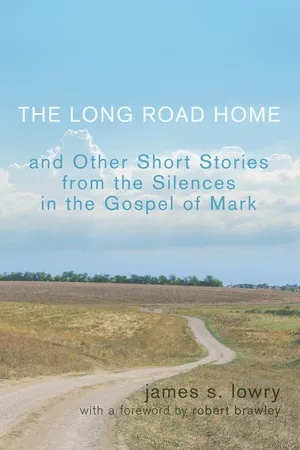
eBook - ePub
The Long Road Home and Other Short Stories from the Silences in the Gospel of Mark
- 120 pages
- English
- ePUB (mobile friendly)
- Available on iOS & Android
eBook - ePub
The Long Road Home and Other Short Stories from the Silences in the Gospel of Mark
About this book
Borrowing from the ancient rabbinic use of midrash as a means of opening Scripture to students, James Lowry has chosen six texts from among those in which he believes Mark deliberately left silences. The author is convinced Mark hoped his readers would be encouraged to raise a variety of possibilities as to what the evangelist left unsaid. Beginning with Mark choosing not to name the temptations of Jesus (Mark 1:12-13) and concluding with Mark choosing to conclude his narrative with the women leaving the tomb of Jesus in stunned silence (Mark 16:8), Lowry spins short stories that suggest several alternative ideas as to how the biblical narrative might have played. In half of the tales, Lowry enters the text and adds fictitious material to Mark's narrative. In the other half, his stories are set in the small textile town of Great Falls, South Carolina, where the author grew up in the 1950s. The hope is these stories will encourage readers of Mark and groups of his readers to raise other possibilities.
Information
Topic
Theology & ReligionSubtopic
Biblical Studiesone
The Temptations of Jesus (Mark 1:9–13)
Notes on the Text
Mark’s story of the temptations of Jesus is part four of a four-part invention that is Mark’s rapid-fire introduction to his gospel narrative. Unlike Matthew and Luke, which begin with their respective stories of the birth of Jesus, and unlike John, which begins with setting the story of Jesus in the context of the ordering of the cosmos, Mark begins with a disarmingly simple fragmented sentence. The fragmented sentence (it has no verb) declares that the story about to be told is the good news that Jesus Christ is the Son of God (1:1). Mark then moves, like the others, to an account of the ministry of John the Baptist who came announcing that one greater than he is coming (1:2–8). Then, like Matthew and Luke, Mark gives an account of Jesus’ baptism by John in the River Jordan. Mark’s account of Jesus’ baptism concludes with the voice of God confirming Mark’s initial declaration that Jesus is the Son of God (1:9–11). On the heels of that dramatic heavenly announcement comes the present text that is Mark’s ever-so-brief account of the forty-day temptations of Jesus. The temptation narrative serves as the last element of the gospel’s introduction and opens the way for an account of Jesus’ ministry in Galilee before beginning his slow-tread journey to Jerusalem, the city of destiny.
For purposes here, the challenge is that, as noted in the introduction, Mark did not tell us what the temptations of Jesus were. Also as noted in the introduction, it is all but impossible to read Mark’s account of the temptations of Jesus without reading into it Matthew’s and Luke’s accounts. Readers of Mark must remember it is all but universally agreed that Mark predates Matthew and Luke. In other words, Mark’s initial readers did not have access to Matthew and Luke. Mark, it seems, wanted his readers to squirm, wondering what the temptations might have been. Or to state the question more directly, if the Son of God, as the ultimate expression of good news, has been given responsibility for saving the world (i.e., redeeming everything that has ever or shall ever go wrong), how might the Son of God be tempted to pull that off?
Inspired by the ancient use of midrash, in the four tales that follow I have attempted to raise some possible alternative ways to redeem the world. In each instance, the question is this: Might any of these (or other) alternatives have been more alluring to Jesus than dying for the sins of the world? In the first two tales, I playfully enter the text and add entirely fictitious details. In so doing, I take Mark’s characters at face value and do not, for example, make any attempt to discuss the nature of Satan or of angels. As a post-Enlightenment person, I am highly suspicious of those who persist in personifying evil. That said, as the well-known preacher Bishop Will Willimon has been heard to say, it is understandable that in our enlightenment we have abandoned talking about devils and demons. The problem, according to Willimon, is that we have not replaced those images with any others that help us talk about the allure of evil in our time. Conversely, the same might be said of shying away from speaking of angels. As for the present exercise, since I shall be entering a first-century document to add fictitious material, I shall when necessary and/or desirable use first-century images to speak of good and evil.
The two remaining stories, while fictitious, are based on experiences taken from my childhood and youth. In one, I serve as the well-intentioned savior figure for my little brother. In the other, an equally well-intended beloved physician serves in that role. It is left to present readers to determine if my suggested acts of redemptions might have tempted Jesus in his quest to redeem the whole creation.
A Tale of Wilderness Wandering
In those days Jesus came from Nazareth of Galilee and was baptized by John in the Jordan. And just as he was coming up out of the water, he saw the heavens torn apart and the Spirit descending like a dove on him. And a voice came from heaven, “You are my Son, the Beloved; with you I am well pleased.”
And the Spirit immediately drove him out into the wilderness. He was in the wilderness forty days, tempted by Satan; and he was with wild beasts; and the angels waited on him.
According to our tradition, on the first night of the thirtieth year of our Lord, three angels appeared at his chamber door. One angel wore seersucker, the second was in gingham, and the third was dressed in a white linen suit. When Jesus answered the door, the first angel grabbed Jesus by the nape of the neck and snarled, “You must come with us. It is time for you to decide.”
“But it’s the middle of the night,” protested Jesus, “and where are we going?”
“We have been sent by the Spirit to drive you into the wilderness. There you must decide by what method and plan you shall save the world.”
“Why the wilderness?” asked Jesus.
“Because in the wilderness you will be apart from the empire with all its principalities and powers. Before you can save the people they must be delivered from empire. The time has come for you to decide how you will do that. Our orders are clear. Don’t make this any harder than it has to be.”
The angels put Jesus on a donkey and drove the donkey to the edge of the wilderness. “It’s time to get off,” said the angel in seersucker. He spoke gently but firmly, as one with authority.
“Alright,” said Jesus. “I’ll go.”
Thus it was Jesus was driven into the wilderness there to decide by what method and plan the world and all its people would be saved.
On his trek in the wilderness Jesus had to be careful to avoid such creatures as lions, tigers, and wolves. Not only that, he had to be ever so careful where he stepped. Once he came within inches of an unfortunate encounter with a boa constrictor. And yet, all things considered, even the fiercest of the wild animals were easier to handle than the Roman army of occupation back in the city; and the monkeys were funny, the robins and cockatoos were pleasant to watch, the deer and antelope liked to play even though they were ever so hard to catch, and berries were both plentiful and delicious. At the end of five weeks, Jesus said to himself, “As long as you stay away from the angry wild beasts, this wilderness experience is not so bad.” He had, however, grown quite tired of berries and was getting a little hungry.
Then in the early morning of day thirty-six, when Jesus awoke from a restful night’s sleep, he saw lurking in the distance a pride of lions who by stealth and raw power were making their way to stalk the oasis where Jesus had stopped to spend the night. If they liked what they saw, which they most certainly would, the lions would surely claim the pool for themselves and keep all others, including Jesus, at bay. Seeing the lions, and afraid of being eaten, Jesus dove into the pool and swam to the middle just out of reach of the fearsome wild beasts. Though safe for the moment, Jesus wondered just how long he would be able to tread water in the face of deadly danger.
Just as Jesus’ arms and legs could hold out no longer, from across the wilderness, at breakneck speed, came a handsome rider dressed in black and mounted on a sleek Arabian steed. The powerful animal was as black as the rider’s attire. Draped across the horse in front of the rider was the carcass of a freshly killed deer. Horse and rider, with no apparent fear, rode into the middle of the pride where the rider slid the deer to the ground.
Not believing their good fortune, the lions began to devour the deer.
With the lions distracted, the powerful horse was able to wade with his rider to the middle of the pool where the rider held out his hand to Jesus and said, “Satan’s the name.”
“Jesus of Nazareth,” said Jesus as he shook the mysterious rider’s hand.
“Let me give you a hand up,” said Satan, and with that, he pulled Jesus up behind him, and the powerful horse took Jesus and Satan a safe distance from the lions. Jesus slid off the horse.
“What’s a nice boy like you doing out in this godforsaken wilderness?” asked Satan when he had dismounted.
“The wilderness is not godforsaken,” said Jesus. “The wilderness is the perfect place for me to figure how best to save the world.”
“Save the world?” said Satan. “That’s a tall order, but I tell you what. This must be your lucky day. I just happen to be an expert on saving the world.”
Satan put his arm around Jesus’ shoulder and pulled him close to his side. Jesus could feel the devil’s hot breath and smell the devil’s musk.
“This is what you must do,” he said. “Stake out a large territory, one with lots of trees and rivers and lakes, and build a great high wall around it. Be sure the wall has only one gate. In fact, you can call it a gated community if you like. Keep a guard at the gate at all times and don’t let human or beast in until they have passed a niceness test.”
“Well, what about everybody outside the wall?” asked Jesus. “What will happen to them?”
“Don’t worry about them,” said Satan. “Just leave them outside, and I’ll take c...
Table of contents
- Title Page
- Foreword
- Acknowledgments
- Introduction
- Chapter 1: The Temptations of Jesus (Mark 1:9–13)
- Chapter 2: Demons Know Best (Mark 4:35—5:13)
- Chapter 3: You Give Them Something To Eat (Mark 6:30–44)
- Chapter 4: The Second Touch (Mark 8:22–26)
- Chapter 5: The Naked Truth (Mark 14:51–52)
- Chapter 6: But What Does It Mean? (Mark 16:1–8)
Trusted by 375,005 students
Access to over 1.5 million titles for a fair monthly price.
Study more efficiently using our study tools.
Frequently asked questions
Yes, you can cancel anytime from the Subscription tab in your account settings on the Perlego website. Your subscription will stay active until the end of your current billing period. Learn how to cancel your subscription
No, books cannot be downloaded as external files, such as PDFs, for use outside of Perlego. However, you can download books within the Perlego app for offline reading on mobile or tablet. Learn how to download books offline
Perlego offers two plans: Essential and Complete
- Essential is ideal for learners and professionals who enjoy exploring a wide range of subjects. Access the Essential Library with 800,000+ trusted titles and best-sellers across business, personal growth, and the humanities. Includes unlimited reading time and Standard Read Aloud voice.
- Complete: Perfect for advanced learners and researchers needing full, unrestricted access. Unlock 1.5M+ books across hundreds of subjects, including academic and specialized titles. The Complete Plan also includes advanced features like Premium Read Aloud and Research Assistant.
We are an online textbook subscription service, where you can get access to an entire online library for less than the price of a single book per month. With over 1.5 million books across 990+ topics, we’ve got you covered! Learn about our mission
Look out for the read-aloud symbol on your next book to see if you can listen to it. The read-aloud tool reads text aloud for you, highlighting the text as it is being read. You can pause it, speed it up and slow it down. Learn more about Read Aloud
Yes! You can use the Perlego app on both iOS and Android devices to read anytime, anywhere — even offline. Perfect for commutes or when you’re on the go.
Please note we cannot support devices running on iOS 13 and Android 7 or earlier. Learn more about using the app
Please note we cannot support devices running on iOS 13 and Android 7 or earlier. Learn more about using the app
Yes, you can access The Long Road Home and Other Short Stories from the Silences in the Gospel of Mark by James S. Lowry in PDF and/or ePUB format, as well as other popular books in Theology & Religion & Biblical Studies. We have over 1.5 million books available in our catalogue for you to explore.