- 184 pages
- English
- ePUB (mobile friendly)
- Available on iOS & Android
eBook - ePub
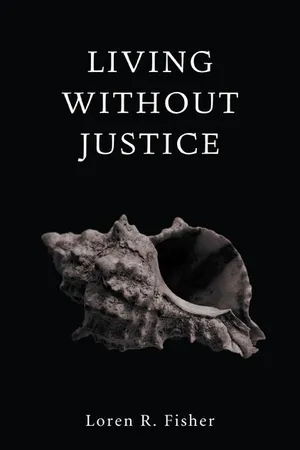
Living without Justice
About this book
"Gift yourself with a tour of ancient worlds. Fisher is a talented scholar in ancient languages and invites the reader into the dynamic world of language and international relations. Once one has read this novel (and hopefully the two previous novels in the series) one will read Old Testament Scriptures with new eyes. Fisher helpfully presents an alternative to a belief in a punishing and rewarding deity."
--Rev. Arthur Gafke, author of Strong Ministry: Strengthening Your Pastoral Leadership and Pray the Seasons
Information
1
The day I met Khety—a scribe and teacher from Egypt—is a day that I will always remember. As I look back, I realize my life changed course that day. I was about fourteen at the time. Khety was in Jerusalem interviewing for a teaching position in the academy. My father brought him to our home for dinner, and I remember asking him what Egyptians would serve at such a dinner. He gave us a typical menu using the Egyptian words and showed us how these words were written. From that moment my mother and I became interested in the Egyptian language. Meeting Khety was only one of the great moments I experienced growing up in Jerusalem, but it was a pivotal moment. I fell in love with the Egyptian language and culture, and this has placed its mark on my teaching and writing at The Jerusalem Academy. This is what makes the academy such an interesting place: there are teachers and students from many other cities, and there is always an air of excitement surrounding new discoveries, foreign news, or new translations of foreign literature.
My father has mentioned on several occasions that he learned a great deal about foreign countries from some of our teachers, but he also said that some of his most interesting information came from people who were working in Jerusalem. When David’s palace was being constructed, he used many workmen from Tyre. Father talked with them about Tyre, about the ships that came to Tyre, and about the Egyptians and others who were just passing through. He also talked with David’s mercenary guards, the Cherethites and Pelethites, who were from Crete and other islands in the far west, as were the Philistines. He noted, however, that many of the guards knew nothing about Crete or the islands, because their grandparents had arrived in this country with the invasions of the Sea Peoples about two hundred years ago. Some of them were born and raised at Beth-shan where the Sea Peoples had been mercenaries for many years, going back to the time of the Egyptian rule at Beth-shan. The ones from Beth-shan did know something about Crete, because their ancestors had kept alive some of their traditions. It is clear that these people have made some contributions to our own language, that is, the language of Canaan. One example is our use of their word seren, meaning, “lord” or “ruler.” But my father says that the most important thing he has learned from all of these contacts is that all of us in our world—from Babylon to Crete and from Ugarit to Egypt—have a common cultural background. At times, even during periods when we are enemies, we all seem to remember, to write, to tell stories, to celebrate, and to worship in ways that reveal this common background. This common background does not mean that individual countries cannot make important and new contributions, but new contributions always have a world of old traditions to overcome—both foreign and local.
The location of the academy in Jerusalem is also important. Other academies in places like Tyre or ancient Ugarit probably receive information as to recent events before we do, but our weather, especially in the summer, is so much better for our work. The inhabitants of coastal cities have to endure hot and muggy days in the summer while at the same time our thin air is invigorating. True, they have the sea to extend their horizons, but we have the exciting views from the mountains. When looking east from the Judean mountains and down toward the Salt Sea, I have often marveled at how the layers of dirt and rock have been twisted and turned in past ages. This landscape is so different from the horizontal layers of earth that make up the lowlands to the west or can be seen in the Egyptian hieroglyph for earth (Egyptian ta’ represented by a horizontal bar). The sea seems so constant, but the mountains cause one to think about the changes that have occurred in the story of our earth. Living in Jerusalem has made me aware that not only do people change, but the earth changes as well.
So the academy and Jerusalem are important to me; I love them dearly. This is not to say that things are perfect here. In the city we have to be aware of the presence King David and his administration, even his prophets and priests. Especially the priests are difficult, and I must say that some teachers and students in the academy are conservative and always against any change or new thought. Such members of our community do not learn anything from our contacts with others or our mountains. They live in fear of King David, his priests, and his God, and their lives are dull and unrewarding. Among the minority, who are aware of our international setting and the opportunity we have to contribute something new to our world, there is a spirit of adventure, and that makes for an interesting and meaningful life.
2
My mother and father, Keziah and Jonathan, are wonderful parents and thoughtful members of the scribal community. They have lived at the Jerusalem Academy since its beginning just after David conquered Jerusalem. My father’s most important works are: The Royal Epic (Genesis), which he edited with the help of others, and his poem, The Rebel Job (Job 3–26). My mother is also a writer. She has always kept a journal, and she has written The Jerusalem Academy, a book about our early years at the academy, and The Minority Report, a book that describes father’s work on The Rebel Job. Both of her books show how our minds and our lives were shaped during those years.
During the first years of the Jerusalem Academy, we celebrated my grandfather Gad’s seventieth birthday party. At the party, my parents also held a naming ceremony for their infant son in which mother read her poem:
“Naam,” we call forth his name.
He will give us pleasant days;
He will fill them with great songs.
Goodness was ours when he came.
We gave him a hero’s name.
Lives touched by him will be changed.
He will sing of great events;
We will never be the same.
My mother had high hopes for me. In her poem she drew upon every possible meaning of the word na‘am. Though I try to be pleasant and good and can sing, as a mature adult I can assure you that I will probably never be a hero.
It was exciting growing up at The Jerusalem Academy, and my childhood was shaped by intellectuals who were drawn to the school. My family had many interesting friends, and they were all involved in projects that could very well change the direction of our lives and our state. My parents invited people into our home who brought growth, change, and happiness to all who were involved in their adventures. This was the case when my father, along with Elimelech and Elishama, produced the Royal Epic. They worked a long time searching for stories about the beginning of our world, and they gathered songs and stories about our fathers Abraham, Isaac, and Jacob. These stories and songs were commonly used in tomb rituals, and it was not an easy task to select the most appropriate stories and songs. They compiled the epic in order to bring unity to the separate states: Israel and Judah. In an epic all the people have to hear the stories and claim them as their stories.
My father, Elimelech, and Elishama were able to complete this epic in time for the dedication of David’s palace. The dedication was a traditional seven-day celebration, and during that time our minstrels performed the entire epic. The people enjoyed this celebration, and it did help to unify them.
Some of the accomplishments of the academy were accompanied by problems and in some cases by dangers. Since the established leaders of both altar and state usually dislike new ideas that are essential to adventure, growth, and happiness, David and the priests did their best to hide my father’s poem, The Rebel Job. Both altar and state went along with The Ancient Story of Job, which stressed the fear of God and obedience as the necessary prerequisites for a good, healthy, and long life. The ancient Job was patient and willing to bow before the creator in repentance for his sins (known or unknown). Thus, he received his reward. But this story was and still is a false illusion. Though threatened by certain priests, father maintained a contrasting opinion: the rebel Job was in touch with the real world and his views were important. The rebel said that the God of the orthodox was not all-powerful and that there was no justice (note God’s hidden testing of the ancient Job). We all suffer in this world regardless of our situation. Father’s Job wanted to build a meaningful life by helping others and blaming no one for life’s difficulties. The Rebel Job, as I have said, is one example of our problems in the academy; it is a powerful example. It is a clear and critical word directed at the idea of retribution by an all-powerful God, and this idea was woven into the fabric of all our traditions: our chronicles, our stories, our laws, our psalms, and even the words of our prophets. But the priests believed that The Rebel Job would create a non-conforming public, and that the public would become impossible to rule. Mother’s book, The Minority Report, deals with this issue in detail, but this is only one example of the kind of tension that existed between some of the scribes at the academy and those entrenched in positions of power in both altar and state. The tensions got better a little later, because Sheva, who was the head of the academy, reversed his rather blind support of altar and state. Also his wife, Sarah, and their daughter, Naomi, helped to convince Sheva to stand with his friends in the academy.
I do not want to give the impression that our life at the academy was always a life of producing great epics or of political tension. We had great times at weddings, parties, celebrations, and at home we always enjoyed our meals around the family table. As children we had great times at school, at play, and in the evenings we would go up on the roof of our house to tell stories. All our friends in The Jerusalem Academy, both adults and children, thought I would become a teacher in the academy. Also they were certain that Rachel, daughter of Elishama and Deborah, and I would be married one day. We grew up together; we went to school together; we helped to care for the other children. Rachel was beautiful and talented, and we sometimes talked about our future life together.
When I was twenty years old, I began to notice just how beautiful Rachel had become, and I was interested in becoming more than Rachel’s good friend. Rachel seemed to be thinking along the same lines. When we were out walking one evening, I stopped and started to kiss her, but Rachel said, “No.” She continued, “Naam, I have to tell you something. I’m in love with Samuel.”
Samuel was a student from the academy, who had gone to Tyre to study with Zadok, a former teacher at The Jerusalem Academy. Samuel had returned recently to Jerusalem to continue his Babylonian studies with Magon, who was a great teacher and came to us from Tyre. I knew that Samuel was a fine student and a wonderful human being, but I was shocked, hurt, and speechless. I was not just angry with Rachel and Samuel; I was angry at everything and everyone. I kicked a large stone in the path and hurt my foot. As we walked back to the academy in total silence, I was limping, and I knew that Rachel was crying softly. I was devastated; I was disappointed and confused.
The next day I talked with mother about all of this. She was always helpful in difficult situations. She reminded me of what I had experienced in Beth-shan a few years earlier. “You told me that you enjoyed meeting Sharmila in Beth-shan,” she said. “You said you felt guilty because you had always been so close to Rachel. But then you said that perhaps you and Rachel were more like a brother and a sister. I wonder. Does Rachel feel the same way?”
“That is possible. I do remember feeling guilty, and I was certainly attracted to Sharmila. She was beautiful, but there was more to it than that. When she came close to serve me some melon, I couldn’t speak until a moment later. That event was not planned.”
“Well, I doubt if Rachel planned ‘her event.’”
“I suppose not. Also I remember when Sharmila came to Jerusalem with her father after our trip to Beth-shan, I had some of the same feelings for her. Even though we wrote a few letters after that, the distance did not allow our friendship to grow. Perhaps I should go up to Beth-shan; I would like to see Sharmila.”
“You should wait a few weeks and see how you feel. Also you should write to her. It is possible, you should know, that she has found a ‘Samuel.’ In any case you need to have a clear head on your shoulders.”
Mother was usually right. It took me several weeks to understand my feelings about all this. I did not talk with Rachel for some time, but I saw Samuel and her at the academy. Rachel did talk with mother and told her that she was sorry about all that had happened. But she said, “I could not help myself; it just happened.” Then she added, “I will always...
Table of contents
- Title Page
- Acknowledgments
- Abbreviations
- Prologue
- 1
- 2
- 3
- 4
- 5
- 6
- 7
- 8
- 9
- 10
- 11
- 12
- 13
- 14
- 15
- 16
- 17
- 18
- 19
- 20
- 21
- 22
- 23
- 24
- 25
- 26
- 27
- 28
- 29
- 30
- 31
- 32
- 33
- 34
- 35
- 36
- 37
- 38
- 39
- 40
- Epilogue
- Afterword
Trusted by 375,005 students
Access to over 1.5 million titles for a fair monthly price.
Study more efficiently using our study tools.
Frequently asked questions
Yes, you can cancel anytime from the Subscription tab in your account settings on the Perlego website. Your subscription will stay active until the end of your current billing period. Learn how to cancel your subscription
No, books cannot be downloaded as external files, such as PDFs, for use outside of Perlego. However, you can download books within the Perlego app for offline reading on mobile or tablet. Learn how to download books offline
Perlego offers two plans: Essential and Complete
- Essential is ideal for learners and professionals who enjoy exploring a wide range of subjects. Access the Essential Library with 800,000+ trusted titles and best-sellers across business, personal growth, and the humanities. Includes unlimited reading time and Standard Read Aloud voice.
- Complete: Perfect for advanced learners and researchers needing full, unrestricted access. Unlock 1.5M+ books across hundreds of subjects, including academic and specialized titles. The Complete Plan also includes advanced features like Premium Read Aloud and Research Assistant.
We are an online textbook subscription service, where you can get access to an entire online library for less than the price of a single book per month. With over 1.5 million books across 990+ topics, we’ve got you covered! Learn about our mission
Look out for the read-aloud symbol on your next book to see if you can listen to it. The read-aloud tool reads text aloud for you, highlighting the text as it is being read. You can pause it, speed it up and slow it down. Learn more about Read Aloud
Yes! You can use the Perlego app on both iOS and Android devices to read anytime, anywhere — even offline. Perfect for commutes or when you’re on the go.
Please note we cannot support devices running on iOS 13 and Android 7 or earlier. Learn more about using the app
Please note we cannot support devices running on iOS 13 and Android 7 or earlier. Learn more about using the app
Yes, you can access Living without Justice by Loren R. Fisher in PDF and/or ePUB format, as well as other popular books in Literature & Literature General. We have over 1.5 million books available in our catalogue for you to explore.