- 254 pages
- English
- ePUB (mobile friendly)
- Available on iOS & Android
eBook - ePub
About this book
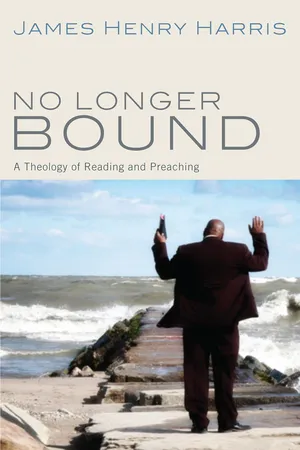
No Longer Bound is about the intersection of reading comprehension and interpretation that leads to the development of a powerful and transformative sermon. Reading facilitates the interpretive process, which is the essence of any sermon. The sermon is an interpretation of an interpretation and as such presents itself as a new gospel message. The ability to write and preach a sermon is an exercise in freedom. The book is grounded in a narrative theological form that begins with the author's experience and filters that experience through the lens of hermeneutic philosophy and theology. Reading and preaching constitute the thread that runs throughout the book. The book suggests that the sermon is the philosophic theology of Black practical religion inasmuch as the Black church is central to religion and culture. This is a fresh and new understanding of homiletics, philosophical theology, and interpretation theory that is intended to produce better preachers and more powerful and life-changing sermons by all who endeavor to preach.
Information
Topic
Teologia e religioneSubtopic
Ministro del culto cristianoChapter 1
Teaching Preaching
Scriptural Texts and Textuality
“Am I not free?”
−1 Corinthians 9:1a
“When we let freedom ring, when we let it ring from every village and every hamlet, from every state and every city, we will be able to speed up that day when all of God’s children . . . Jews and Gentiles, Protestants and Catholics will be able to join hands and sing in the words of the Old Negro Spiritual, “‘Free at Last! Free at last! Thank God almighty, we are free at last!’”
−Martin Luther King Jr.
Born to Read:
A Prelude to Teaching Preaching
A Prelude to Teaching Preaching
Reading is life. Each word and sentence instantiates the breath of God in us, enabling us to live. In other words, learning to read is to learn to live. Reading is a life and death enterprise because to read is to be born again, to be reborn, to be born of the Spirit. It is to be transformed and made anew.1 This means that I love words—big words, small words, hard words, and easy words. As a preacher, one of the most powerful tools in my arsenal is the use of words. I love to use words to paint a picture, to make a clear claim, and to speak truth. I love to write and to speak words.
When I was growing up, we didn’t have many books in our house. The only books we had were textbooks from school and a Bible with some pages missing. We were too poor to buy books on our own. While we knew love, we were too poor to really know what poverty was and too proud to admit it. To tell the truth, I had to go to school to learn about how poor we really were.
Our house had no electricity and no running water. It had no indoor plumbing and no central heat. We used to draw water from the well at the big house and carry it in buckets to our house, along the back path about a quarter mile away. The big house was my grandmother’s, an old plantation house in the center of a 100-acre farm. It was a pretty deep well, about twenty to twenty-five feet. I used to lean over it and look down into the cavernous dark hole. Sometimes, I’d drop a rock into the well and wait to hear it reach the bottom. Its echo sounded so distant; I imagined what it would feel like to slip and fall over into the abyss. Each bucket carried about five gallons, and most of the time two or three of us would draw water using the four buckets we had at the house. The water was thick-tasting and pretty dirty. Often it contained the grit and bugs that inhabited the well. But we drank the water and never got sick from it. Since water was scarce, bathing was a luxury. During the week, we would wash up in the wash pan with about a half gallon of water. Taking a bath was a once-a-week activity so we would be fresh and clean for church on Sundays. A bath was an exercise in splurging or splashing that was supposed to last all week.
What we called the outhouse sat about fifty yards from the back door of the little house that Daddy built. At night we used a chamber pot or slop jar if we needed it. Most of the time we would hold it until morning. The outdoor toilet was a big hole in the ground with a little two foot by four foot house covering it. In later years, water also came from a well not too far from the outhouse. I’m not sure that waste water and drinking water weren’t pretty much the same. They were no more than two hundred feet apart. There was no process of chlorination or filtration system to purify the water and kill bacteria. Still, it didn’t kill us then, and we’re not dead yet.
We used to do our homework by the light of the kerosene lamp. Most of time this meant that when the sun went down, we went to bed. And we got up when the sun came up—at sunrise.
I always had a head cold or sinus infection that lasted most of the winter. Nose running or congested. Head and stomach aches. No health insurance, which meant no doctor visits, unless you were sick unto death. The first time I went to the dentist, I was in the eleventh grade, sixteen years old. I wouldn’t have gone then, either, if any of Daddy’s concoctions had worked. Daddy was a jackleg in everything. He was both doctor and pharmacist, whose only credential was what he called “mother-wit.”
We would sleep with three or four to a bed—often two at the head and two at the foot. We covered the thin blanket with coats and old clothes to keep warm, because the winters were often quite frigid. Any joy of winter lay only in the knowledge that spring was around the corner, but I often felt that it took forever to arrive. I started thinking of spring the day after Christmas. Spring was greater than Christmas because it was a gift of warmth and sunshine. It was the promise and hope of God’s long and sweet-smelling summer. I could hardly wait for springtime and summertime. No shoes needed. No coats or hats. No freezing from the wisp of the wind or the snow blowing in from the north. Summer was like the joy of heaven. It was a dream fulfilled every single year, and I loved every minute of it.
What a joy to walk around in summertime with bare feet and scanty clothes. The years were 1958 through 1965, and I was so eager to start school. I couldn’t wait to demonstrate my reading knowledge and my ability to comprehend. I have been able to read and spell big words for as long as I can remember. Truthfully, I cannot remember a time when I could not read. This is not hubris or delusion; it is simply the truth as I remember it. Anything put before me: the English Bible, the newspaper, the dictionary, picture books, word books, the Weekly Reader, magazines, and, yes, the romance novels my oldest sister Maria left on the couch. She was a romantic.
I was born reading; I was gifted with the word. In his memoir Father and Son, Edmund Gosse’s words about himself also apply to me: “I one day drew towards me a volume, and said, ‘book’ with startling distinctness . . . I cannot recollect a time when a printed page of English was closed to me.”2 Reading and writing were critical to understanding and excelling in school. I was good at both. So I was a young scholar throughout elementary school. Aside from the nightly visits to the big house, we had no distractions. That’s part of the reason I could excel in school. I loved school so much that I feel even now that I was born to go to school both as a learner and a teacher. Most of my life has been centered around school. Education is my passion.
Ever since I was a child, I have had a love for school and a thirst for knowledge. I could learn anything that was put before me—especially reading and writing. It was my gift to learn and to teach others. In the summertime, when school was out, I ran my own school and tutorials. My students were my parents and my brothers and sisters. There were ten of us children, so I had a small class where I taught reading, writing, social studies, and arithmetic. I started this when I was eight years old and I have been teaching and preaching ever since. In elementary school, I became the teacher’s pet because I always wanted to please. My teachers were like goddesses. Gurus. Gandhi was indeed right in saying that true knowledge is impossible without a guru. They were all very attractive women. So, I think I was in love with my teachers as well as with the opportunity to learn. I wanted to display good conduct and excel academically. Whenever I was called upon to go to the blackboard to solve a math problem, spell a word, conjugate a verb, or write a sentence, I was eager to do it. I seldom missed a day of school. For years, I had perfect attendance.
We never had to walk to school because by the time I came along we had public school buses, and since I had S’s or E’s (for satisfactory and excellent) in all my subjects, I got to be in the school safety patrol. This meant that I sat on the front seat by the bus driver and would help to operate the school bus door and step outside to hold the safety patrol flag in front of the bus while traffic came to a complete stop. Not that there was much traffic on the rural back roads where we lived and traveled. Nevertheless, I was happy to hold that coveted position.
Our elementary school was about five miles from where we lived, and it was not much bigger than a large house. But it was still the biggest building I had ever entered. We could not attend the white children’s school, which was less than one mile from our house—within walking distance. Every day, we passed the pretty red brick school with concrete sidewalks in front of it and large hedges and a manicured yard. The white school was two or three stories high with a stone facade and a parapet wall spiraling above the slate roof. Balustrades. It had large Greek Revival columns. Oh, and lots and lots of floor-to-ceiling windows. It made education seem important and serious, because the building spoke for itself. It was Jeffersonian. It looked like the ideal school, if there is such a thing. But for me and all the other Black children, it was not for us—off limits.
In stark contrast, just four miles away, was the Black school—Union Grove Elementary School. Window panes were broken. Bricks were missing from the steps. It sat off the main road on the edge of a soybean field and directly across from a cemetery. It was one level, brick exterior, paint peeling off the window frames and the entire structure struggling to resemble a place where learning takes place—much less where it is a top priority. The contrast was glaring. Something was always wrong: leaking faucets, broken light fixtures, window panes missing, ceiling peeling, and roof leaking. I remember some cold days in the middle of January and February when there was no heat anywhere in the school. Was this Siberia or somewhere in the frigid mountains of Eastern Europe? Sometimes, it was so cold that we had to keep our coats on all day long. Those who had coats, that is. A coat in winter was a prized commodity because when you were one of ten poor children, as I was, simple economics taught that not everybody could get a coat. (At least not one that fits perfectly or with buttons or a zipper that worked.) And yet, we learned in spite of the dilapidated building. We learned cultural anthropology and sociology. We learned the meaning of racial difference and the politics of segregation.
During one report card or grading period, the teacher wrote that I complained of headaches and stomach aches almost daily. “James is a good student, but he seems to suffer from constant headaches and stomach aches,” she wrote. For the most part, I think I was simply congested and hungry. During those days it was hard for me to get enough to eat. I even looked malnourished. I was skinny as a bean pole. I never could get enough food at home or at school.
My favorite teacher during this childhood period was an elegant, soft-spoken, and prim lady named Mrs. Gladys Oswald. She was so poised, so articulate, so polished. There was not a priggish bone in her body. I thought that the sun rose and set according to the will of Mrs. Oswald. She could write so elegantly on the chalkboard. Every letter was perfectly placed within the lines and her cursive writing was flawless. I wanted, one day, to write like Mrs. Oswald. It was my dream. The Black teachers of that day apparently practiced writing every night when they went home. I certainly thought they did because penmanship was a craft—an art. It was like the poetry of Langston Hughes and Emily Dickinson. Or that of Zora Neale Hurston, Richard Wright, or Adrienne Rich. It was photography, like the captivating shots of Marilyn Monroe’s curvaceous, naked body by Milton H. Greene. It had its own narrative to it. It had a language that spoke of precision and respect. Penmanship. It said to the eyes, Look at me. I have style and class; I am beautiful to behold. It said to the hands, I am curvaceous and slender and tall. Keep me within the lines. I am cursive. Teachers were architects of the word. They were alphabet stylists. Calligraphers. And we were graded on how well we formed the letters to the alphabet. Style and substance are still one and the same for Black people. Writing well is not a bad thing; although any boy who did so was said to “write like a girl.” This was reverse sexism. It’s equivalent to saying that a Black student who studies hard and makes straight A’s is “acting white.” We’ve heard that craziness before. It is a foolish misinterpretation of Black culture, Black pride, Black achievement, and the love of learning for the sake of knowing; learning as a sign of intellectual curiosity; learning as a sense and symbol of pride. That’s what learning means to me. It means possessing good self-esteem. Life-long learning is a virtue like prudence or honesty or truth or justice. It is freedom.
The school building we were housed in—as rickety and ragged as it was—was not as bad as the textbooks. They were the discarded, the discontinued, the old editions of every subject. They were ragged and worn, marked up and vandalized on purpose. Some of the books had pages missing and backs torn off. White children from years past had used these books until they were deemed discards; then they would be carted off to the Black schools for us to use. Not that there was anything salvific about freedom and justice in the books either. Another example of the blatant inequality of segregation. The books were always splattered with bad words. Profanity. Ugly words: niggers, spooks, coons, monkeys. Pictures of Blacks would be embellished: teeth blackened, ears and lips enlarged like they’d been injected with botox. The books looked like they had been edited by Mark Twain’s illustrator, E. W. Kemble, who was a master of the caricature of Blacks.
Darker-skinned children (like me) were treated with less favor than light-skinned Blacks by teachers, school administrators, and other children. It was hard for dark-complexioned children to do well in school. There was a color caste and class system within the all-Black classroom. Educated Blacks, or as Carter G. Woodson said, “mis-educated Negroes,” had begun to hate themselves to the point that “white was right, Black get back, brown stick around” was the modus operandi. Black teachers had internalized the ways of their colonizers. The darker you were, the less favor you received. Lighter-skinned children were presumed to be smarter by Black teachers. This was a fallacy that my dark-skinned body proved every day I sat in the classroom. I was always in the top group for reading, spelling, and math. Ability grouping or tracking meant nothing to me. I was always in group One A—because there was no word that I couldn’t pronounce and no word I couldn’t spell. Like Frederick Douglass and Vernon Jordan, James Henry could read. Big words, too!
I looked up to the school principal. He had authority and power. Maybe because he wore a necktie and a starched white shirt every day. He looked like Twain’s nigger professor. One day he came to our classroom and asked the teacher to allow me to ride with him to the school board office, since I was a model student. I was excited. I got to ride in the principal’s shiny new Chevrolet. I was riding with “Mr. Big-shot.” The man. Our principal was a cigar-and-cigarette smoking, fast-driving, slick-headed man who ruled the school with an iron fist. To me, he acted very much like a slave master or an overseer who kept all the female teachers standing in subjection and fear. He was the only male in the school’s leadership and faculty. Black patriarchy was mimicking white authority. The janitor, however, was a Black man, too, but he was voiceless and powerless. A peon. He was of a lower socio-economic and educational class. There was no respect shown him by the principal or most of the teachers. He did all the dirty work: cleaned toilets, mopped floors, collected trash, washed the blackboards, cut the grass. You name it, and he did it.
Black leaders are often chosen because of their ability to keep other Blacks under control and in subjection. Black educators have always been status quo oriented, perpetuating an ideology that is more conformist than anything else. Education for freedom...
Table of contents
- Title Page
- Acknowledgments
- Introduction: Practical, Narrative, and Sermonic Theology
- Chapter 1: Teaching Preaching
- Chapter 2: Black Preaching as an Act of Love
- Chapter 3: The Preacher Struggles with Life, Suffering, and Death
- Chapter 4: Sermonic Discourse
- Chapter 5: Sermonic Discourse as Sign and Symbol of Freedom
- Chapter 6: Black Church Preaching, Culture, and Counter-Culture
- Chapter 7: The Place and Problem of Race in Literature, Theology, and Preaching
- Chapter 8: The Disembodiment of Language in Literary Texts and Culture
- Chapter 9: The Preacher as Interpreter
- Bibliography
Trusted by 375,005 students
Access to over 1.5 million titles for a fair monthly price.
Study more efficiently using our study tools.
Frequently asked questions
Yes, you can cancel anytime from the Subscription tab in your account settings on the Perlego website. Your subscription will stay active until the end of your current billing period. Learn how to cancel your subscription
No, books cannot be downloaded as external files, such as PDFs, for use outside of Perlego. However, you can download books within the Perlego app for offline reading on mobile or tablet. Learn how to download books offline
Perlego offers two plans: Essential and Complete
- Essential is ideal for learners and professionals who enjoy exploring a wide range of subjects. Access the Essential Library with 800,000+ trusted titles and best-sellers across business, personal growth, and the humanities. Includes unlimited reading time and Standard Read Aloud voice.
- Complete: Perfect for advanced learners and researchers needing full, unrestricted access. Unlock 1.5M+ books across hundreds of subjects, including academic and specialized titles. The Complete Plan also includes advanced features like Premium Read Aloud and Research Assistant.
We are an online textbook subscription service, where you can get access to an entire online library for less than the price of a single book per month. With over 1.5 million books across 990+ topics, we’ve got you covered! Learn about our mission
Look out for the read-aloud symbol on your next book to see if you can listen to it. The read-aloud tool reads text aloud for you, highlighting the text as it is being read. You can pause it, speed it up and slow it down. Learn more about Read Aloud
Yes! You can use the Perlego app on both iOS and Android devices to read anytime, anywhere — even offline. Perfect for commutes or when you’re on the go.
Please note we cannot support devices running on iOS 13 and Android 7 or earlier. Learn more about using the app
Please note we cannot support devices running on iOS 13 and Android 7 or earlier. Learn more about using the app
Yes, you can access No Longer Bound by James Henry Harris in PDF and/or ePUB format, as well as other popular books in Teologia e religione & Ministro del culto cristiano. We have over 1.5 million books available in our catalogue for you to explore.