eBook - ePub
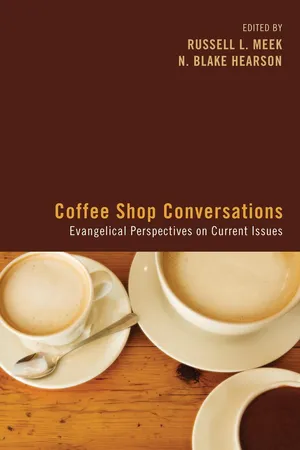
Coffee Shop Conversations
Evangelical Perspectives on Current Issues
- 142 pages
- English
- ePUB (mobile friendly)
- Available on iOS & Android
eBook - ePub
Coffee Shop Conversations
Evangelical Perspectives on Current Issues
About this book
There are numerous issues in the public square confronting the Western church. While there are any number of books available on each of the topics engaged in this collection of essays--just war, family planning, rest, immigration, politics, economic recession, fair trade, and health care--there is no compact guide that approaches each of these issues from an evangelical perspective. Coffee Shop Conversations does just that. The book does not aim to address each issue exhaustively; instead, it offers an evangelical approach to these topics, with the hopes that the door will be opened for further conversation.
This book brings together the expertise of several evangelical scholars who are committed to serving the church through scholarship. The volume is therefore ideal for student ministry, Sunday school classes, small groups, and individuals interested in engaging the wider culture from a stance that is well reasoned and committed to biblical faith and practice.
Information
Topic
Theology & ReligionSubtopic
Christian Church1
Over Worked and Stressed Out
What Can the Sabbath Teach Us about Truly Living?
Introduction
We live in a busy society. That fact is no surprise to anyone. Technology, while helpful, has filled our lives with more tasks. We can now work while driving and text or talk during lunch. There are no times that are off limits for accomplishing the tasks we feel we must do. This has, in turn, created the perceived need to do more in less time. As a result, technology gives us more leisure time which we fill with other tasks, increasing the demands and pressure on our lives. We feel the anxiety of trying to get everything done and outperform everyone else. Having a relaxed life has become so unusual that there are more and more news stories about people simplifying their lives or getting away from the demands of technology and life in American society.
Modern churches take full advantage of multimedia and busy schedules, doing their best to maximize volunteers and compete for time in the lives of their parishioners. It is often these very same churches that present whole series on balancing life and work and making sure that people carve out daily time with God. It was not always this way in our culture. It was not that many years ago that many parts of the United States enforced “blue laws” that required a day off on Sunday. Some of these laws required businesses to be closed all day on Sunday. Eventually these laws were eroded so that businesses were only closed on Sunday morning and modified so that no alcohol could be sold during that time. Of course, this restriction disappeared with time and now there is only a slight vestige of uniqueness remaining to Sundays in the vast majority of the United States.
This change has not been without effect on the Christian culture. The restaurant chain Chick-fil-a has made the conscious decision to close on Sundays so that its work force can go to church and have a break. Yet, the fact that the Chick-fil-a policy is so widely known and commented on shows just how out of character it is for our society. Many conservative Christians honor this stance with a somber nod and the feeling that it is the right decision. However, honoring the policy in principle does not stop them from going to a different restaurant after church with friends.
Our rapidly changing and accelerating culture and its effect on Christians should give us pause, but, ironically enough, it does not. Most Christians feel that some sort of rest on Sunday is a good idea, but they do not feel bound to any particularities. Many Christians view Sunday as a Sabbath of sorts, which for them constitutes a break from work, time for a nap, and maybe watching sports on television. Indeed, most modern American Christians view the Sabbath as an antiquated law from the Old Testament that has no bearing on them in the here and now. Yet, the Sabbath functions as an anchor point for the entire story of creation and the identity of Israel. Moving forward through Scripture, the command to observe the Sabbath occupies a pivotal point in the Ten Commandments, and the prophets and the New Testament have significant teachings on the Sabbath as well. Given the major role the Sabbath plays in the Bible, it is shocking that the Sabbath command is the only one of the Ten Commandments that Christians seem to ignore. At the same time, the rapidity of life has brought us to a place of turmoil and exhaustion. We need to look closely at the idea of Sabbath in Scripture and see that its principles offer a way to find peace and rest.
In many ways our culture has come to view the idea of Sabbath—in terms of stopping activity—as a burden. Noted theologian Marguerite Shuster states, “To rest from our labors because the world has already been created, and our final trust rests in God and not in ourselves, goes flatly against the violent manipulativeness and rabid self-reliance that permeate our whole culture, not to mention the relentless acquisitiveness that seems to head the list of our values.”1 However, this negative cultural attitude may have been true for early Jewish communities as well. Jesus admonished the Pharisees about the constant emphasis they placed on doing the commandments of Torah perfectly which made keeping both Sabbath and the other laws irksome and discouraging.2 The focus of the Jewish teachers and early community had come to be on their own power and control to do everything right. The later rabbinical teachings seek to correct this negative attitude by emphasizing that the Sabbath should be welcomed with joy.3
Among both Jewish and Christian communities, past and present, the negative attitude toward keeping the Sabbath is grounded in a lack of understanding of its nature and purpose. The classic perception of the Sabbath is that it is a time when one does not have to work, but one cannot do anything fun either. The aforementioned blue laws and obligatory church or synagogue service attendance no doubt contributed to this perception.4 Biblical and theological scholar Dennis T. Olson notes that, “The Old Testament Sabbath may be one of the most strongly countercultural concepts in the Bible in relation to our modern society and its values.”5 Ultimately, Sabbath becomes a different form of work in the view of the all-important “I” of our society. Rest is an obligation rather than something we want to do. This distorted picture of the Sabbath comes from both a fundamental misunderstanding about what the Sabbath is and an assumption of discontinuity between the Old and New Testaments.
Genesis and the Sabbath
In order to understand the Sabbath and where it should lead us, a brief overview of the biblical ideas about Sabbath is in order. Naturally, we start at the beginning—the end of the acts of creation in Gen 2:1–3 (NASB). The passage reads, “Thus the heavens and the earth were completed, and all their hosts. By the seventh day God completed His work which He had done, and He rested on the seventh day from all His work which He had done. Then God blessed the seventh day and sanctified it, because in it He rested from all His work which God had created and made.” In this passage we find that the Sabbath is actually the very last thing that God creates. Everything else is finished and complete, but creation as a whole is not complete until the Sabbath is put in place. God then goes on to bless the Sabbath, an act that is usually reserved for animate beings. The creation of human beings is usually understood to be the ultimate creation, the crowning act of creation to which all other created things lead. Yet, mankind’s creation is not the final act. Sabbath rest is. In a very real sense, Sabbath, and not mankind, unifies and brings all of creation together.
God blesses the seventh day and calls it holy specifically because He rests on it. Sabbath has this unifying effect because God rests on that day. Why does God rest? The God of monotheism does not need to rest. God does not grow tired or weary.6 Expenditure of energy does not deplete God in some way. Therefore, the idea of God resting on the Sabbath must have something else behind it.
While it is only implied, the idea of rest is associated with completion. At this point in the narrative, all is created so that there is nothing lacking. We have seen throughout the creation story that each successive thing created is, in some way, incomplete. Darkness and light have to be set apart. Water and land must have boundaries set between them. Plants need light and moisture. Animals need plants. Humanity needs the entire ecosystem and is responsible for continuing to maintain it and keep it in order. Indeed, any who study the creation story see a certain parallel and pairing between the first six days.7 One rabbinic story notes this pairing as well as the fact that the seventh day, the Sabbath day, is left without a partner.8 The final day is both incomplete and yet is the completion of creation. It looks back on creation and God rests in it. At the point of Sabbath, all that is needed is present. Nothing is lacking. Perfection has been achieved.
The fact that God rests on the Sabbath also means that creation has a purpose beyond function and action. Creation is complete so that fellowship with God is possible. The Sabbath is the period in which the fellowship takes place. Fellowship in this instance means trusting and resting in God based on His perfect provision via creation. Men and women will continue to work in creation and in this way reflect the creative nature of God, but the work is not the goal; trust and fellowship with God is. They will not forget the purpose of creation because they will rest in God’s provision and not their own accomplishments. They will trust God because he rested, thereby proving the trustworthiness of what he had made. There is no more certain statement that God has provided all that is needed and that he can be trusted than the idea that he is able to cease and to rest. Fellowship with God is possible because there is no need or lack that can keep people from it. Adam and Eve do not need to do anything to have fellowship with God and rest in his presence.
The Sabbath’s role in the creation narrative is to show that it is incumbent upon all creation to trust God. If the nature of creation is such that God illustrates that it is complete through rest, how much the more should human beings trust in God? The Sabbath looks back on creation and says it is complete, but as with Jesus’s words on the cross, the story does not end there. The Sabbath also looks forward to fellowship with God and his creation. The completion provides for the fellowship—the rest that comes from trusting in God’s provision.
Enter the fall. With the failure of humanity, creation and all that was in it became twisted and tainted, but God remained the same. Creation was no longer complete, so Sabbath rest took on a more redemptive role. The certainty of all needs being met in the world was lost with the sin and rebellion of humanity, but trusting in God to meet all of one’s needs remained. As God worked toward the redemption of humanity through Israel, the Sabbath became a command to realize that redemption in a practical way: trust in God to provide and rest in the assurance of that provision.
Exodus and the Sabbath
This idea of the redemption and restoration ...
Table of contents
- Title Page
- Contributors
- Foreword
- Preface
- Introduction
- Chapter 1: Over Worked and Stressed Out
- Chapter 2: Fair Trade
- Chapter 3: Immigration
- Chapter 4: Birth Control
- Chapter 5: Economic Recession
- Chapter 6: Blessed Insurance
- Chapter 7: Right vs. Left
- Chapter 8: Warfare and Christian Discipleship
- Bibliography
Trusted by 375,005 students
Access to over 1.5 million titles for a fair monthly price.
Study more efficiently using our study tools.
Frequently asked questions
Yes, you can cancel anytime from the Subscription tab in your account settings on the Perlego website. Your subscription will stay active until the end of your current billing period. Learn how to cancel your subscription
No, books cannot be downloaded as external files, such as PDFs, for use outside of Perlego. However, you can download books within the Perlego app for offline reading on mobile or tablet. Learn how to download books offline
Perlego offers two plans: Essential and Complete
- Essential is ideal for learners and professionals who enjoy exploring a wide range of subjects. Access the Essential Library with 800,000+ trusted titles and best-sellers across business, personal growth, and the humanities. Includes unlimited reading time and Standard Read Aloud voice.
- Complete: Perfect for advanced learners and researchers needing full, unrestricted access. Unlock 1.5M+ books across hundreds of subjects, including academic and specialized titles. The Complete Plan also includes advanced features like Premium Read Aloud and Research Assistant.
We are an online textbook subscription service, where you can get access to an entire online library for less than the price of a single book per month. With over 1.5 million books across 990+ topics, we’ve got you covered! Learn about our mission
Look out for the read-aloud symbol on your next book to see if you can listen to it. The read-aloud tool reads text aloud for you, highlighting the text as it is being read. You can pause it, speed it up and slow it down. Learn more about Read Aloud
Yes! You can use the Perlego app on both iOS and Android devices to read anytime, anywhere — even offline. Perfect for commutes or when you’re on the go.
Please note we cannot support devices running on iOS 13 and Android 7 or earlier. Learn more about using the app
Please note we cannot support devices running on iOS 13 and Android 7 or earlier. Learn more about using the app
Yes, you can access Coffee Shop Conversations by Russell Meek,N. Blake Hearson, Meek, Hearson in PDF and/or ePUB format, as well as other popular books in Theology & Religion & Christian Church. We have over 1.5 million books available in our catalogue for you to explore.