eBook - ePub
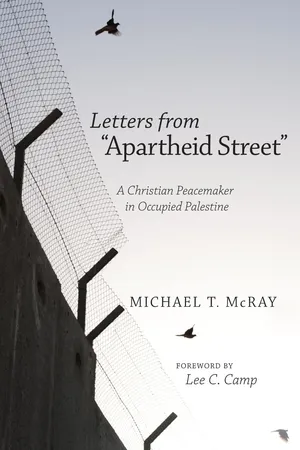
Letters from “Apartheid Street”
A Christian Peacemaker in Occupied Palestine
- 168 pages
- English
- ePUB (mobile friendly)
- Available on iOS & Android
eBook - ePub
About this book
In 1984, Ron Sider challenged that until Christians are ready to risk everything in pursuit of peace, "we dare never whisper another word about pacifism . . . Unless we are ready to die developing new nonviolent attempts to reduce conflict, we should confess that we never really meant that the cross was an alternative to the sword." From this challenge, Christian Peacemaker Teams was born. Nearly thirty years later, Michael McRay too explored Sider's challenge, interning with CPT in the West Bank city of Hebron. Alongside local and international peacemakers, McRay learned how to resist the violence of occupation, sharing in the stories of a suffering people as he struggled to embody the peaceable spirit of the rabbi from Nazareth. This book tells those stories.
Drawing on his personal experience with the land and its history, McRay's raw letters home tackle critical issues relevant to peacemakers everywhere: What is really happening in Palestine that mainstream media fails to report? How are Palestinians' lives being affected? How can one be peaceable amidst such violence and oppression? How should Christian discipleship influence one's pursuits of peacemaking and reconciliation? McRay's letters illustrate both the challenge and promise of the cross in today's world.
Information
Topic
Theology & ReligionSubtopic
Christianity1 / The Beginning
Saturday, December 31, 2011—Newark, United States
I am in the airport in Newark, New Jersey, sitting just outside the special Israeli security area. Israel has this type of special security in each airport offering direct flights to Tel Aviv. This security check is in addition to normal airport security. It probably goes without saying why Israel requires extra security. Security is everything in Israel. Obviously, all nation-states are concerned with security. Each wants to be safe, to protect its citizens. This is why nation-states have militaries. The logic is that the more military power one has, the safer one is from external threats. But Israel is even unique to this arguably universal standard among recognized nation-states. Given a history of persecution against the Jewish people, and in light of historical and ongoing tensions in the Middle East, Israel has understandable reason to be paranoid about its security. Double security measures are just one small indication of this paranoia. When one arrives in Tel Aviv and enters the land, one sees the way this fear has affected the whole of Israeli life, and thereupon the life of those around Israel. I hope to write more about this after I arrive.
Allow me to give a little background for this trip. I made my first trip to Israel and Palestine in 2000 with my father and his parents. The next year my entire family visited the land for a month during a six-month sabbatical, which we spent primarily in Greece. I did not return until 2007, when my father and I spent a week traveling around the West Bank and Israel making preparations for subsequent annual medical trips he now takes with med students and residents. In 2010, I spent spring break of my junior year in college attending a Christian peace conference in Bethlehem (which I will attend again this year) and visiting my brother (who was working with Musalaha1, a reconciliation organization based in Jerusalem) and my dad (who was leading his medical group). I returned again that summer with two college friends, Jonathon Valentin and Paul Reeser, to volunteer in Beit Sahour, a small town adjacent to Bethlehem. During our two months, we worked primarily with the Al Basma Center for the Developmentally Disabled.2 This beautiful organization was founded by a dear family friend with whom I will be staying during my week in Bethlehem for the peace conference in early March. This current trip, though, will be quite different than any of the previous ones.
I arrive in Tel Aviv tomorrow, and on Monday, I begin a two month internship with Christian Peacemaker Teams (CPT) in Hebron. As is widely known but too often denied, Israel is maintaining a military occupation in Palestine.3 Recounting the history of the occupation and all the details of daily life for Palestinians inside what are “officially” known as the Palestinian Territories is much too large a task to do in this first update.4 Throughout the next three months (I return to the U.S. just before Easter), I will be documenting my experiences and sharing my thoughts from my work with CPT.
As I understand it, CPT began as a call to the Mennonite Church for Christians to begin taking Jesus’s teachings of nonviolence seriously. CPT holds that if Christians truly are to claim that the cross is an alternative (or perhaps the alternative) to the sword, then Christians must be willing to pay the price for this claim. Soldiers are willing to die by the thousands for what they believe in; Christians must be willing to do the same. Thus, CPT has organized teams that have a permanent presence now in Palestine, Colombia, Canada, and Iraqi Kurdistan. CPT seeks to get physically in the way of violence—thus their motto: “getting in the way.”5 In Palestine, they stand alongside both nonviolent Palestinian and Israeli partners resisting violence, supporting them by sitting atop houses set to be illegally demolished, confronting soldiers who are harassing locals, and recording everything they see so that those on the outside can come to know the reality on the ground. This is an organization that wants to take seriously Jesus’s call to “love your enemies.” But Jesus knew you cannot love people you do not know. He spoke the haunting words above to a people whose enemies, internal and external, were in their midst, in their everyday lives. Jesus knew that loving your enemies means getting personal with the “other.” This is certainly dangerous and terrifying, but there are incredible stories of transformation of people who refused to dehumanize, and instead acknowledged the human quality of the other, creating space for justice, reconciliation, and peacebuilding. This is what CPT seeks to be a part of.6
I am excited for this journey. It will be a very different experience for me, both due to the nature of the work and the fact that I am going alone, which is something I have never done in my travels to nearly thirty countries. I have always had at least one familiar face with me. For this, and many other reasons, I am nervous, but I remain hopeful for a meaningful experience.
1. For more on Musalaha, visit their website: www.musalaha.org.
2. For more on Al Basma, see Jonathan McRay’s essay at the end of the book. See also a fantastic recent documentary directed by Zachary Crow called We See No Enemy (www.weseenoenemy.com). This highly recommended film introduces five stories from the West Bank, one of which is Al Basma, creating a kind of West Bank anthology. We See No Enemy includes interviews with my brother, father, and beloved family friends in Palestine.
3. That is, the West Bank and Gaza. Officially, Israel withdrew its settlers and soldiers from within Gaza in 2005, but it has maintained a blockade of the area. Israel controls all comings and goings to and from Gaza.
4. See “Further Reading” below for my recommendations on literature regarding the Israeli-Palestinian conflict.
5. For a variety of reasons, CPT has moved away from this language and instead adopted the motto: “Building partnerships to transform violence and oppression.”
6. For more on CPT, visit their website: www.cpt.org.
2 / Welcoming the Enemy
Thursday, January 5, 2012—Hebron, Occupied Palestine
“CPT! CPT! Come, come! The soldiers have a man!”7 Her voice startled me. Jean, Rosie, and I had been returning from afternoon patrol, but I had lagged behind to look at a few shops in Hebron’s Old City. Though I did not know the woman requesting my presence, she knew who I was. My red hat and grey vest bearing the CPT name and logo unmistakably identify with whom I work. Her call immediately made me nervous. I was alone, inexperienced in the field. Questions flooded my mind. How do I proceed? What are CPT protocols in this situation? What do the people expect me to do? Do they really expect I can free a detained man from a group of Israeli soldiers? Despite my hesitancies, I set down the potential gift I was holding and followed the woman.
Turning a corner, I arrived on scene in a matter of seconds. Four Israeli soldiers stood in a semicircle next to a wall, with two more in the center. One was pointing a gun toward a Palestinian man who was leaning casually against the stone wall, and the other had the Palestinian’s green identification card, radioing his headquarters to check the ID. Soldiers do this often, randomly check the IDs of passersby. As far as I can tell, no rhyme or reason exists for their method of choosing whom to check. The superior gives the command to check IDs, so they check IDs. While some may excuse the soldiers since they are ostensibly only “following orders,” the Palestinians do not share that sentiment. They feel harassed. For the soldiers, it is of no real importance the agenda of the Palestinian, his or her errand or timeframe. If a soldier wants to check an ID, then the Palestinian must stand there and wait. This particular man was not even crossing a checkpoint. He was merely walking through the old suuq (marketplace) of his city, just like everyone else. Palestinians can generally be held for ID checks for as long as twenty minutes before calls and interventions are made, which often are ineffective. This is no doubt a major inconvenience for the people.
I was unsure of how to proceed. This being only my second day on team, I had not yet encountered any incidents I could use as reference points. I tried calling Jean, but quickly remembered her phone was charging and thus not with her. I accepted the fact I was on my own for this one. I decided to do what I had always read that CPTers do: that is, confront the soldiers.
“Why are you holding this man,” I said to one of the soldiers in the middle. “What did he do?” No answer. “Why do you need to check his ID?” The soldier looked up at my eyes with seeming disdain but said nothing. I turned to the man pointing the gun at the detainee. “Why are you pointing a gun at him? What did he do?” Still no response from anyone.
Realizing I would not get the soldiers to talk to me, I decided to at least make them aware that I was documenting their actions. I pulled out my small blue notebook and transcribed the scene. My hands shook as I began photographing and videoing. I had never before confronted someone carrying an automatic weapon, much less six people. After only a few minutes, however, the ID cleared, and the soldiers released the Palestinian. Both parties proceeded about their business.
I decided to follow the soldiers, though, to see if they stirred up any other mischief. Trailing them by only a few feet, I held my camera up, videoing their march. They walked in two lines, three to a line, and seemed to be practicing some kind of drill or routine. Periodically, a couple would lift up their rifles, briefly taking aim at houses above, or down alleyways. After the first...
Table of contents
- Title Page
- Reader Reviews
- Foreword
- Preface
- 1 / The Beginning
- 2 / Welcoming the Enemy
- 3 / Life On Team
- 4 / “Apartheid Street”
- 5 / Amir’s Arrest
- 6 / The Struggles of the Past Week
- 7 / Assault
- 8 / Rehumanization and the Danger of the Single Story
- 9 / The Golani and the Struggle to be Peaceable
- 10 / The Powers of Destruction
- 11 / Darkness Cannot Drive Out Darkness
- 12 / The Difficult Road Ahead
- 13 / The Search for Human Interaction
- 14 / Home Invasions
- 15 / I Hate Occupation
- 16 / Open Shuhada Street
- 17 / The Action
- 18 / The Weekend
- 19 / The Next Stage
- 20 / The Conference, Hebron, and Israel’s “Security Fence”
- 21 / Qalqiliya
- 22 / The Mount of Beatitudes and the Nonviolent Teachings of Jesus
- 23 / They Teach Life
- 24 / The Standoff
- 25 / Moving On
- 26 / The Exit and the Protest
- 27 / Beirut
- 28 / Homeward Bound
- Epilogue
- Bibliography
- Contributors
- Acknowledgements
- Glossary
- Appendix A: Further Reading
- Appendix B: Al Basma Center for the Developmentally Disabled
Trusted by 375,005 students
Access to over 1.5 million titles for a fair monthly price.
Study more efficiently using our study tools.
Frequently asked questions
Yes, you can cancel anytime from the Subscription tab in your account settings on the Perlego website. Your subscription will stay active until the end of your current billing period. Learn how to cancel your subscription
No, books cannot be downloaded as external files, such as PDFs, for use outside of Perlego. However, you can download books within the Perlego app for offline reading on mobile or tablet. Learn how to download books offline
Perlego offers two plans: Essential and Complete
- Essential is ideal for learners and professionals who enjoy exploring a wide range of subjects. Access the Essential Library with 800,000+ trusted titles and best-sellers across business, personal growth, and the humanities. Includes unlimited reading time and Standard Read Aloud voice.
- Complete: Perfect for advanced learners and researchers needing full, unrestricted access. Unlock 1.5M+ books across hundreds of subjects, including academic and specialized titles. The Complete Plan also includes advanced features like Premium Read Aloud and Research Assistant.
We are an online textbook subscription service, where you can get access to an entire online library for less than the price of a single book per month. With over 1.5 million books across 990+ topics, we’ve got you covered! Learn about our mission
Look out for the read-aloud symbol on your next book to see if you can listen to it. The read-aloud tool reads text aloud for you, highlighting the text as it is being read. You can pause it, speed it up and slow it down. Learn more about Read Aloud
Yes! You can use the Perlego app on both iOS and Android devices to read anytime, anywhere — even offline. Perfect for commutes or when you’re on the go.
Please note we cannot support devices running on iOS 13 and Android 7 or earlier. Learn more about using the app
Please note we cannot support devices running on iOS 13 and Android 7 or earlier. Learn more about using the app
Yes, you can access Letters from “Apartheid Street” by Michael T. McRay in PDF and/or ePUB format, as well as other popular books in Theology & Religion & Christianity. We have over 1.5 million books available in our catalogue for you to explore.