eBook - ePub
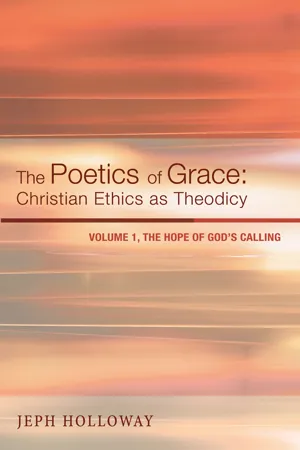
The Poetics of Grace: Christian Ethics as Theodicy
Volume 1, The Hope of God’s Calling
- 304 pages
- English
- ePUB (mobile friendly)
- Available on iOS & Android
eBook - ePub
About this book
What is God doing about a world marked by conflict and division? What about a world in which our technologies promise great good but also threaten our existence? What is God doing in a world where the demands for accumulation and acquisition create division and despair? Can Christians hope to be of positive influence in a world that does not always support, reflect, or even understand Christian commitments?
Christian ethics often raises such questions as these, and the possible answers vary widely. Paul's Letter to the Ephesians is a tremendous resource for exploring a faithful response to perhaps the toughest question of all: what is God doing about evil? The role of Christian ethics is to take seriously the challenge that, whatever God is doing, God calls us to participate in a distinctive task that embraces our own commitments and labors within the divine purpose. Ephesians says that God has taken the initiative to pursue that purpose and, remarkably, offers that we ourselves are part of the answer to the question, what is God doing about evil?
Information
Topic
Theology & ReligionSubtopic
Christian Theology1
“We Are His Workmanship”
A Theocentric Ethic
“Woe to us if we should be found to be our own creator, inventor, and author of our own future well-being.”
Johann Georg Hamann1
“What should I do?” For many, that is the central question of the moral life. That can certainly be an important question in the midst of this situation or that. A coworker steals from the company you both work for. Do you tell the boss? A young couple finds it next to impossible to get pregnant. Is in vitro fertilization the solution? A political action committee presses for a state referendum banning gay marriage. Is that the Christian thing to do? The question, “What should I do?” seems to be at the center of so many moral issues.
For others, however, another question has surfaced in discussions of moral philosophy in general and Christian ethics in particular. A strong emphasis on matters of character and virtue finds expression not in the question, “What should I do?” but “Who am I?”2 The significance of persistent traits expressed across the days, week, months, and years of our lives are of tremendous importance for what the moral life is all about (and will be explored later in this book), but there is an even more important question for the task of Christian ethics.
As important as moral decisions are, Oswald Bayer insists that we should not begin any exploration of Christian ethics with the standard question, “What should I do?” Instead, we should ask, “‘What has been given to us?’ For human action does not start with itself; it draws its life from freedom that has already been given.”3 Christian ethics begins with neither our action nor our character, but by celebrating the divine initiative and agenda.
In his letter to the Ephesians, Paul offers an ethical vision that begins, not with the question “What should I do?” or even “Who am I?” but by emphasizing what God is doing. That is, the vision of the moral life in Ephesians is fundamentally tied to what it has to say about the character, actions, and will of God made known through Jesus Christ. Clearly this outlook differs from many other approaches to the moral life, particularly any moral strategy that creates and separates something called “ethics” from something called “religion.” What this means is that for Christians to talk about the sort of life we believe God intends for humanity, we have to talk about matters that go by the designation “theology.”
To emphasize theology, however, is likely to occasion grumbling on the part of some. Gordon Graham observes what he considers to be a general trend of retreat by Western Christianity at the turn of the twenty-first century: “Theologians and believers more generally have lost confidence in the relevance of Christian theology to the explanatory endeavors of intellectual inquiry.” Hardly anyone, he insists, “confidently deploys theology in the discussion of intellectual problems in cosmology, evolutionary biology, historiography, jurisprudence, or metaphysics.”4 This abandonment of theology is no more evident, says Graham, than in the discipline called “Christian ethics.” In this arena, there is the rejection of a larger theological outlook that could provide any comprehensive frame of reference for an all-embracing vision of reality. Rather, the view of the nineteenth-century mathematician Henri Laplace, that “God is an hypothesis of which the scientist has no need,” is now apparently endorsed even by the Christian moralist who would construe Christianity as “but a code by which to live, with, perhaps, ‘radical’ implications for social criticism as well as for the behavior of individuals.”5
What accounts for the willingness to reduce the Christian faith to matters of “ethics,” according to Graham, is the widely held assumption that we live in a pluralistic age where the claims of the Christian faith concerning God, Christ, redemption, the Holy Spirit, the Christian community of the church, eschatology, etc., have no public significance. In such a context, if Christianity wants to have any genuine relevance in the world today, it will not be “in any theological-cum-metaphysical explanation of existence and experience that Christian theology has hitherto been thought uniquely to supply.” Instead, “if Christianity is to speak to the contemporary world it is [only] in its ethic that a meaningful message is to be found.”6 In this way, as Stephen Long puts it, “The discipline of Christian ethics becomes one more immanent anthropological discourse that incessantly addresses questions of justice, rights, care, autonomy, and the need for religion to have a role in the public square. But seldom does Christian ethics actually engage with the theology of the moral life, that is, with what difference it might actually make for understanding the moral life if the God whom Christian tradition confesses as Father, Son, and Holy Spirit were true.”7
It is a great irony that for many the obligation Christian faith imposes on us is to seek influence in the world by offering a view of moral practices and obligations independent of the story of God’s redemptive work, of the importance of worship and discipleship, of a hope in God’s future that rests its confidence in God’s past. What Christian ethics must be (some say), if it is to have any contemporary significance in today’s pluralistic environment, is anything but Christian. What Christian ethics must be is about positions on this or that issue employing arguments that are expressible in terms that any clear-thinking person can affirm so that such positions can be formulated as policy enacted through legislative means, thus enforceable by the power of the state.8 Matters of personal agency, the formation of character, the shaping of moral vision, and the painful and sometimes slow acquisition of skills and disciplines that might be needed to sustain a particular form of life are all irrelevant. Arguments that justify policies implemented through the power of the state are all that are needed. Stanley Hauerwas and Samuel Wells describe this as the strategy of “conventional ethics,” an effort given over to the task of “trying to make a better world without us becoming better people.” Hauerwas and Wells insist that “not only is this task impossible, but it is neglecting its chief resource—the way God chooses to form his people.”9 Wells elsewhere describes the ethical enterprise as “about forming lives of commitment, rather than informing lives without commitment.”10 For many, though, the task has become a matter of providing information (telling people what to do) rather than offering transformation (bearing witness to a life-changing gospel). How we have come to this state of affairs requires a look back into important events in European history and philosophy that continue to have significant impact in our world today. Once we have considered features of these forces that have shaped our world, we will hear from Paul in Ephesians how it is that the life God intends for us rests upon God’s gifts of grace and peace.
Where Are We?
Alasdair MacIntyre’s “Disquieting Suggestion”
In Walter Miller’s A Canticle for Leibowitz, the young monk Francis, living in a post-nuclear-holocaust world, discovers fragments of paper with scratch marks on them. Eventually those scratch marks are determined to be from the hand of the blessed Saint Leibowitz, a sacred figure from the distant past. Six hundred years earlier, Leibowitz had actually been an engineer associated with the development of the very nuclear weapons that had caused such widespread destruction. Since the worlds of science, knowledge, and education had all been destroyed, though, there was no context available for deciphering the significance of the various words, formulae, and equations that Francis had discovered. Ceaseless debates follow on the meaning of phrases like “circuit design” and “Transistorized Control System.” The debates rage endlessly since there is no shared frame of reference that would make the words intelligible; instead the words are simply employed to advance various viewpoints that seek credibility through association with terms that sound authoritative.11
Alasdair MacIntyre uses something like this story as a metaphor for what has occurred in our culture. We still use words like “good,” “bad,” “right,” and “wrong,” but there is no longer ...
Table of contents
- Title Page
- Preface
- Introduction: Christian Ethics as Theodicy
- Chapter 1: “We Are His Workmanship”
- Chapter 2: “Created in Christ Jesus”
- Chapter 3: “New Life in the One Body of Christ”
- Bibliography
Trusted by 375,005 students
Access to over 1.5 million titles for a fair monthly price.
Study more efficiently using our study tools.
Frequently asked questions
Yes, you can cancel anytime from the Subscription tab in your account settings on the Perlego website. Your subscription will stay active until the end of your current billing period. Learn how to cancel your subscription
No, books cannot be downloaded as external files, such as PDFs, for use outside of Perlego. However, you can download books within the Perlego app for offline reading on mobile or tablet. Learn how to download books offline
Perlego offers two plans: Essential and Complete
- Essential is ideal for learners and professionals who enjoy exploring a wide range of subjects. Access the Essential Library with 800,000+ trusted titles and best-sellers across business, personal growth, and the humanities. Includes unlimited reading time and Standard Read Aloud voice.
- Complete: Perfect for advanced learners and researchers needing full, unrestricted access. Unlock 1.5M+ books across hundreds of subjects, including academic and specialized titles. The Complete Plan also includes advanced features like Premium Read Aloud and Research Assistant.
We are an online textbook subscription service, where you can get access to an entire online library for less than the price of a single book per month. With over 1.5 million books across 990+ topics, we’ve got you covered! Learn about our mission
Look out for the read-aloud symbol on your next book to see if you can listen to it. The read-aloud tool reads text aloud for you, highlighting the text as it is being read. You can pause it, speed it up and slow it down. Learn more about Read Aloud
Yes! You can use the Perlego app on both iOS and Android devices to read anytime, anywhere — even offline. Perfect for commutes or when you’re on the go.
Please note we cannot support devices running on iOS 13 and Android 7 or earlier. Learn more about using the app
Please note we cannot support devices running on iOS 13 and Android 7 or earlier. Learn more about using the app
Yes, you can access The Poetics of Grace: Christian Ethics as Theodicy by Jeph Holloway in PDF and/or ePUB format, as well as other popular books in Theology & Religion & Christian Theology. We have over 1.5 million books available in our catalogue for you to explore.