eBook - ePub
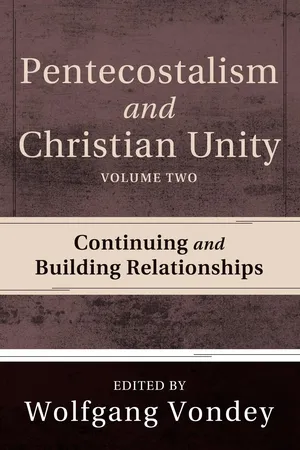
Pentecostalism and Christian Unity, Volume 2
Continuing and Building Relationships
- 312 pages
- English
- ePUB (mobile friendly)
- Available on iOS & Android
eBook - ePub
About this book
This book is the follow-up volume to Pentecostalism and Christian Unity: Ecumenical Documents and Critical Assessments. The first volume documented the history and ecumenical engagement of Pentecostals during the twentieth century. This new collection traces the ecumenical developments, narratives, and conversations during the first decade of the twenty-first century. The ecumenical community and Pentecostals have consistently lamented the absence of a comprehensive gathering of resources for both groups. This particular volume provides two significant assets in this regard: (1) documentation of new and emerging conversations that have not yet produced official reports, and (2) official reports from continuing conversations. The book begins with an overview of a century of Pentecostal participation in Christian unity. Part One contains ecumenical narratives on the Joint Consultative Group of Pentecostals and the World Council of Churches, Lutherans and Pentecostals, the Global Christian Forum, and Christian Churches Together in the USA. Part Two contains the extensive reports from the official dialogue of Pentecostals with the Roman Catholic Church, the World Alliance of Reformed Churches, and the Oneness-Trinitarian Pentecostal dialogue. This collection presents an invaluable resource for teachers, scholars, and pastors interested in engaging the global Christian arena from the worldwide and ecumenical perspectives of Pentecostalism.
Information
Topic
Theology & ReligionSubtopic
Christian ChurchPart 1
Ecumenical Narratives with Pentecostal Participation
1
Lutherans and Pentecostals in Dialogue
Insights and Analysis
2004–2010
1. Starting Points87
Identifying the Dialogue Partners. It is relatively easy to identify the Lutheran dialogue partner, namely the member churches of the Lutheran World Federation, which “confesses the Holy Scriptures of the Old and New Testaments to be the only source and norm of its doctrine, life, and service. It sees in the three Ecumenical Creeds and in the Confessions of the Lutheran Church, especially in the unaltered Augsburg Confession and the Small Catechism of Martin Luther, a pure exposition of the Word of God” (Constitution of the LWF.II).
It is more difficult to identify the Pentecostal partner. Pentecostalism is a vast, rapidly growing, and rapidly changing movement with many independent congregations. All the same, Pentecostals do have structures more or less parallel to Lutheran ones. Among these are individual denominations (e.g., Assemblies of God, Church of God in Christ, International Pentecostal Holiness Church, Foursquare Gospel Church, etc.). There are also umbrella structures, such as the Pentecostal World Fellowship, the Pentecostal European Conference, and the World Assemblies of God Fellowship. While these trinitarian groups might demonstrate differences in focus, nevertheless they would recognize one another as full partners in nearly all aspects of Pentecostal ministry. It should be noted that the Pentecostals mentioned here look to the Scriptures of the Old and New Testaments as normative for all of faith and life and they accept the historic teachings of the church.88
Method for Dialogue. At the outset of our discussions it became clear that the usual ecumenical method for bilateral dialogue would not serve our specific circumstances well. When churches have formulated specific condemnations against each other, it makes sense to pursue a doctrinal course of reflection to work on the resolution of the disagreements, as for instance between Lutherans and Catholics. But while Lutherans and Pentecostals are not currently in fellowship with one another, this is not because of official mutual condemnation but rather because they developed in different circumstances with different histories. Like Lutheranism, Pentecostalism did not begin in a theological vacuum. Yet, while reading the Scriptures, Christians from many denominations who would become Pentecostals desired to receive the same kind of spiritual manifestations that they read about in the early church (e.g., Acts). Having received these experiences, they went back to the Scriptures to understand them. To this day, spirituality identifies Pentecostals more than institutions or doctrines do, though most Pentecostal have written statements of faith.
Given this reality, we sought to develop a method that suited both partners’ lived experience as church communities. We began with a mutual sharing of a narrative of our experience of God’s action in our own lives. We also made a point of experiencing Christian life together through participation in each other’s worship services and daily prayer, as well as mutual testimony and consolation. The starting point in experience naturally gave rise to questions about doctrine and spiritual practice; it also set the doctrine and spiritual practice in a context that made them more accessible to the other partner. Sometimes we found similar or parallel concerns or commitments under widely different terminology and practices. Imagination and intuition, rather than direct one-to-one comparison, served well in this regard.
Out of this method we proposed to continue our discussion under the rubric of “How Do We Encounter Christ . . .?” This allowed for a fruitful combination of experiential and doctrinal exploration in our ensuing discussions.
2. How Do We Encounter Christ?
The Pure Gospel of Christ. Christ is primarily understood in Lutheran theology and piety as the savior on account of his sacrificial atonement in the crucifixion and his resurrection from the dead. As a result, Lutheran theology has historically placed more emphasis on justification, in which we receive Christ’s atoning work for us by faith alone, as a gift of the Holy Spirit, than on sanctification, the transformation ensuing from this faith. Especially in their rich musical tradition, Lutherans focus on their gratitude for and faith in Christ’s self-giving for us and for the forgiveness of sins, leading to everlasting life. Lutherans are taught not to put trust in themselves or in signs of their sanctification, but continually to return to the promises of Christ. Luther’s explanation of the second article of the Creed in the Small Catechism (which every Lutheran confirms and studies) illustrates the relationship between what Christ has done for us and how we receive it in faith: “I believe that Jesus Christ, true God, begotten of the Father from eternity, and also true man, born of the Virgin Mary, is my Lord, who has redeemed me, a lost and condemned creature, purchased and delivered me from all sins, from death, and from the power of the devil, not with gold or silver, but with His holy, precious blood and with His innocent suffering and death, in order that I may be wholly His own, and live under Him in His kingdom, and serve Him in everlasting righteousness, innocence, and blessedness, even as He is risen from the dead, lives and reigns to all eternity.”
The Full Gospel of Christ. Pentecostals resonate with many aspects of Lutheran christology and its doctrine of salvation, as is evident in Pentecostals’ hymns, prayers, statements of faith, and proclamation. At the same time, Pentecostals have additional emphases. Lutherans
often mistakenly think that the addition lies in a one-sided Pentecostal focus on the Holy Spirit. Quite the contrary, Pentecostals teach that the gift of the Spirit is a specific endowment of power to witness to Christ. Pentecostal preaching focuses on the person of Christ far more than on the Spirit (or on the Father). A common Pentecostal formulation speaks of the “full gospel,” a term borrowed from the Holiness tradition, which depicts Christ in a four- or fivefold office as justifier, sanctifier/baptizer in the Spirit, healer, and soon-coming king, in addition to the traditional language of the church about Christ as the Son of God, the second person of the Trinity, and the Word incarnate. Pentecostal christology attempts to expand the “comma” between the portions of the creed that talk about Jesus’ birth and death by drawing attention to his life and ministry of healing, casting out demons, and feeding the hungry. Chiefly, Pentecostals expect that those things that Jesus the Christ did in the power of the Spirit during his earthly ministry, he can do and is now doing in the church and in the life of believers—saving and healing them, releasing them from evil, and providing for their daily needs. Pentecostals acknowledge that the term “full gospel” is sometimes used in an ideological way to criticize what some perceive to be the “half-full gospel” of other churches. The Pentecostal concept of “full gospel” nonetheless contains a critique that Lutherans should take seriously.
often mistakenly think that the addition lies in a one-sided Pentecostal focus on the Holy Spirit. Quite the contrary, Pentecostals teach that the gift of the Spirit is a specific endowment of power to witness to Christ. Pentecostal preaching focuses on the person of Christ far more than on the Spirit (or on the Father). A common Pentecostal formulation speaks of the “full gospel,” a term borrowed from the Holiness tradition, which depicts Christ in a four- or fivefold office as justifier, sanctifier/baptizer in the Spirit, healer, and soon-coming king, in addition to the traditional language of the church about Christ as the Son of God, the second person of the Trinity, and the Word incarnate. Pentecostal christology attempts to expand the “comma” between the portions of the creed that talk about Jesus’ birth and death by drawing attention to his life and ministry of healing, casting out demons, and feeding the hungry. Chiefly, Pentecostals expect that those things that Jesus the Christ did in the power of the Spirit during his earthly ministry, he can do and is now doing in the church and in the life of believers—saving and healing them, releasing them from evil, and providing for their daily needs. Pentecostals acknowledge that the term “full gospel” is sometimes used in an ideological way to criticize what some perceive to be the “half-full gospel” of other churches. The Pentecostal concept of “full gospel” nonetheless contains a critique that Lutherans should take seriously.
Differences in Church Cultures. It is evident that our respective christologies do not exclude or condemn each other, but they do have different focal points. Lutherans cultivate and assume that the primary locus of encounter with God is in the word and sacraments, out of a concern to be absolutely sure that they are having a genuine, authentic encounter with the God witnessed to by the Scriptures. Pentecostals cultivate and assume the possibility that encounters with God may take place outside of any immediate or obvious relationship to the word and sacraments, but it is expected that such experiences will always be tested for their accordance with the word and discerned accordingly by the community. Lutherans accept the possibility of genuine encounters with God not directly mediated by word and sacrament; Pentecostals reject experiences that are in contradiction to the word.
Consideration of our respective histories helps to make sense of our different church cultures. Lutherans were fighting against “Schwärmer” (enthusiasts) who claimed that the word of the Scriptures was no longer necessary since the Spirit gave them immediate and new revelations. This would be equally problematic for Pentecostals, as one example from early Pentecostalism suggests. In a series of meetings in Virginia, in which people were speaking in tongues, one observer noted that, “There is a band of saints that do not read the Bible like saints [do]. They say the Bible is for unbelievers so they do not read it at all. O for someone to help. Won’t you come and help if you can, and as soon as you can?”89 In fact, early Pentecostals criticized Lutherans and other traditional Christians for failure to live in strict accordance with the word, for instance in Lutherans’ rejection of pacifism and of speaking in tongues. On the other side, Pentecostals arose in a setting of rationalism that gave little room to the Spirit or to any experience of the living God. Such greatly different circumstances have led to misunderstandings and suspicion between us.
In sum, Lutherans have perceived Pentecostals as adding a lot of nonessential and suspect requirements that detract from the central work of Christ, whereas Pentecostals understand themselves as faithfully expecting all God has to offer. Pentecostals have perceived Lutherans as having a reductive and limited view of what Christ can actually do in people’s lives, whereas Lutherans understand themselves to be faithfully adhering to the pure, constitutive message of Christ. To put it aphoristically, our respective worries are “more than the pure gospel” versus “less than the full gospel.”
3. How Do We Encounter Christ in Proclamation?
The Necessity of Discernment. It is important to begin with the observation that Lutherans and Pentecostals agree that all charismatic manifestations, beliefs, and theological claims are to be accompanied by a process of discernment in the community of the church and subject to Scripture as the “norming norm.” The capacity for discernment is itself a gift of the Spirit (“it has seemed good to the Holy Spirit and to us,” Acts 15:28; see also 1 Cor 12:10). While special responsibility for discernment typically rests with the ministries of oversight among both Lutherans and Pentecostals, discernment is also a task that involves all believers.
Proclamation as a Task of the Whole Community. Lutherans and Pentecostals share the view that the worshiping congregation is a vital and active instrument in the encounter with Christ. Pentecostals understand worship as an encounter with Christ in the Spirit and as a manifestation of fellowship that extends the invitation of Christ to all people (Acts 2:42 ff. and Acts 4:32 ff.). This has led to some distinctive Pentecostal worship practices. One of these is the testimony, that is, people witnessing to the continuing works of God in their lives. Another is the “altar call”: the preacher’s public invitation to prayer at the altar. This prayer can include committing oneself to Christ, confessing sins, seeking baptism in the Holy Spirit, consecrating oneself for ministry, or asking for healing or for any other need. More generally, the Pentecostal congregation is not only a receiving but also as a resonating body for proclamation. The response of the congregation to the word is itself part of the proclamation.
These distinctive practices, though not common in Lutheranism, are occasionally found, for example in Pietist settings. Overall Lutherans have tended to align proclamation with the preaching work of the pastor. This grows out of the Lutheran understanding of the sovereignty of the word that is to be heard and believed; the pastor’s task is to speak the words of Christ to the faithful. However, hymnody has always been an essential part of Lutheran worship and creativity, and this has been a powerful means by which the congregation has participated in proclamation. The common practice of recitation of the creeds and responsive liturgies are further instances of this. For Lutherans, the “altar call” is the invitation to the Lord’s Supper where people come forward to receive the body and blood of Christ for the forgiveness of sins. But there is no a priori reason for them to reject the Pentecostal altar call, which Lutherans may regard as an enactment of justification and sanctification—forgiveness of sins and renewal of life taking place as the person is “invited” to come to Christ.
The Hermeneutics of Scriptural Interpretation. Within their respective traditions, Lutherans and Pentecostals include a wide
spectrum of hermeneutical approaches to the interpretation of Scripture. Generalizations referring to one tradition as “literalist” and the other as “non-literalist” are simply not tenable. We found many examples where each of our traditions takes some passages of Scripture literally and others spiritually or allegorically. Future discussion between Lutherans and Pentecostals on the question of biblical hermeneutics is essential, with the understanding that this is an ongoing matter of discernment within their own communities as well.
spectrum of hermeneutical approaches to the interpretation of Scripture. Generalizations referring to one tradition as “literalist” and the other as “non-literalist” are simply not tenable. We found many examples where each of our traditions takes some passages of Scripture literally and others spiritually or allegorically. Future discussion between Lutherans and Pentecostals on the question of biblical hermeneutics is essential, with the understanding that this is an ongoing matter of discernment within their own communities as well.
In conversations wit...
Table of contents
- Title Page
- Acknowledgments
- Introduction
- Part 1: Ecumenical Narratives with Pentecostal Participation
- Chapter 1: Lutherans and Pentecostals in Dialogue
- Chapter 2: Recommendations of the Joint Consultative Group of the World Council of Churches and Pentecostals to the Ninth Assembly, Porto Alegre, Brazil
- Chapter 3: Summary Report of the Europe Consultation on the Global Christian Forum
- Chapter 4: One in Christ for the Sake of All
- Part 2: Official Ecumenical Documents with Pentecostal Participation
- Chapter 5: On Becoming a Christian
- Chapter 6: Experience in Christian Faith and Life
- Chapter 7: Final Report of the Oneness-Trinitarian Pentecostal Dialogue
- Epilogue
Trusted by 375,005 students
Access to over 1.5 million titles for a fair monthly price.
Study more efficiently using our study tools.
Frequently asked questions
Yes, you can cancel anytime from the Subscription tab in your account settings on the Perlego website. Your subscription will stay active until the end of your current billing period. Learn how to cancel your subscription
No, books cannot be downloaded as external files, such as PDFs, for use outside of Perlego. However, you can download books within the Perlego app for offline reading on mobile or tablet. Learn how to download books offline
Perlego offers two plans: Essential and Complete
- Essential is ideal for learners and professionals who enjoy exploring a wide range of subjects. Access the Essential Library with 800,000+ trusted titles and best-sellers across business, personal growth, and the humanities. Includes unlimited reading time and Standard Read Aloud voice.
- Complete: Perfect for advanced learners and researchers needing full, unrestricted access. Unlock 1.5M+ books across hundreds of subjects, including academic and specialized titles. The Complete Plan also includes advanced features like Premium Read Aloud and Research Assistant.
We are an online textbook subscription service, where you can get access to an entire online library for less than the price of a single book per month. With over 1.5 million books across 990+ topics, we’ve got you covered! Learn about our mission
Look out for the read-aloud symbol on your next book to see if you can listen to it. The read-aloud tool reads text aloud for you, highlighting the text as it is being read. You can pause it, speed it up and slow it down. Learn more about Read Aloud
Yes! You can use the Perlego app on both iOS and Android devices to read anytime, anywhere — even offline. Perfect for commutes or when you’re on the go.
Please note we cannot support devices running on iOS 13 and Android 7 or earlier. Learn more about using the app
Please note we cannot support devices running on iOS 13 and Android 7 or earlier. Learn more about using the app
Yes, you can access Pentecostalism and Christian Unity, Volume 2 by Wolfgang Vondey in PDF and/or ePUB format, as well as other popular books in Theology & Religion & Christian Church. We have over 1.5 million books available in our catalogue for you to explore.