- 230 pages
- English
- ePUB (mobile friendly)
- Available on iOS & Android
eBook - ePub
About this book
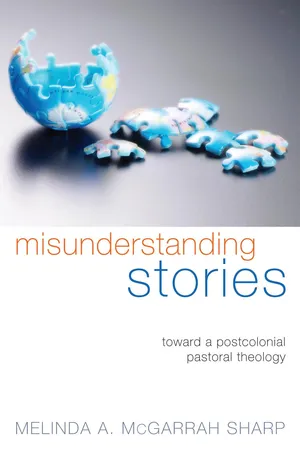
How can we work toward mutual understanding in our increasingly diverse and interconnected world? Pastoral theologian Melinda McGarrah Sharp approaches this multifaceted, interdisciplinary question by beginning with moments of intercultural misunderstanding. Using misunderstanding stories from her experience working with the Peace Corps in Suriname, Dr. McGarrah Sharp argues that we must recognize the limits of our own cultural perspectives in order to have meaningful intercultural encounters that are more mutually empowering and hopeful. Bringing together resources from pastoral theology, ethnography, and postcolonial studies, she provides a valuable resource for investigating the complexity of providing care and fostering communities of belonging across cultural differences. McGarrah Sharp illustrates a process of moving from disconnection to regard for diverse others as neighbors who share a common yearning for hopeful and meaningful connection. Leaders in faith communities, practitioners of care, and scholars will all be able to use this resource to better understand the conflicts, tensions, and uncertainties of our postcolonial twenty-first-century world. An included discussion guide facilitates classroom study, small group discussion, and personal reflection.
Information
Topic
Theology & ReligionSubtopic
Christian Ministry1
A Framework for Understanding Intercultural Misunderstandings
I intervened in my home when a mother began to strike her daughter with my broom. In another experience, I arranged for a group of new Peace Corps volunteers to learn about cultural taboos in MoiKonde, inadvertently breaking a cultural taboo in the process. In another, I returned to my village home after a trip and learned that four young girls had not only stolen from me but had also been publicly beaten in my absence for their crime. Months earlier, in a conversation with some of these same young girls, I had come to realize some of the difficulties of engaging histories of slavery and colonialism across cultures. These brief stories merely hint at intercultural misunderstandings. In this chapter, I propose a framework for understanding intercultural misunderstandings and their dynamic nature.
Anthropologist Victor Turner’s structural anthropology of ritual suggests a broad framework for understanding intercultural relationships. Turner claims that a disruption in so-called normal social relations proceeds from breach to crisis to redress to reconciliation. Turner provides a vocabulary for understanding challenges of intercultural relationships as a series of crises and efforts to repair. In a postcolonial context, conflict around identities and values can strain interpersonal and communal relationships, contributing to intercultural crises. Resolving these difficulties involves participation in intercultural relational repair. In turn, I argue, creating and enhancing opportunities for participation in processes of relational repair facilitate better theories about and practices of care in a postcolonial context.
I locate the phenomena of intercultural crisis and repair in a broader academic problem of insufficient attention to postcolonial theories on the part of pastoral theologians. My primary argument is that by attending to postcoloniality as our present-day context, pastoral theologians will have a more complex understanding of culture(s) that will in turn deepen the field’s understanding of suffering exacerbated by colonialism and the possibilities of the healing work of empathy and mutuality. My primary audience is scholars, students, and practitioners in the field of pastoral theology, to whom I am extending the psychology-theology conversation to consider postcolonial theories. In addition, this project comes out of my own participation in intercultural relationships; thus, I hope that it will prove relevant to those readers who find themselves in the midst of intercultural crises and seeking to repair or restore relationships.
Misunderstanding as Crisis
Consider the phenomenon of crisis. Rather than chaos, which describes a disorganized and unpredictable state, the root meaning of crisis is “turning point,” after which point things get better or worse.1 Developmental psychologist Erik Erikson certainly has this meaning of crisis in mind when he claims that developmental achievements are born from specific kinds of crises along the lifespan.2 Crises call for response. In the context of theological education, seminaries offer resources in formation as a response to both predictable and unexpected vocational crises. Pastoral theologians call for self-reflection and imagination in response to crises of identity. One scholar calls for slowing down to invite imaginative, reflective listening in light of his claim that the hardest thing about being a pastor in the early twenty-first century is “confusion about what it means to be the pastor.”3 Pastoral theologians also offer new stories in response to the experience of participating in a discipline in crisis. Some argue that the label of crisis applied to the discipline of pastoral theology calls for the response of ongoing work rather than a disciplinary stalemate that fails to do the work claimed as particular to pastoral theology.4
Pastoral theologians pay particular attention to crisis because pastors, trained pastoral counselors, chaplains, and ministers in other contexts are requested and expected to respond to a variety of crises in their vocation. Howard Stone, a pastoral theologian who focuses on crisis counseling, draws on Charles Gerkin to describe crisis as a “boundary condition” where a conflict emerges between infinite aspirations and the obvious conditions of finitude.5 More and more, ministers are confronting the same kinds of developmental and situational crises as before but with the added factor of increasing recognition of diverse identities, life experiences, and cultural differences. The phenomenon of crisis that most concerns me and that has received little attention in the field of pastoral theology to date is that which arises around cultural differences. Cultural or intercultural dimensions accompany many specific kinds of crisis experiences.6 Few pastoral theologians who address crisis explicitly attend to culture even while many call for the field to address cultural shifts.
Womanist pastoral theologians have done a better job of attending to immediate crisis situations with explicitly cultural dimensions.7 Attention to culture(s) is not the role or responsibility of communities who have experienced the greatest marginalization; rather, attention to culture(s) is a shared responsibility of all ministers and pastoral theologians. Students often ask when they will know enough about a particular identity marker or life experience to minister responsibly around a particular identity marker or life experience. Men often ask whether they ought to refer all women to women pastoral counselors; heterosexual students often ask whether they ought to counsel homosexual congregants; white students often ask whether they ought to counsel Latino congregants. I contend that responsible ministry includes both preparation to be in community and to participate in care across differences while also building and maintaining a robust referral network in one’s local community. A referral network in this sense is not a list of names but a network based in relationships among caring professionals in the local community.8 Responsible ministry is ministry that acknowledges and proactively learns about difference. Provisional understanding in this sense is not an excuse to eschew relationships of diversity, but quite the opposite: to cultivate diverse networks of relationships within and across faith communities. Culture(s) not only affects all kinds of crisis experiences but also draws ministers to participate in responding to crises with attention to cultural differences.
While the Oxford English Dictionary describes crisis as a moment rather than a process, I use the terms crisis and repair to refer to processes within relational life that manifest various dynamics over time. I am most concerned with crises of understanding within relationships. Within a traditionally Western therapeutic tradition, a whole body of literature exists around the idea that counselors must develop multicultural competencies as essential to good and professional care to limit the risks of intercultural misunderstandings in the therapeutic hour.9 Nonetheless, few pastoral theological resources engage a theory of culture. I redress this lack in pastoral theology by clarifying an understanding of crisis and repair that extends beyond traditional models in recognizing the intercultural nature of relationships.
Crisis in Context
Crises that occur within and between seemingly distinct communities always include layers of intrapersonal, interpersonal, and familial dimensions. Relational psychologies argue that each individuated person experiences a sense of self that includes a vibrant internal world filled with representations of other people and experiences. The internal world represents a matrix of relationships in which persons internally experience themselves and other people.10 Social psychologists argue that greater connection to other people corresponds to greater personal uniqueness. These theories hold together the idea of individuated selves embedded in webs of interconnected relationships.11 Process theologians argue that there is no distinct individuated person apart from one’s relationships and overlapping connections with...
Table of contents
- Title Page
- Illustrations
- Acknowledgments
- Introduction
- Chapter 1: A Framework for Understanding Intercultural Misunderstandings
- Chapter 2: Misunderstanding Stories in Context(s)
- Chapter 3: Narrating Identities in Crisis
- Chapter 4: Sharing in Vulnerability
- Chapter 5: Misunderstanding Empathy
- Chapter 6: Toward a Postcolonial Pastoral Theology
- Appendix: Journal Prompts and Discussion Questions
- Bibliography
Trusted by 375,005 students
Access to over 1.5 million titles for a fair monthly price.
Study more efficiently using our study tools.
Frequently asked questions
Yes, you can cancel anytime from the Subscription tab in your account settings on the Perlego website. Your subscription will stay active until the end of your current billing period. Learn how to cancel your subscription
No, books cannot be downloaded as external files, such as PDFs, for use outside of Perlego. However, you can download books within the Perlego app for offline reading on mobile or tablet. Learn how to download books offline
Perlego offers two plans: Essential and Complete
- Essential is ideal for learners and professionals who enjoy exploring a wide range of subjects. Access the Essential Library with 800,000+ trusted titles and best-sellers across business, personal growth, and the humanities. Includes unlimited reading time and Standard Read Aloud voice.
- Complete: Perfect for advanced learners and researchers needing full, unrestricted access. Unlock 1.5M+ books across hundreds of subjects, including academic and specialized titles. The Complete Plan also includes advanced features like Premium Read Aloud and Research Assistant.
We are an online textbook subscription service, where you can get access to an entire online library for less than the price of a single book per month. With over 1.5 million books across 990+ topics, we’ve got you covered! Learn about our mission
Look out for the read-aloud symbol on your next book to see if you can listen to it. The read-aloud tool reads text aloud for you, highlighting the text as it is being read. You can pause it, speed it up and slow it down. Learn more about Read Aloud
Yes! You can use the Perlego app on both iOS and Android devices to read anytime, anywhere — even offline. Perfect for commutes or when you’re on the go.
Please note we cannot support devices running on iOS 13 and Android 7 or earlier. Learn more about using the app
Please note we cannot support devices running on iOS 13 and Android 7 or earlier. Learn more about using the app
Yes, you can access Misunderstanding Stories by Melinda McGarrah Sharp in PDF and/or ePUB format, as well as other popular books in Theology & Religion & Christian Ministry. We have over 1.5 million books available in our catalogue for you to explore.