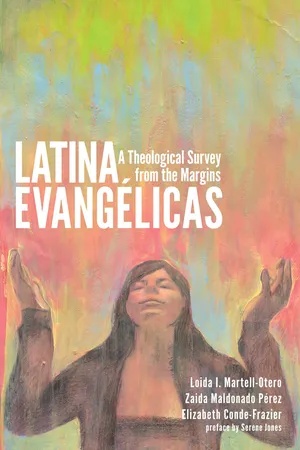
Latina Evangélicas: A Theological Survey from the Margins is a constructive and postcolonial examination of the theology of Protestant Latinas who reside in the United States. Written by three Latinas who have pastored and who teach in Latina/o communities, the book seeks to expand beyond Latina feminist and mujerista voices to include those whose perspectives have not yet been heard. It thus introduces an important theological perspective to a wider audience, and provides an important resource that has been lacking for evangelicas/os and other marginalized groups who study in various theological programs. Key terminology, such as evangélica, is defined throughout, and a glossary is included for non-Spanish-speaking readers. Each chapter considers theological themes important to the Latina Protestant worshiping community, beginning with a constructive discussion of the doctrine of the Holy Spirit and followed by the doctrines of salvation and Jesus Christ, the Trinity, the church, Scripture, and “the last things” (eschatology). Given that one of the characteristics of Latina/o theologies is their dialogical and collaborative nature, the book concludes with a conversation among the three authors about the theological thinking that took place in its composition. Study questions are included at the end of each chapter.
eBook - ePub
Latina Evangélicas
A Theological Survey from the Margins
- 178 pages
- English
- ePUB (mobile friendly)
- Available on iOS & Android
eBook - ePub
Latina Evangélicas
A Theological Survey from the Margins
About this book
Information
Topic
Theology & ReligionSubtopic
Christian Churchone
Introduction
Abuelita Theologies
Loida I. Martell-Otero
In 1994 when I wrote “Women Doing Theology: Una Perspectiva Evangélica,” there was a dearth of Latina Protestant (evangélica) women with PhD degrees in the theological disciplines.1 Daisy L. Machado was the first when she completed her degree in church history. Others, including Elizabeth Conde-Frazier and Zaida Maldonado Pérez, soon followed her. Seventeen years later the number of evangélicas has increased, thanks in great part to the efforts of some churches, organizations such as the Fund for Theological Education and the Hispanic Theological Initiative, and to countless individuals—some of whom will be named throughout the chapters of this book. Together they fought for greater representation of Latin@s in all arenas of theological education. Consequently, the Hispanic Theological Initiative estimates that as we write in 2011 there are more than eighteen such scholars representing various fields of theology throughout the United States, Canada, and Puerto Rico.2 Of them, Conde-Frazier, Machado, and Maldonado Pérez serve as deans in different academic institutions. While we have not yet reached a “critical mass” in academia, with new evangélica scholars beginning academic and seminary studies all the time, it is imperative that we begin to articulate what defines us.
What defines us are the theologies that we have inherited from our abuelas, madres, comadres, and tías—that is to say, the wise women of our faith communities who gave us a firm foundation of the gospel, and taught us to love the Lord and to demonstrate that love in the world.3 Yet, our theology transcends the theologies we inherited. Those wise women taught us about the power of prophetic words and the responsibility we have to seek and hear them. They did not simply pass on el evangelio (the gospel) as a set of accepted dogmatic statements. They nurtured us with a keen sense of the Spirit’s ability to create anew. While their teachings were our starting points, an ongoing communal collaborative effort to constructively expound upon various themes from the perspective of evangélicas—a teología en conjunto—leads us to critically discern aspects of our inherited traditions that have been colonized. Thus this book also represents a postcolonial reinterpretation of our theologies.
The increase in the quantity and quality of resources that address theological themes from the perspective of Latin@s in the past two decades has been gratifying to see.4 However, many of the books and articles published, particularly those written by Latinas, represent Latin@ Catholic perspectives. The contributors to this book are grateful for the rich theological lode provided by such notable scholars as Ada María Isasi-Díaz, Jeannette Rodríguez, María Pilar Aquino, and a host of others with whom we have collaborated in the past; but we also recognize a need to provide a voice that is distinctively Protestant, or evangélica. A few other books have done this. Justo L. González’s Mañana: Christian Theology from a Hispanic Perspective was an early salvo in 1990.5 Teología en Conjunto: A Collaborative Hispanic Protestant Theology was published in 1997 as a means to articulate an evangélic@ perspective, but it was not necessarily geared to specifically Latina voices.6 Subsequent publications were meant to represent Protestant Latin@ viewpoints but again lack an articulation of a specifically evangélica perspective.7 While articles dealing with various themes by evangélica theologians have been published, this is the first book-length project that responds to the need to create awareness about naming ourselves as Latina evangélicas.8 Therefore it demonstrates how we are distinctive from Latin@ theologians and Euro-dominant theologians in general, and from other non-evangélica Latina voices in particular.
This is a book about Latina theology from an evangélica perspective, yet its audience is not so narrowly circumscribed. Theology is a discourse whose truths become only proximate even with an increase in the diverse communities that participate in the dialogue. Contextual theologies have made clear that all theologies are socially circumscribed, and consequently have both creative insights and painful blind spots. The various viewpoints allow for an enriching and often prophetic conversation. The absence of Latina evangélica voices has impoverished this overall discourse. Our absence is not due to the fact that we have nothing to contribute, but rather has occurred because our traditions have too easily been dismissed. Some consider our abuelita theologies sobraja (leftovers)—marginal or derivative. We insist that they and we contribute a needed and valuable voice to Christian theological discourse from a distinctive social location, for we have each experienced the impact that our theologies has made upon the lives of our students and colleagues, whether Latin@ or not, in the classroom as well as in academic, professional, and ecclesial circles.
The authors of this book have resisted the tendency of non-Latin@ and Latino scholars to name us. When someone else names you, they have the power to objectify you and create you in whatever image they desire. White feminist, womanist, Asian North American, and Latin@ scholars have insisted upon the right to name themselves.9 Scriptural texts attest to the power of naming. I believe that it is not coincidental that so many oppressed women in the Bible are also nameless. Many of the evangélicas that taught us, guided us, and inspired us also remain nameless to the wider world. As Latinas they have been objectified or rendered invisible. This book seeks to name our abuelas and to honor them by naming ourselves, our theologies, and our contributions to the Church and to the world.
Thus we begin with a fundamental question: who are Latina evangélicas? Latinas are women from a Latin American or Latin Caribbean background who either reside, or were born, in the continental United States. The controversy of using such broad terms as Hispanic or Latina has been discussed sufficiently elsewhere and will not be repeated here.10 Suffice it to say that, technically, there is no such thing as Latinas or Latinos. Sixto J. García and Orlando O. Espín use the term Latin@ to underscore that there is a “community of communities” in the United States composed of such disparate groups as Mexicans and Mexican Americans, Puerto Ricans, Cubans, Dominicans and other Caribbean Latin groups. Also included are the various ethnic, cultural, or national enclaves that arise from Central and South America. This community is currently one of the fastest-growing and largest “minoritized” groups in this country.11
The 2010 census count has estimated that there are 50.5 million Latin@s, making up approximately 16.3 percent of the total population—a 43-percent increase in the past decade, making them one of the fastest growing groups in the country.12 This is a significant undercount that does not take into consideration the almost twelve million undocumented migrant workers inhabiting its borders, or the three million inhabitants of the island of Puerto Rico. Latinas compose almost half (48.3 percent) of the total US Latin@ population, 13 and their voices must be heard and their experiences taken into account.
Latinas are part of a community that though disparate, nevertheless faces a number of issues and shares common experiences of bilingualism, multiculturalism, popular religious faith, marginality, poverty, colonization, migration, and cultural alienation. They are undereducated, and underemployed. The likelihood that they are poor is double that of white women.14 They are exploited. They lack access to quality housing and proper health care. Justo L. González’s 1996 observation that “every negative statistic for Hispanics—employment, underemployment, poverty rate, school dropouts—has remained at a steady 150% of what it has been for the rest of the population” still holds true fifteen years later.15 In the words of David T. Abalos, Latin@s lack “access to vital connections.”16
Latin@s are not newcomers to this country. They are an intrinsic part of the hist...
Table of contents
- Title Page
- Contributors
- Foreword
- Acknowledgments
- 1. Introduction
- 2. Dancing with the Wild Child
- 3. From Satas to Santas: Sobrajas No More
- 4. The Trinity Es and Son Familia
- 5. Evangelicas Reading Scriptures
- 6. Being the Gospel Together
- 7. Neither “Left Behind” Nor Deciphering Secret Codes
- 8. Epilogue
- Glossary
- Bibliography
Trusted by 375,005 students
Access to over 1.5 million titles for a fair monthly price.
Study more efficiently using our study tools.
Frequently asked questions
Yes, you can cancel anytime from the Subscription tab in your account settings on the Perlego website. Your subscription will stay active until the end of your current billing period. Learn how to cancel your subscription
No, books cannot be downloaded as external files, such as PDFs, for use outside of Perlego. However, you can download books within the Perlego app for offline reading on mobile or tablet. Learn how to download books offline
Perlego offers two plans: Essential and Complete
- Essential is ideal for learners and professionals who enjoy exploring a wide range of subjects. Access the Essential Library with 800,000+ trusted titles and best-sellers across business, personal growth, and the humanities. Includes unlimited reading time and Standard Read Aloud voice.
- Complete: Perfect for advanced learners and researchers needing full, unrestricted access. Unlock 1.5M+ books across hundreds of subjects, including academic and specialized titles. The Complete Plan also includes advanced features like Premium Read Aloud and Research Assistant.
We are an online textbook subscription service, where you can get access to an entire online library for less than the price of a single book per month. With over 1.5 million books across 990+ topics, we’ve got you covered! Learn about our mission
Look out for the read-aloud symbol on your next book to see if you can listen to it. The read-aloud tool reads text aloud for you, highlighting the text as it is being read. You can pause it, speed it up and slow it down. Learn more about Read Aloud
Yes! You can use the Perlego app on both iOS and Android devices to read anytime, anywhere — even offline. Perfect for commutes or when you’re on the go.
Please note we cannot support devices running on iOS 13 and Android 7 or earlier. Learn more about using the app
Please note we cannot support devices running on iOS 13 and Android 7 or earlier. Learn more about using the app
Yes, you can access Latina Evangélicas by Loida Martell-Otero,Zaida Maldonado Pérez,Elizabeth Conde-Frazier in PDF and/or ePUB format, as well as other popular books in Theology & Religion & Christian Church. We have over 1.5 million books available in our catalogue for you to explore.