- 184 pages
- English
- ePUB (mobile friendly)
- Available on iOS & Android
eBook - ePub
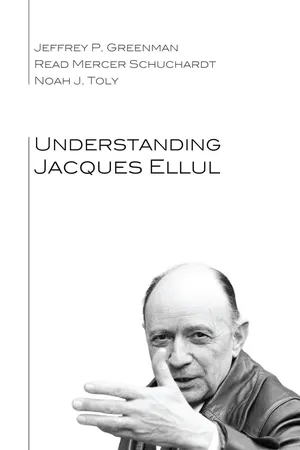
Understanding Jacques Ellul
About this book
Jacques Ellul (1912-1994) was one of the world's last great polymaths and one of the most important Christian thinkers of his time, engaging the world with a simplicity, sincerity, courage, and passion that few have matched. However, Ellul is an often misunderstood thinker. As more than fifty books and over one thousand articles bear his name, embarking on a study of Ellul's thought can be daunting. This book provides an introduction to Ellul's life and work, analyzing and assessing his thought across the most important themes of his scholarship. Readers will see that his remarkably broad field of vision, clarity of focus, and boldly prophetic voice make his work worth reading and considering, rereading and discussing.
Information
Topic
Theology & ReligionSubtopic
Christian TheologyChapter 1
Ellul’s Life and Thought
Although Jacques Ellul wrote over fifty books and one thousand articles during his career, his life involved much more than a professor’s typical labors of lecturing and writing.1 Andrew Goddard has aptly commented that “Ellul’s life and his thought are intricately interwoven. He wrote out of what he lived and he lived out what he wrote.”2 This chapter aims to set the stage for understanding Ellul’s thought by locating his writings in the context of his life.
Early Years and Education
Jacques César Ellul was born on January 6, 1912, in Bordeaux, France.3 He spent almost his entire life in the southwest region of his home country, some six hundred kilometers removed from Paris. He was the only child of Joseph and Martha Ellul. Joseph Ellul was an Austrian subject of Serbian-Italian heritage, and Martha Ellul was French from Portuguese-Jewish ancestry. Ellul was “what people call a métèque, a product of the melting pot,”4 as he recalled in reflection upon his mixed heritage. Métèque is a derogatory term in France for Mediterranean foreigners, suggesting Ellul’s identity as an outsider to the mainstream of French society. Although both of his parents had been raised in aristocratic families, the Ellul family lived in poverty. His mother was a painter and teacher of art lessons. His father was a businessman who struggled through the economic catastrophe of the Depression, often without steady work. Ellul said: “One of the most important, most decisive elements in my life was that I grew up in a rather poor family. I experienced true poverty in every way, and I know very well the life of a family in a wretched milieu, with all the educational problems that this involves and the difficulties of having to work while still very young. I had to make my living from the age of fifteen, and I pursued all my studies while earning my own and sometimes my family’s livelihood.”5
Despite this, Ellul recalled a happy childhood, spending time on the docks at the port of Bordeaux and visiting the Jardin Public with its trees, ponds, and fountains. His only “bad memory” was “harassment in high school because I was the smallest in the class—and the best student.”6 He writes of loving parents: “I lived with two parents who loved me very much, but in completely different ways. My father was very distant . . . my mother was very close to me, though extremely reserved.”7 Concerning his religious upbringing, Ellul stated that he “really did not have any at all.” His father was “a skeptic, a Voltairian” in outlook, and therefore quite critical of religion. “He didn’t forbid that I receive any kind of Christian education, but nothing was done in that direction.”8 His mother was a Protestant whom Ellul describes as “deeply religious” but who kept her faith to herself: “she never spoke to me about it; she never told me anything.”9 Despite this situation, as a child he read the Bible by himself. Ellul was not raised in “a Christian atmosphere” but later experienced a dramatic Christian conversion.
Despite the family’s poverty, when Ellul graduated from high school, his mother insisted that he begin university rather than get a job immediately. His father overruled Ellul’s desire for a career as a naval officer and steered him toward law.10 This resonated for pragmatic reasons; according to Ellul, law “was a subject that seemed to lead to a profession, and the study of it was relatively short. Those were frankly the only reasons I had for choosing it.”11 He began his studies in law at the University of Bordeaux in 1929, the year of the worldwide economic crash. He completed his licence en droit in 1931 and his licence libre et lettres in 1932; after his mandatory military service during 1934–35, he completed his doctoral thesis in 1936 on an ancient Roman legal institution, the mancipium (the right of father to sell children). During 1937, he taught at Montpellier and then in 1938 took a position at Strasbourg University.
Turning Points
Early in his law studies there were two decisive events—reading Karl Marx and becoming a Christian.12 Of his conversion, Ellul said, “I was alone in the house busy translating Faust when suddenly, and I have no doubts on this at all, I knew myself to be in the presence of something so astounding, so overwhelming that entered me to the very centre of my being. That’s all I can tell you. I was so moved that I left the room in a stunned state. In the courtyard there was a bicycle lying around. I jumped on it and fled.”13 He explained:
I was converted—not by someone, nor can I say I converted myself. It is a very personal story, but I will say it was a very brutal and very sudden conversion. . . . From that moment on, I lived through the conflict and contradiction between what became the center of my life—this faith, this reference to the Bible, which I henceforth read from a different perspective—and what I knew of Marx and did not wish to abandon. For I did not see why I should have to give up the things that Marx said about society and explained about economy and injustice in the world. I saw no reason to reject them just because I was now a Christian.14
One of the most important elements of his conversion was that Ellul encountered the Bible in a new way. He recalled that reading the eighth chapter of Paul’s letter to the Romans was “a watershed in my life. In fact, it was such a totally decisive experience that it became one of the steps in my conversion. And for the first time in my life, a biblical text really became God’s Word to me. . . . It became a living contemporary Word, which I could no longer question, which was beyond all discussion. And that Word then became the point of departure for all my reflection in the faith.”15
Regarding his encounter with Marx, Ellul explained:
In 1930, I discovered Marx. I read Das Kapital and I felt I understood everything. I felt that at last I knew why my father was out of work, at last I knew why we were destitute. For a boy of seventeen, perhaps eighteen, it was an astonishing revelation about the society he lived in. It also illuminated the working-class condition I had plunged into and those dealings at the port of Bordeaux . . . Thus, for me, Marx was an astonishing discovery of the reality of this world . . . I plunged into Marx’s think...
Table of contents
- Title Page
- Contents
- Acknowledgments
- Introduction
- Chapter 1: Ellul’s Life and Thought
- Chapter 2: Technology and Technique
- Chapter 3: Communication: Media, Propaganda, and the Word
- Chapter 4: The City and Urbanism
- Chapter 5: Politics and Economics
- Chapter 6: Scripture
- Chapter 7: Ethics
- Chapter 8: Ellul as a Christian Scholar
- Key Events in the Life of Jacques Ellul
- Bibliography
Trusted by 375,005 students
Access to over 1.5 million titles for a fair monthly price.
Study more efficiently using our study tools.
Frequently asked questions
Yes, you can cancel anytime from the Subscription tab in your account settings on the Perlego website. Your subscription will stay active until the end of your current billing period. Learn how to cancel your subscription
No, books cannot be downloaded as external files, such as PDFs, for use outside of Perlego. However, you can download books within the Perlego app for offline reading on mobile or tablet. Learn how to download books offline
Perlego offers two plans: Essential and Complete
- Essential is ideal for learners and professionals who enjoy exploring a wide range of subjects. Access the Essential Library with 800,000+ trusted titles and best-sellers across business, personal growth, and the humanities. Includes unlimited reading time and Standard Read Aloud voice.
- Complete: Perfect for advanced learners and researchers needing full, unrestricted access. Unlock 1.5M+ books across hundreds of subjects, including academic and specialized titles. The Complete Plan also includes advanced features like Premium Read Aloud and Research Assistant.
We are an online textbook subscription service, where you can get access to an entire online library for less than the price of a single book per month. With over 1.5 million books across 990+ topics, we’ve got you covered! Learn about our mission
Look out for the read-aloud symbol on your next book to see if you can listen to it. The read-aloud tool reads text aloud for you, highlighting the text as it is being read. You can pause it, speed it up and slow it down. Learn more about Read Aloud
Yes! You can use the Perlego app on both iOS and Android devices to read anytime, anywhere — even offline. Perfect for commutes or when you’re on the go.
Please note we cannot support devices running on iOS 13 and Android 7 or earlier. Learn more about using the app
Please note we cannot support devices running on iOS 13 and Android 7 or earlier. Learn more about using the app
Yes, you can access Understanding Jacques Ellul by Jeffrey P. Greenman,Read Mercer Schuchardt,Noah J. Toly in PDF and/or ePUB format, as well as other popular books in Theology & Religion & Christian Theology. We have over 1.5 million books available in our catalogue for you to explore.