eBook - ePub
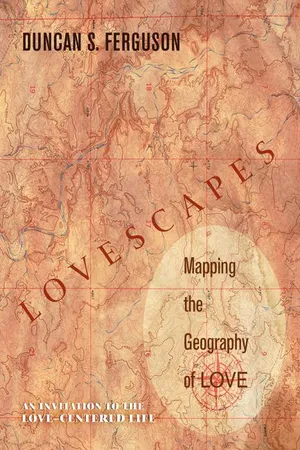
Lovescapes, Mapping the Geography of Love
An Invitation to the Love-Centered Life
- 308 pages
- English
- ePUB (mobile friendly)
- Available on iOS & Android
eBook - ePub
About this book
Lovescapes introduces the reader to the various meanings and manifestations of love and its many cognates such as compassion, caring, altruism, empathy, and forgiveness. It addresses how love and compassion have been understood in history and the religions of the world. It goes on to explore the ways that our environments and heredity influence our capacity to love and suggests ways to cultivate love and compassion in one's life. The book shows how the values of love and compassion are integral to finding humane solutions to the daunting problems we face as individuals, as a human family, and as an earth community--a world in crisis.
Lovescapes has the following features:
-Describing how love is the essence of the divine, and therefore the ground of reality
-Understanding the meaning of love and its place in our lives
-Learning how love and compassion have been understood across history, culture, and tradition
-Gaining insight about how to increase our capacity to love and show compassion
-Discerning how love and compassion can be applied in all aspects of our lives, in the regions where we live, and in our global setting.
Trusted by 375,005 students
Access to over 1.5 million titles for a fair monthly price.
Study more efficiently using our study tools.
Information
Topic
Theology & ReligionSubtopic
Social PsychologySection I
The Need for Love in Contemporary Life
Perhaps every age is an age of crisis, although the judgment that is made about a period of time being in crisis may depend upon the conditions of one’s life in a particular moment of history. It may be a crisis for some and not for others. The judgment about our age being a time of crisis is confirmed by most of us; the majority of us would say that we do live in a troubled time. Regardless of our circumstances, we who live in the early part of the twenty-first century find the problems we face daunting in character. Perhaps it is because our problems are staggering in complexity and stubbornly resist our efforts to solve them. Or it may be because they threaten our way of life and our earth habitat. In Section I we will briefly describe the range of these overwhelming problems, point out their size and difficulty, and propose that love and compassion, understood in their several meanings, have a critical role to play in solving them, or at least in gaining perspective about them and easing the pain and suffering which they cause.
The world is a theatre of love.
—Kashmiri Proverb
1
Love in an Age of Crisis
A Picture of Our Crisis
The popular song of a previous generation, which invited us to sing along, opened with the following words: “What the world needs now is love sweet love. It’s the only thing that there’s just too little of.” These lyrics were true at an earlier time and certainly true today. We live in a difficult moment of history, one filled with vexing problems that have an enormous impact on individual lives. While there are signs of hope and encouragement, it is nevertheless accurate to say that we live in a volatile world, filled with global warming and a threatened physical environment, natural disasters, insoluble wars, international conflict, insurgency and violence, religious intolerance, cities rampant with crime, widespread poverty, devastating hunger, a threatened economy, failing states, and the list goes on and on. It would be easy to give up hope, especially if one is caught in the middle of one of these conditions. Perhaps Richard Cory was such a person, as described in the poem by Edward Arlington Robinson:
Whenever Richard Cory went downtown
We people on the pavement looked at him;
He was a gentleman from sole to crown,
Clean favored, and imperially slim.
And he was always quietly arrayed,
And he was always human when he talked;
But still he fluttered pulses when he said,
“Good morning,” and he glittered when he walked.
And he was rich—yes, richer than a king—
And admirably schooled in every grace:
In fine, we thought that he was everything
To make us wish that we were in his place.
So on he worked, and waited for the light,
And went home without meat, and cursed the bread;
And Richard Cory, one calm summer night,
Went home and put a bullet through his head.
What Richard Cory needed was someone to give him “love sweet love.” The fundamental purpose of this book is to add love and compassion in what I hope is a wise and realistic way as one part of the strategy as we seek to find solutions to the overwhelming problems we must face in the decades ahead. I am well aware that this rhetoric may be viewed as almost naïve, uninformed by a grasp of the complexity of the issues, real-world politics and uses of power, and the subtleties of human nature. In light of this point of view, I am reluctant to claim that love and compassion are the answer, but these qualities of the human spirit have the potential to provide an outlook and motivation for developing strategies to approach these staggering challenges. I am given guidance and encouraged by the Dalai Lama’s determination to place love and compassion at the forefront of his life and leadership.1
The harsh realities which humankind must address in the first quarter of the twenty-first century are challenging, perplexing, and alarming. They are challenging in the sense that they demand solutions that require political will, international cooperation, and enormous costs. For example, to find solutions to the problem of global warming means challenging the vested interests of corporations whose profits depend upon the continuation of the use of fossil fuels. As we know, the extensive use of fossil fuels threatens the delicate ecological balance that sustains life. Questioning these vested interests requires political risk for elected officials. The same “inconvenient truth” about the environment requires international cooperation because global warming is indeed global, not exclusively regional, although some regions may feel its impact more profoundly than others.2 Efforts to achieve international cooperation in solving the problems of the environment have been mixed at best. The costs of addressing the variety of problems caused by global warming are astronomical and require a fundamental shift of values and ways of life, not easy for any individual, society, or nation.
These harsh realities are also perplexing because the size and complexity of the problems are beyond the scope of what humankind has ever had to address before. New research and technologies are required for many of these disturbing problems. For example, new strategies and approaches are required in stabilizing the changing climate. It has been necessary to engineer a revolution in lighting technology and produce energy-efficient appliances that will reduce dependence on excessive uses of electricity. Cutting carbon emissions has meant a turn toward electrifying the transportation systems.3 In a wide variety of ways, we have had to find new ways of generating energy that will stabilize the climate of the earth.
The tremendous changes that are occurring have caused alarm on many fronts. Again, to illustrate, there is the life and death issue of feeding over seven billion people well. It is not easy to learn about and watch children of the world suffer and die because of malnutrition and starvation. In fact it is so painful that we often switch channels or lay the paper aside in order to put it out of our minds. There may be enough food on the earth to feed all of the people of the world, but it is not easy to distribute food equitably across country and continental boundaries, and underlying equitable food distribution is the competition for water.4 Equally alarming is the continuation of international conflict and the resort to violence to resolve conflict. At this point in time, we wonder if the violence in Iraq, Afghanistan, and the Middle East (and larger Arab world) will ever cease as others have wondered in the midst of their wars whether the violence would ever cease. We all suffer from the consequences of war, but it is especially the innocent who suffer the most. Finding solutions for world hunger and international conflict will require new strategies and shifts of outlook on the ways that we live together on the planet.
The purpose of this chapter is to provide a brief description of these critical concerns in order to see how love and compassion may be factors in addressing them. The description will be brief, providing only a glimpse of the current problems that must be faced by the human family. We divide these issues into two categories: (1) those that are global in character and deal with existing infrastructure and the macro systems that cause distress in nearly every corner of the planet; and (2) the ways that these conditions impact individuals, causing suffering, illness, and general dis-ease.
The Expression of the Crisis in the
World We Inhabit
World We Inhabit
I will group the global concerns in the following categories:5
1. The issues dealing with ecology.
2. The issues dealing with over-population.
3. The issues dealing with poverty, hunger, and disease.
4. The issues dealing with the global economy.
5. The issues dealing with war and conflict.
A central concern of all who dwell on the earth is whether it will remain a habitat that allows humans and all sentient beings to continue to flourish and live in an environment that will sustain a high quality of life. There are those who would argue that the earth continues to be relatively safe for all of life and that the changes we see and experience are just the natural rhythms of the earth which have within them some natural threat. Some knowledgeable scholars do not fully believe in what we have come to call global warming and deny that the slight change is caused by human practices.6 But the scientific evidence would say otherwise; there is indeed a crisis that must be faced with a change in human behavior. It is a reality which if not dealt with in a timely and informed way will cause great suffering. The challenges are many.7 There is the pressure of the increasing population that will tax the land and water resources of the earth. Already, a large percentage of the population does not have access to clean water and sanitation, causing disease and malnutrition with a devastating impact on children. Farmers who provide the food for the people of our cities and whose water tables are falling are in conflict with the cities for limited water supplies. There are political conflicts locally, regionally, and internationally about the use of land and access to water. Increasingly, there are “environmental refugees,” vast numbers of people whose water supply has dwindled to little or nothing and whose land is no longer fertile. These problems coupled with others are causing a number of failed states whose populations migrate to find ways of surviving.8
Equally alarming is the changing climate. Global warming...
Table of contents
- Title Page
- Preface
- Section 1: The Need for Love in Contemporary Life
- Section 2: The Geography of Love
- Section 3: The Development of Love
- Section 4: The Practice of Love
- Bibliography
Frequently asked questions
Yes, you can cancel anytime from the Subscription tab in your account settings on the Perlego website. Your subscription will stay active until the end of your current billing period. Learn how to cancel your subscription
No, books cannot be downloaded as external files, such as PDFs, for use outside of Perlego. However, you can download books within the Perlego app for offline reading on mobile or tablet. Learn how to download books offline
Perlego offers two plans: Essential and Complete
- Essential is ideal for learners and professionals who enjoy exploring a wide range of subjects. Access the Essential Library with 800,000+ trusted titles and best-sellers across business, personal growth, and the humanities. Includes unlimited reading time and Standard Read Aloud voice.
- Complete: Perfect for advanced learners and researchers needing full, unrestricted access. Unlock 1.5M+ books across hundreds of subjects, including academic and specialized titles. The Complete Plan also includes advanced features like Premium Read Aloud and Research Assistant.
We are an online textbook subscription service, where you can get access to an entire online library for less than the price of a single book per month. With over 1.5 million books across 990+ topics, we’ve got you covered! Learn about our mission
Look out for the read-aloud symbol on your next book to see if you can listen to it. The read-aloud tool reads text aloud for you, highlighting the text as it is being read. You can pause it, speed it up and slow it down. Learn more about Read Aloud
Yes! You can use the Perlego app on both iOS and Android devices to read anytime, anywhere — even offline. Perfect for commutes or when you’re on the go.
Please note we cannot support devices running on iOS 13 and Android 7 or earlier. Learn more about using the app
Please note we cannot support devices running on iOS 13 and Android 7 or earlier. Learn more about using the app
Yes, you can access Lovescapes, Mapping the Geography of Love by Duncan S. Ferguson in PDF and/or ePUB format, as well as other popular books in Theology & Religion & Social Psychology. We have over 1.5 million books available in our catalogue for you to explore.