eBook - ePub
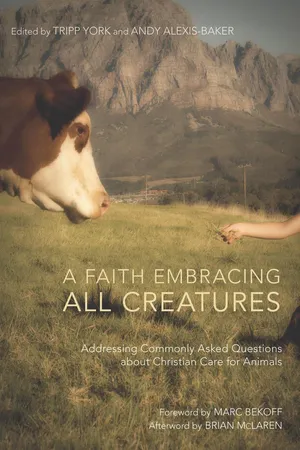
A Faith Embracing All Creatures
Addressing Commonly Asked Questions about Christian Care for Animals
- 212 pages
- English
- ePUB (mobile friendly)
- Available on iOS & Android
eBook - ePub
A Faith Embracing All Creatures
Addressing Commonly Asked Questions about Christian Care for Animals
About this book
What is the purpose of animals? Didn't God give humans dominion over other creatures? Didn't Jesus eat lamb? These are the kinds of questions that Christians who advocate compassion toward other animals regularly face. Yet Christians who have a faith-based commitment to care for other animals through what they eat, what they wear, and how they live with other creatures are often unsure how to address these biblically and theologically based challenges. In A Faith Embracing All Creatures, authors from various denominational, national, ethnic, and cultural backgrounds wrestle with the text, theology, and tradition to explain the roots of their desire to live peaceably with their nonhuman kin. Together, they show that there are no easy answers on "what the Bible says about animals." Instead, there are nuances and complexities, which even those asking these questions may be unaware of. Editors Andy Alexis-Baker and Tripp York have gathered a collection of essays that wrestle with these nuances and tensions in Scripture around nonhuman animals. In so doing, they expand the discussion of nonviolence, peacemaking, and reconciliation to include the oft-forgotten other members of God's good creation.
Information
Topic
Theology & ReligionSubtopic
Christian Theology1
What about Dominion in Genesis?
it is unfortunate that Christians often choose Genesis 1, a chapter that so poetically describes relationship and goodness, to justify human abuse and exploitation of other animals. Genesis 1 describes God’s relationship to the created world in powerful and elegant prose. Yet, when most modern readers reflect on other animals, this beautiful landscape and focus on God and God’s relationship with all creatures disappears. Instead, we often narrow our attention to Genesis 1:26 and 28—and, at times, even more narrowly to the word dominion.
Then God said, “Let us make humankind in our image, according to our likeness; and let them have dominion over the fish of the sea, and over the birds of the air, and over the cattle, and over all the wild animals of the earth, and over every creeping thing that creeps upon the earth.” So God created humankind in his image, in the image of God he created them; male and female he created them. God blessed them, and God said to them, “Be fruitful and multiply, and fill the earth, and subdue it, and have dominion over the fish of the sea and over the birds of the air and over every living thing that moves upon the earth.” (Gen 1:26–28)
With these verses, we find ourselves in the midst of controversy. Ironically, a chapter that evokes images of peace among all becomes the source of heated disagreement. Many are confused by the word dominion—what it means and what it allows. As issues of veganism and animal rights gain more cultural legitimacy, the question, “Didn’t God give people dominion over animals and doesn’t that permit us to [fill in the blank: eat them, wear them, experiment on them, cage them]?” becomes an honest attempt to reconcile the cultural worldview about other animals (they are ours to use) with the biblical mandate by which many wish to live their lives. Isn’t dominion over the other animals what God permits? Isn’t this the message of these passages? At other times, the question about God granting human beings dominion is asked not out of confusion but out of defensiveness. It is thrown at someone to cut off discussion rather than to open up discussion; it arises from a desire to justify contemporary practices.
This chapter seeks to answer the question by looking at dominion, both the word and its context—not just the context of Genesis 1, though it is a very important context, but also the christological context. Let’s start with a different question: What does dominion look like today? Why do we move away from other animals in seeking to establish who we are? Why is our identity so fragile that acts of denial are required to hide our actions? What is being protected—our relationship to Scripture or our relationship to dinner?
It has been said that if kings and queens exercised dominion over their subjects the way human beings do over the other animals, kings and queens would have no subjects. So why is being in God’s image often interpreted in view of power, manipulation, and hegemony instead of compassion, mercy, and emptying unconditional love? We often anthropomorphize God as powerful, fierce, and angry (if not belligerent). When we are lording over others, using power—it is then that we are most likely to assert the image of God. Acts of unconditional love, suspensions of judgment, mercy for the weak, and kindness to animals get associated with a wishy-washy picture of who Jesus was, but are rarely discussed regarding God the Creator.
By beginning with beginnings, we are offered the opportunity to reflect not only on the meaning of dominion in the context of Genesis 1, but on what it means to read and heed the biblical story, what it means to live in God’s creation, and what it means to follow Jesus.
Genesis 1: A Habitat and Its Inhabitants
Genesis 1 shows us how human and nonhuman animals are the inhabitants of God’s created world. There is a movement in Genesis 1. Not just a poetic movement conveyed by the repetition of certain words, or a creative movement from chaos and darkness to order and light, but a movement of intent and relationship. God creates a habitat for inhabitants. The commonality of humans and nonhumans as the inhabitants is emphasized through God’s instructions concerning their shared diet, that is, how they will use the habitat.
In Genesis 1:26–28, the word dominion appears twice, as we saw above. But day six remains incomplete. Then immediately follows:
God said, “See, I have given you every plant yielding seed that is upon the face of all the earth, and every tree with seed in its fruit; you shall have them for food. And to every beast of the earth, everything that has the breath of life, I have given every green plant for food.” And it was so. God saw everything that he had made, and indeed, it was very good. And there was evening and there was morning, the sixth day.
A vegan diet for all inhabitants culminates all of God’s creative activity.
Parallels between Days 1–3 and Days 4–6
Some commentators see a parallel construction between the creation of days 1–3 and days 4–6. During God’s creative acts of days 1–3, the creation of light results in the naming of day and night, the creation of the sky gives us sky and water, and the creation of land provides plants yielding seed of every kind. So days 1–3 feature the creation of the habitat: “structure and light, sky and water, land and plants.”1 With days 4–6, God creates the inhabitants of those habitats: heavenly lights, living creatures who fill the waters and fly in the sky, living creatures for the land, and humankind.
| Days 1–3: HABITAT | Days 4–6: INHABITANTS | ||
| Day 1: | Let there be Light | Day 4: | lights in the sky |
| Named Day/Night | heavenly lights/stars that rule the sky “Rule” | ||
| Day 2: | Dome that separates water | Day 5: | living creatures that inhabit the waters and the sky |
| Named sky | |||
| Day 3: | dry land | Day 6: | land creatures and human beings |
| Dominion for human beings | |||
| Plant reproduction | Human reproduction | ||
| Their “reproductive powers are included in their creation”2 | “These livings beings are endowed with the right of self-propagation by a separate act—a benediction.”3 | ||
| plants yielding seed, and fruit trees of every kind on earth that bear fruit with the seed in it. | Your food will be plant yielding seeds and fruit trees | ||
23
After all this dynamic, creative activity that relates inhabitants to habitat, the word radah (translated as “dominion”) appears. The word appears twice (Gen 1:26, 28). In 1:28, the inhabitants of the sea, the air, and the land (still in the order of creation) are said to be under the dominion of humankind. One more thing occurs: God tells humankind about the habitat, especially that which was created on day three. The “plants yielding seed, and fruit trees of every kind” (Gen 1:10) created on day three are now presented as food for humankind. The parallels between days 1–3 and days 4–6 culminate here, in God’s instructions about what to consume from the created world. “Everything that has the breath of life” (that is, the inhabitants) are “given every green plant for food” (habitat).4
Here in Genesis, God’s word is spoken, and all creation flows from it. In Genesis 1, creation and God’s presence throughout the earth are linked. Moreover, creation and blessing are linked. Dry land appears out of the water and it is good. Fruit-bearing trees appear and they are good. Heavenly lights appear and they are good. Living creatures of the sea appear and God sees they are good. God blesses them. God creates land creatures and they, too, are good. God c...
Table of contents
- Title Page
- Contributors
- Foreword: Expanding Our Compassion Footprint
- Introduction
- Chapter 1: What about Dominion in Genesis?
- Chapter 2: What about the Covenant with Noah?
- Chapter 3: What about Animal Sacrifice in the Hebrew Scriptures?
- Chapter 4: Doesn’t the Bible Say that Humans Are More Important than Animals?
- Chapter 5: Didn’t Jesus Eat Lamb? The Last Supper and the Case of the Missing Meat
- Chapter 6: Didn’t Jesus Eat Fish?
- Chapter 7: Does Christian Hospitality Require that We Eat Meat?
- Chapter 8: Doesn’t Romans Say that Vegetarians Have “Weak Faith”?
- Chapter 9: Doesn’t Jesus Treat Animals as Property?
- Chapter 10: What’s the Point of Animals?
- Chapter 11: Are We Addicted to the Suffering of Animals?
- Chapter 12: Does “Made in the Image of God” Mean Humans Are More Special than Animals?
- Chapter 13: Can the Wolf Lie Down with the Lamb without Killing It? Confronting the Not-So-Practical Politics of the Peaceable Kingdom
- Chapter 14: Vegetarianism: A Christian Spiritual Practice Both Old and New
- Afterword
- Bibliography
Trusted by 375,005 students
Access to over 1.5 million titles for a fair monthly price.
Study more efficiently using our study tools.
Frequently asked questions
Yes, you can cancel anytime from the Subscription tab in your account settings on the Perlego website. Your subscription will stay active until the end of your current billing period. Learn how to cancel your subscription
No, books cannot be downloaded as external files, such as PDFs, for use outside of Perlego. However, you can download books within the Perlego app for offline reading on mobile or tablet. Learn how to download books offline
Perlego offers two plans: Essential and Complete
- Essential is ideal for learners and professionals who enjoy exploring a wide range of subjects. Access the Essential Library with 800,000+ trusted titles and best-sellers across business, personal growth, and the humanities. Includes unlimited reading time and Standard Read Aloud voice.
- Complete: Perfect for advanced learners and researchers needing full, unrestricted access. Unlock 1.5M+ books across hundreds of subjects, including academic and specialized titles. The Complete Plan also includes advanced features like Premium Read Aloud and Research Assistant.
We are an online textbook subscription service, where you can get access to an entire online library for less than the price of a single book per month. With over 1.5 million books across 990+ topics, we’ve got you covered! Learn about our mission
Look out for the read-aloud symbol on your next book to see if you can listen to it. The read-aloud tool reads text aloud for you, highlighting the text as it is being read. You can pause it, speed it up and slow it down. Learn more about Read Aloud
Yes! You can use the Perlego app on both iOS and Android devices to read anytime, anywhere — even offline. Perfect for commutes or when you’re on the go.
Please note we cannot support devices running on iOS 13 and Android 7 or earlier. Learn more about using the app
Please note we cannot support devices running on iOS 13 and Android 7 or earlier. Learn more about using the app
Yes, you can access A Faith Embracing All Creatures by Tripp York,Andy Alexis-Baker, York, Alexis-Baker in PDF and/or ePUB format, as well as other popular books in Theology & Religion & Christian Theology. We have over 1.5 million books available in our catalogue for you to explore.